Do not follow a forex signal automatically after its entry price has moved: reassess the current price against the original stop-loss, target, and entry instructions, and skip the trade if those instructions no longer fit. A worse entry can increase the distance to your stop while reducing the distance to your target; a seemingly better entry can also reflect a failing trade idea. For your 2026 trading decisions, treat a missed entry as a reason to reassess—not permission to chase.
- A changed forex signals entry price requires a fresh risk check, not an automatic trade.
- Tradeforex delivers forex signals through its web app; subscribers still need to assess each trade idea.
- Check entry instructions, stop-loss, target, spread, and position size before placing an order.
- Skip a late signal when you cannot establish whether the original setup remains valid.
Should you follow forex signals after the entry price has moved?
Only consider a late entry when it still meets the signal's stated conditions and your own risk limit. If the signal specifies an entry range, check whether the executable price remains inside it. If it specifies a single entry price without guidance for late arrivals, do not assume a different price is acceptable.
Before subscribing to signals, understand how your trading platform handles prices and orders. The guide to choosing a forex trading app before subscribing to signals addresses that separate app-selection decision.
Use this sequence when a signal arrives late:
- Read the entry instructions. Establish whether the idea calls for an immediate entry, a specified price, or an entry range.
- Check the current executable price. Use the price available for your intended buy or sell order, not just a chart marker.
- Reassess the trade. Compare that price with the stop-loss, target, and conditions that would invalidate the idea.
- Decide independently. Enter only if the instructions and your risk rules still fit; otherwise wait or skip.
A notification is not an instruction to trade at any price. Receiving a signal does not make its original entry available to you.
Why this matters
A forex signal describes a trade idea under particular conditions. Your actual entry determines the distance to your exit levels, and those distances affect both potential loss and potential reward.
For a buy trade, entering higher while keeping the same stop below and target above increases the stop distance and reduces the target distance. For a sell trade, entering lower has the equivalent effect. The direction differs; the problem is the same.
A 2026 app comparison should therefore look beyond notification convenience. You need to distinguish the signal's proposed price, the platform's quoted price, and the price at which your order actually fills. Those are not interchangeable.
What are your options after the entry price changes?
The practical choices are to reassess a current entry, wait for the stated entry conditions, or skip the idea. None removes market risk.
| Option | Best for | Advantage | Limitation |
|---|---|---|---|
| Reassess a current entry | A setup whose stated conditions still apply | Lets you evaluate the actual trade available now | Requires a fresh risk calculation; the original trade relationship has changed |
| Wait for the stated entry | A signal with clear, still-valid entry instructions | Avoids accepting a worse price merely to participate | Price might never return, and the setup can become invalid while you wait |
| Skip the signal | An unclear, expired, or unsuitable setup | Avoids taking a trade you cannot justify | You give up participation if the market later moves favorably |
The right comparison is not “trade or miss out.” It is “valid trade or invalid trade.” A profitable move after you skip does not prove that an unclear entry was a sound decision.
Reassess a current entry: check the whole trade
A current entry deserves consideration only when you can explain why the original idea still applies. An entry range can provide explicit boundaries, but it does not cancel the need to check the stop, target, and current market conditions.
Recalculate the distance from your intended entry to the stop-loss. Then compare the distance from that entry to the target. Reward-to-risk means potential profit relative to potential loss before execution differences and trading costs; it is not the probability of winning.
Do not keep the original position size automatically. Position size is the amount you trade. If the stop distance increases and the position stays unchanged, the planned monetary loss at that stop increases as well.
Wait for the stated entry: preserve the conditions
Waiting makes sense when the signal calls for a particular entry and the idea remains valid. It does not mean placing an order and forgetting about it.
A pending order instructs your broker to act when specified price conditions are met. It does not independently check whether the reasoning behind a signal still holds. Review any expiry instructions, cancellation conditions, and subsequent updates before leaving an order active.
There is also a difference between waiting for the original entry and expecting the market to return there. The market does not owe you another opportunity. If price never returns, the correct outcome can be no trade.
Skip the signal: reject an unclear setup
Skip when you cannot establish whether the signal remains active, where the trade becomes invalid, or how much you stand to lose. Missing information is not a reason to improvise.
Skipping also fits when the target has already been reached or a stated cancellation condition has occurred. A later price move does not restore the original instructions automatically.
The drawback is emotional rather than procedural: watching a skipped trade move favorably can tempt you to abandon your rules next time. Judge the decision using the information available when you made it, not the chart you saw afterward.
Why a forex signals entry price changes
Several factors affect the gap between a proposed entry and the trade you can actually place:
- Market movement. Currency prices change between publication, notification, and your decision. A signal is not a reservation at its displayed price.
- Notification and decision delay. Time passes while a message reaches you and while you read it. That delay matters even when the signal itself is clear.
- Bid and ask prices. The bid is the quoted selling price; the ask is the quoted buying price. Their difference is the spread, so a chart display alone does not establish your executable entry.
- Order type. A market order seeks execution at an available price. A limit order sets a price boundary but does not guarantee a fill.
- Slippage. Your execution price can differ from the price expected when the order was submitted. Slippage can be favorable or unfavorable.
- Different broker quotes. Forex quotes can differ between providers. A signal's displayed market price and your broker's price need not match exactly.
These factors explain why an entry differs. They do not establish whether accepting that difference is sensible.
How do you check a late forex signal before trading?
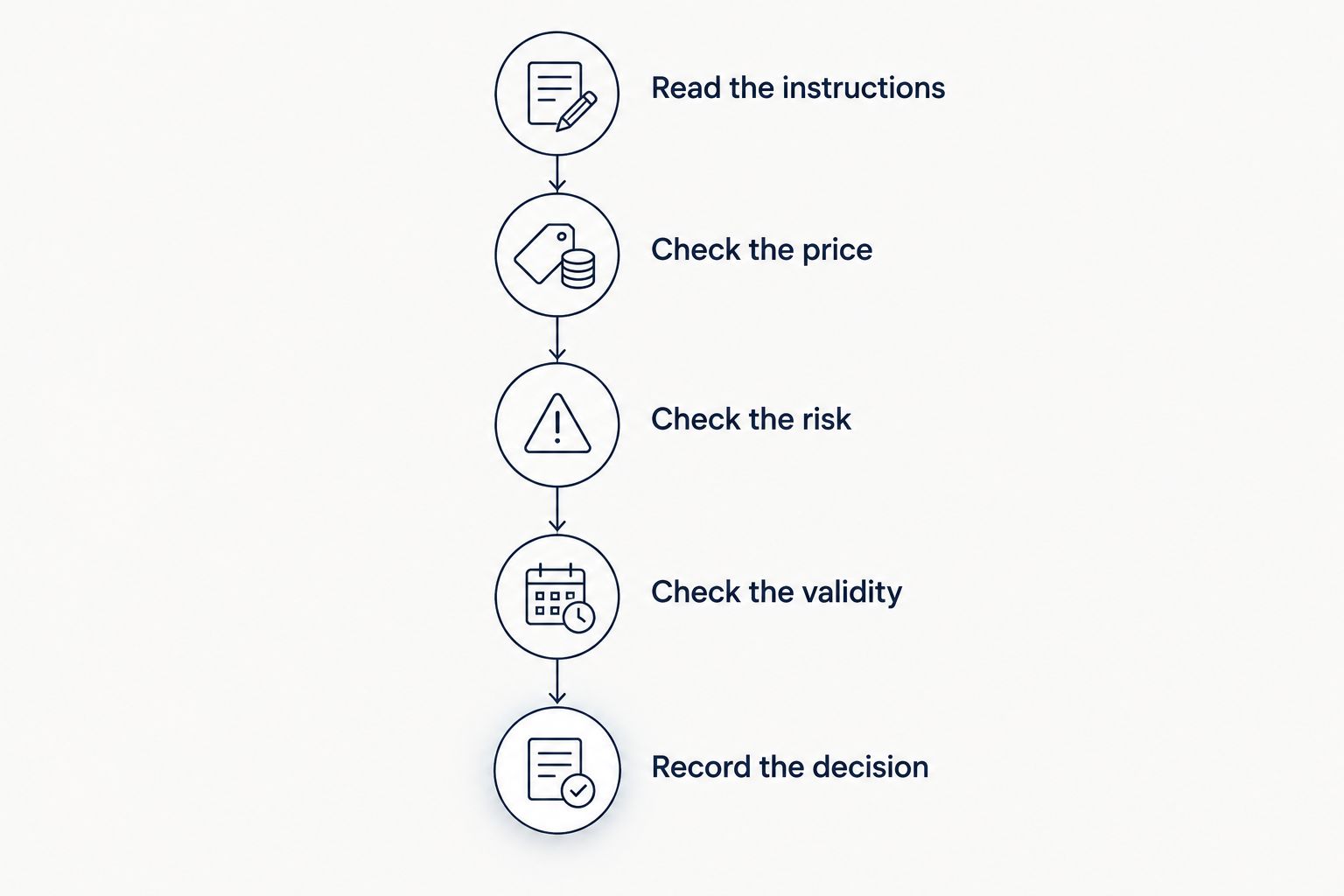
Use this 2026 checklist to separate reading the signal from deciding whether to place an order. Stop whenever a required condition is unclear.
Read the instructions
Identify the currency pair and trade direction. A pair names the currencies being exchanged; buying and selling express opposite views on their relative movement.
Next, identify the entry condition, stop-loss, target, and any expiry or cancellation instructions. Do not fill gaps by copying settings from an unrelated signal. Different trade ideas can depend on different conditions.
Check the price
Open your broker platform and inspect the relevant bid or ask. Confirm that the pair matches the signal, then compare the executable price with the stated entry.
Avoid judging the difference by appearance alone. A small-looking chart movement can still change the relationship between the entry, stop, and target. Your decision needs those distances, not a visual impression.
Check the risk
A stop-loss is an instruction intended to close a position when a specified condition is reached. It is not a guarantee that execution will occur at the exact stop price.
Calculate the planned loss using your intended entry, stop distance, position size, and account currency. Account for trading costs separately. If you cannot understand that calculation, practice it before committing real money.
Check the validity
Ask whether anything has happened that contradicts the trade idea. Check for an update, cancellation, expired condition, or previously reached exit level.
A more attractive entry price does not answer this question. Price moving against the proposed direction can improve the apparent entry while also weakening the reason for taking the trade.
Record the decision
Write down whether you entered, waited, or skipped, and why. Record your intended entry separately from the actual fill if you trade.
Keep skipped signals in your 2026 trade log too. Otherwise, your review excludes decisions that protected you from unclear setups and encourages attention only to trades you placed.
Is a better entry price always safer?
A better entry price is not automatically a safer trade. A lower buy entry or higher sell entry improves the distance relationship to unchanged exit levels only while those levels remain on the intended sides of the entry.
More importantly, the move can signal that the original reasoning no longer holds. Assess validity before treating a price improvement as an advantage.
Should you move the stop-loss to make a late entry work?
Do not move the stop-loss merely to justify a late entry. A stop should reflect where the trade idea becomes invalid and how that translates into acceptable risk, not your desire to join a move.
Changing the stop creates a different trade. Reassess it independently rather than treating the change as a harmless adjustment to the original signal.
Should you increase position size to recover missed profit?
Do not increase position size to recover a move you missed. A missed opportunity is not a realized loss, and increasing size increases exposure rather than repairing the entry.
Set position size from the current trade's planned risk. The profit you imagine earning at the original price has no role in that calculation.
Where a signals subscription fits
Tradeforex is a fit for readers seeking forex signals delivered inside a web app. Subscribers receive its signals through the Tradeforex web app; it is not a broker trading app and does not execute your trades.
The delivery format gives you a place to receive trade ideas. Its limitation is equally important: receiving a signal does not establish that the original entry remains suitable when you read it. Before subscribing, assess the actual instructions and decide whether you understand how to evaluate them.
You can visit Tradeforex to review the service. Keep the subscription decision separate from any individual trading decision, and reject profit guarantees as a basis for either.
FAQ
What should I do when the forex signals entry price has already moved?
Reassess the current executable price against the signal's entry conditions, stop-loss, target, and validity. Skip the trade if you cannot establish that the instructions and your risk limit still fit.
How should I evaluate a late forex signal in 2026?
In 2026, evaluate a late forex signal using the actual entry available, its stop distance, target distance, costs, and current validity. The publication price alone does not describe the trade you can place now.
Can I enter a forex signal after it reaches the target?
Do not treat a signal that has reached its target as an unchanged entry opportunity. A further trade needs a fresh assessment rather than an assumption that the original target remains useful.
Is waiting for the original entry better than buying immediately?
Waiting preserves the specified entry condition, but it does not guarantee a trade or a valid setup. Recheck cancellation conditions and updates while you wait.
Can a stop-loss guarantee my maximum loss?
A stop-loss does not guarantee execution at the exact stop price. Slippage can change the realized loss, so planned risk is not a guaranteed outcome.
Does Tradeforex execute trades from its signals?
Tradeforex delivers signals to subscribers inside its web app; it does not execute trades. You must evaluate the idea and make any trading decision separately through your broker.
Should beginners practice late-entry decisions first?
Beginners should practice reading entry conditions and calculating risk before using real money. Practice helps you understand the process, but it does not establish future trading results.
One last thing
A worse entry does not require a replacement trade. You can finish the decision with no position, no pending order, and no attempt to recover the missed move.
Before placing any late order, write a sentence explaining why the setup remains valid at the price available now. If that sentence depends only on not wanting to miss out, skip. Your task is to evaluate the trade in front of you—not recreate an entry that has already passed.