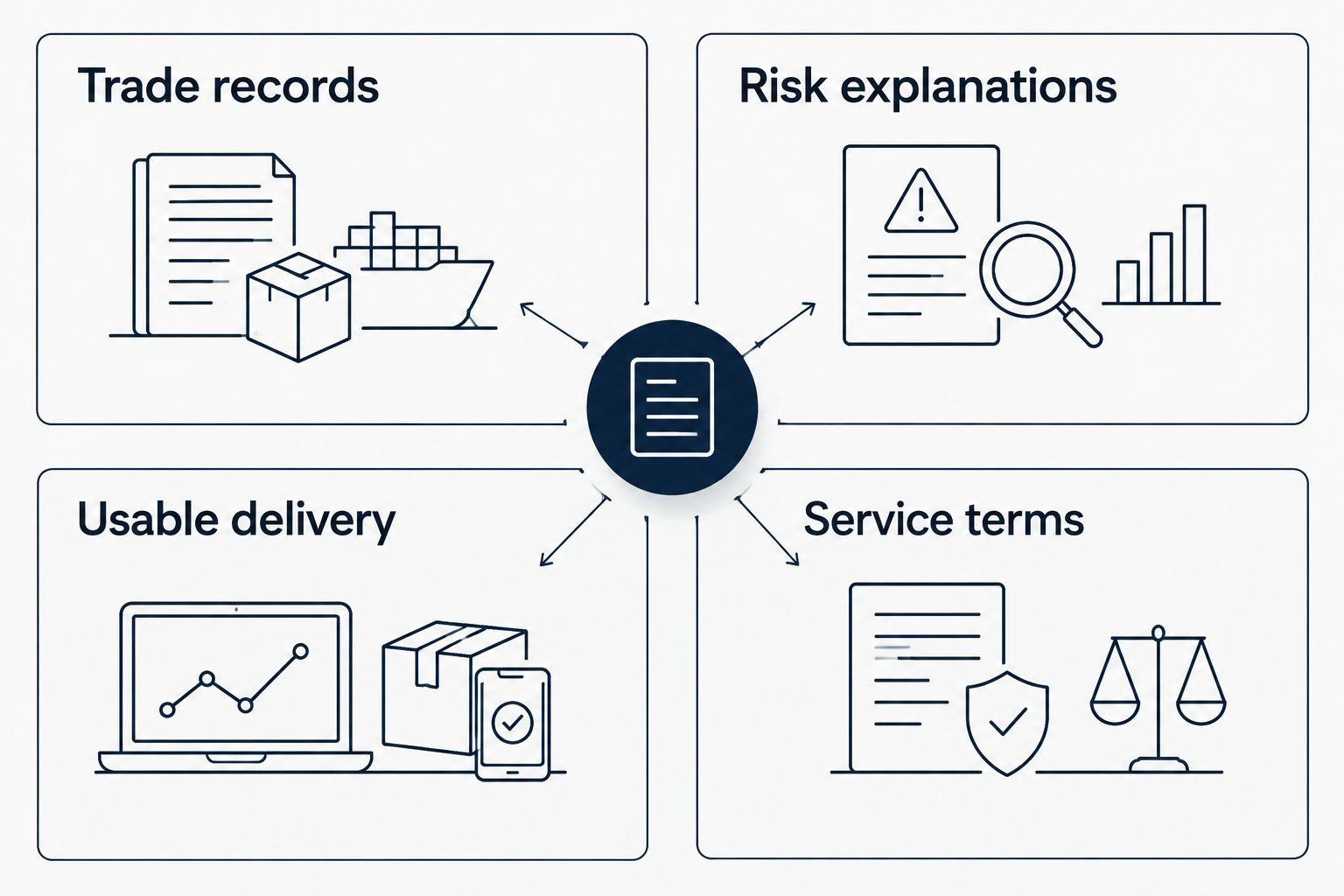
A paid forex signals subscription should add verifiable trade records, understandable risk information, and delivery you can act on—not a promise of better returns. For the free forex signals vs paid decision in 2026, judge the evidence and usefulness rather than the subscription label; you still face trading costs, execution differences, and potential losses.
- Free forex signals vs paid: pay for clearer evidence and usable information, never a promise of profits.
- Check losing trades, timestamps, trading costs, and risk explanations before subscribing to forex signals.
- Tradeforex delivers subscriber signals inside its web app; it does not replace your broker trading app.
- Reject results that exclude losses or cannot be connected to the original trade ideas.
Before comparing subscriptions, separate the service that supplies trade ideas from the app that places your orders. This guide to choosing a forex trading app before subscribing to signals explains the app-selection side of that decision.
Free forex signals vs paid: what should a subscription add?
A subscription should make a signal easier to evaluate, not merely make it exclusive. Compare the information available before a trade, the record afterward, and the practical demands on you. Neither payment nor public access establishes accuracy.
The table below is a decision framework, not a claim that every service in either category has these characteristics.
| Option | Best for | Potential benefit | Main limitation | Evidence to require |
|---|---|---|---|---|
| Free signals | Learning how to assess trade ideas without a subscription commitment | Lets you inspect the information before deciding whether to subscribe | Public access does not establish quality or make trading risk-free | Original signals, timestamps, and losing outcomes |
| Paid signals | Readers who have identified a specific information or delivery need | Can justify payment when the service demonstrably meets that need | Payment adds a commitment without guaranteeing better trades | Inspectable records, clear service terms, and delivery details |
Why this matters
A signal and a trading result are different things. A signal proposes a trade; your result depends on whether you act, your execution price, position size, trading costs, and exit.
That distinction matters even when the original idea was reasonable. Following an alert after the market has moved means taking a different entry, and copying another person's position size means accepting risk that was not calculated for your account.
For a beginner comparing services in 2026, the useful question is not whether paid signals sound more professional. It is whether the subscription resolves a specific problem you can name and verify.
What evidence should a subscription provide?
Trade records
Look for original trade ideas with timestamps and an outcome record that includes losing trades. Screenshots of selected winners cannot show how a service handles a sequence of losses, changed instructions, or ideas that never reached their proposed entry.
Ask how the provider classifies each outcome. A canceled idea, an expired entry, a partly closed position, and a completed loss are different events. A record that mixes them without explanation is difficult to interpret.
Also distinguish live trades, hypothetical examples, and backtests. A backtest applies rules to historical data; it does not establish that a subscriber received those instructions or could execute them at the displayed prices.
Reject any performance claim you cannot connect to the underlying trade record. An impressive total is not a substitute for that connection. Even a well-documented historical record does not guarantee future results.
Risk explanations
A usable signal needs enough context for you to decide whether taking the trade fits your own limits. Inspect whether the sample explains the proposed entry, intended exit, and what would invalidate the idea. These are evaluation criteria, not features to assume a provider offers.
An entry is the price or condition for opening a position. An exit is the price or condition for closing it. A stop-loss order requests an exit when a specified level is reached, but it does not guarantee that exact execution price during a fast market or price gap.
Position size determines how much exposure you take. In conventional forex terminology, a standard lot represents 100,000 base-currency units, a mini lot 10,000 units, and a micro lot 1,000 units. Check your broker's contract specifications rather than assuming every platform uses identical labels.
Those contract sizes are not recommended trade sizes. Your account currency, currency pair, stop distance, and broker's trading conditions all affect the monetary risk.
Usable delivery
Find out where signals arrive and how you access updates. Then compare that process with your actual routine: whether you can read an alert, understand it, and check your broker's current quote before deciding.
A signal that depends on immediate action is unsuitable if you cannot monitor it at the required time. Do not treat a missed entry as an instruction to enter at whatever price is now available.
Check whether the service explains signal expiry and subsequent changes. If an instruction is revised, you need to distinguish the original idea from the revision. Otherwise, a later record can appear clearer than the decision actually was in real time.
Service terms
Read the subscription terms separately from the trading material. Establish what access includes, how renewal works, and how cancellation works before committing. Do not infer those details from a promotional page or a conversation about market performance.
Also ask what happens when you cannot find an alert or understand an instruction. Support arrangements belong in your evaluation, but support does not turn a trade idea into personalized financial advice.
The distinction is simple: operational clarity helps you understand what you bought. It cannot remove uncertainty from the currency market.
When are free forex signals enough?
Free signals are enough for learning to assess trade instructions when they provide the information you need for that exercise. You can examine whether an idea was clear before the market moved, whether its outcome was recorded fairly, and whether the trading schedule fits yours.
Best for: beginners practicing evaluation rather than seeking a shortcut to live trading. Keep observation separate from execution. Reading an alert does not oblige you to place an order.
The limitation is evidential, not simply financial: an incomplete free record remains incomplete. If you cannot inspect original instructions or losing outcomes, do not assume the paid version fixes those problems. Require evidence of the difference before upgrading.
When does paying for forex signals make sense?
Paying makes sense when you have identified a specific need and verified that the subscription meets it. Examples of needs include access through a particular delivery method, clearer documentation, or a reviewable record—not an expectation that payment produces profitable trades.
Best for: readers who can explain the subscription's practical value without referring to promised returns. Write that value down before subscribing. If the explanation is only that the provider sounds confident, the case for payment is weak.
There is also an attention commitment. You need time to read instructions, check your own risk, and review what happened. A subscription does not transfer those decisions to the signal provider or make every published idea suitable for your account.
Why the value of a forex signals subscription varies
Judge these factors against your needs rather than treating a larger feature list as better:
- Record quality: Original instructions and complete outcomes support evaluation; selected success stories do not.
- Instruction clarity: You need to understand the proposed action and its limits before deciding whether to trade.
- Delivery fit: The access method and timing must work with your schedule and broker workflow.
- Trading conditions: Spreads, commissions, financing charges, and execution affect the result you actually receive.
- Service terms: Access, renewal, cancellation, and support arrangements determine the subscription commitment.
For a 2026 comparison, verify the current terms rather than relying on an old review. Historical descriptions do not establish what a service includes now.
How should you evaluate a subscription before joining?
Use the same process for free and paid services. That keeps presentation and exclusivity from replacing evidence.
- Read a complete sample. Identify the currency pair, trade direction, entry instructions, exit logic, and timing. Record anything you cannot interpret.
- Inspect the original record. Check that outcomes connect to instructions published before the relevant market movement. Look for losses and changes, not just winners.
- Check execution assumptions. Compare the proposed entry with the quote available through your broker. Account for the spread, which is the difference between buying and selling prices.
- Practice the workflow. Where your broker provides a demo account, use it to learn order entry and sizing. Demo results are not proof of live results.
- Read the subscription terms. Confirm the access method, renewal process, and cancellation procedure before deciding.
Keep a journal of your own decisions as well as the provider's alerts. Separate an unclear instruction from your own delayed entry or sizing mistake. Without that distinction, you cannot tell whether changing services would solve the problem.
Skip any trade you do not understand. Paying for access creates no obligation to act on an alert, recover a previous loss, or increase your position size.
Where Tradeforex fits in your decision
Tradeforex is best for readers seeking forex signals delivered in a web app, not a broker app that executes trades. Subscribers receive its signals inside the Tradeforex web app; order execution remains separate.
That distinction gives you a concrete delivery fact to evaluate, not evidence of trading performance. Assess the Tradeforex signals service against the same record, risk, delivery, and terms checklist you would apply to another subscription.
The advantage is a defined place to receive subscriber signals. The limitation is that access to trade ideas does not establish their suitability for your account, guarantee outcomes, or replace your broker. Subscribe only after you understand the commitment and can explain how the service fits your process.
Evaluate the signals service
Check the service details against your evidence, delivery, and risk checklist before subscribing.
Are paid forex signals more accurate than free signals?
Paid forex signals are not more accurate merely because they require a subscription. Accuracy requires an inspectable record and a clear definition of what counts as success.
A winning-trade percentage alone also leaves out the size of wins and losses. Evaluate outcomes alongside trading costs and execution assumptions rather than treating accuracy as a complete measure of value.
Can you use forex signals without understanding trading?
You can receive forex signals without understanding trading, but receiving instructions is not the same as being able to evaluate risk. Learn order types, position sizing, and exit behavior before placing live trades.
A signal cannot know your financial circumstances simply because you subscribe. If an instruction is unclear, do not fill the gap with a guess or copy another subscriber's exposure.
FAQ
What's the main difference between free forex signals and paid signals?
The main difference is the access arrangement, not proven trading quality. Compare the actual records, instructions, delivery, and terms rather than assuming payment improves outcomes.
Are paid forex signals guaranteed to make money?
Paid forex signals do not guarantee profits. Currency trading can produce losses, and historical performance does not establish future results.
What should I check before subscribing to forex signals in 2026?
Before subscribing in 2026, check original trade records, losing outcomes, risk explanations, delivery arrangements, and subscription terms. Confirm that the process fits your broker and schedule.
Does Tradeforex place trades for subscribers?
Tradeforex provides subscriber signals inside its web app, not a broker trading app that executes trades. Receiving a signal and placing an order are separate actions.
Can I test forex signals in a demo account?
You can practice following signals in a demo account if your broker offers one. Demo trading helps you learn the workflow but does not prove what your live results will be.
Does a stop-loss guarantee my maximum loss?
A stop-loss does not guarantee the exact price at which your position closes. Price gaps and fast market conditions can produce execution beyond the requested level.
Should I subscribe if a provider only shows winning trades?
Do not subscribe on the strength of winning trades alone. Ask for the original instructions and a record that includes losses, changes, and the treatment of unfilled ideas.
One last thing
Before choosing a subscription in 2026, write down what would make you decide not to trade. Examples include an unclear entry, an expired idea, an unsuitable position size, or a price that has already moved beyond your plan.
Your ability to reject an alert matters more than your ability to receive it. A useful service supplies information you can evaluate; it does not create an obligation to trade. Apply that rule to free alerts and paid subscriptions alike.