Spot forex signals scams by checking who runs the service, whether performance claims include losses, and what access or payments the provider demands before you subscribe. Guaranteed returns, requests for account credentials, and pressure to send more money to release supposed profits are reasons to stop—not problems a convincing screenshot can solve.
- Check forex signals scams through provider identity, complete trading records, account permissions, and subscription terms—not testimonials alone.
- Tradeforex suits beginners seeking forex signals inside a web app, not broker trade execution.
- Reject guaranteed returns; forex signals are trade ideas, not assured outcomes.
- A broker trading app and a signals subscription serve different purposes. Evaluate each separately.
How to spot forex signals scams before subscribing
Check the provider before judging the trade ideas. A polished app, an active chat group, or a profitable screenshot does not establish who receives your payment or whether the trading record is complete.
Tradeforex provides its own forex signals service, with signals delivered inside its web app. That delivery method is separate from broker trade execution; assess the subscription and your broker independently.
Use the following checks before subscribing in 2026. Keep written answers, not just impressions from a sales conversation.
Establish who receives your money
Find the legal name behind the subscription, the payment recipient, and a working support channel. Compare those details across the checkout, terms, receipts, and any regulatory claims.
A brand name alone is not enough to identify the business responsible for the service. If the payment recipient differs from the advertised provider, request an explanation before paying; the mismatch is a reason to investigate, not automatic proof of fraud.
Verify regulatory claims independently
If a provider claims registration, search the relevant regulator's official records yourself. Match the legal name, registration status, and permitted activities rather than accepting a badge or copied certificate.
For U.S. forex intermediaries, NFA BASIC provides registration and disciplinary information. A signals publisher and a broker do not necessarily have the same registration obligations, so check the claimed activity rather than assuming every subscription needs a broker license.
Ask for the complete record
Winning trades without losing trades do not show overall performance. Ask whether the record includes every published signal, its original publication time, subsequent changes, and the result under a stated calculation method.
Check whether results describe live trading, hypothetical trading, or a backtest—a strategy applied to historical data. These are different forms of evidence, and none guarantees future returns.
Check what access the service requests
A signal is a trade idea; receiving an idea does not inherently require handing over your broker password. Treat requests for withdrawal access, remote control of your device, or authentication codes as account-security concerns.
If software uses an API key, a credential that lets software communicate with an account, inspect its exact permissions. Do not accept a verbal assurance that an unrestricted key is harmless.
Read the subscription terms before checkout
Find the billing schedule, renewal process, cancellation method, and refund conditions. Save the version presented when you subscribe, along with the checkout confirmation.
Missing terms are a reason to pause. A provider's refusal to explain how billing stops is a subscription problem even before you evaluate its trading ideas.
Why this matters
You are evaluating both a financial idea and a commercial relationship. A useful-looking signal does not excuse unclear billing, and a clearly written subscription does not establish that its trades will perform well.
Separate fraud risk from trading risk. A genuine provider can publish losing ideas; a dishonest provider can advertise a winning trade. Neither a loss nor a win settles the question by itself.
For a 2026 subscription decision, focus on evidence you can retain: original messages, dated terms, payment records, and independently checked identity details. An explanation that disappears after a sales call is harder to assess than a written statement you can revisit.
Which warning signs deserve the most attention?
Different warning signs call for different responses. Use this comparison to decide whether you need clarification, stronger evidence, or an immediate stop.
| What you see | What it establishes | What to do |
|---|---|---|
| Guaranteed returns or claims of no trading risk | The sales claim contradicts the uncertainty of forex trading | Reject the promise; do not treat it as a benefit |
| Screenshots of selected winning trades | Selected results, not a complete record | Request the full history and calculation method |
| A regulatory badge without matching official details | An unverified registration claim | Search official records independently |
| Requests for passwords or withdrawal permissions | A request for sensitive account access | Refuse access and review account security |
| Pressure to deposit more to release profits | A demand requiring independent verification | Stop sending money and contact the payment provider |
| Unclear cancellation instructions | Unresolved subscription terms | Resolve the terms before paying |
A warning sign is a decision trigger, not a substitute for evidence. Some findings justify ending the conversation immediately; others justify asking a specific question and refusing payment until it is answered.
Avoid turning this into a points system. Clear terms do not cancel out a false guarantee, and an impressive-looking performance record does not make an account-access request safe.
Broker apps versus signal services: what are you buying?
A broker trading app lets you access a brokerage account and submit orders. A signal service supplies trade ideas; buying that subscription does not, by itself, open a brokerage account or execute a trade.
| Option | Best for | Useful role | Limitation |
|---|---|---|---|
| Broker trading app | Placing and managing your own orders | Account access and order entry | The interface does not validate outside signals |
| Standalone signal service | Receiving trade ideas to evaluate | A separate source of suggested trades | Delivery does not establish accuracy or suitability |
| Broker demo account | Practicing order entry | Learning the controls without committing real money | Simulated results do not prove live performance |
A well-designed app can still display poor trade ideas. Conversely, a clearly explained signal does not tell you whether a broker's execution, permissions, or account terms meet your needs.
Before subscribing, identify who supplies the idea, who holds the trading account, and who submits the order. If those roles are unclear, stop and ask; do not assume the subscription handles everything.
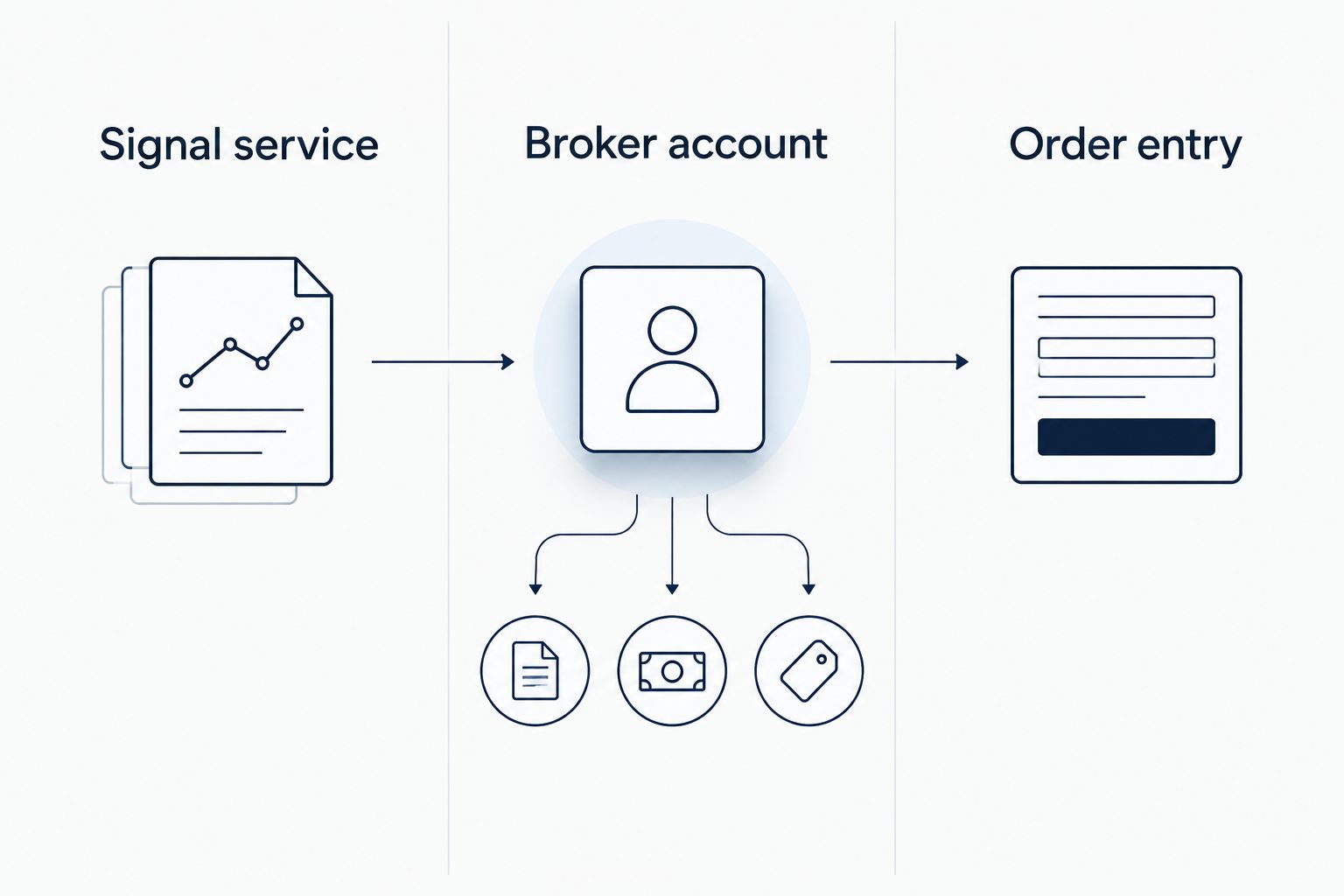
Why the risk of a signals subscription varies
The delivery channel is not a reliable safety test. A web app, messaging group, or email list can distribute trade ideas; the evidence and permissions behind the service matter more than the format.
- Provider identity: A named payment recipient gives you a party to investigate. An unexplained identity mismatch leaves that investigation unresolved.
- Record completeness: A continuous history supports scrutiny. A gallery of selected winners leaves losses and omitted trades unanswered.
- Trading assumptions: Spreads, commissions, and execution timing affect whether an advertised result resembles a subscriber's experience.
- Account permissions: Receiving messages and granting trading or withdrawal access create different security exposures.
- Subscription terms: Renewal and cancellation rules determine what happens after the initial signup.
- Sales conduct: Pressure to act immediately works against the time you need to verify claims independently.
For your 2026 review, write down the unresolved questions under these headings. A confident sales response is not the same as a documented answer, and you do not need to subscribe to discover whether the provider will answer basic questions.
How do you check a forex signals performance record?
Start with the original signal, not the final screenshot. You need enough information to understand what was suggested, when it was published, and how the provider decided whether it won or lost.
Look for a record that preserves mistakes as well as successes. Deleted losing ideas, unexplained edits, or results calculated differently across trades prevent a fair comparison.
Check the trading instructions
An entry describes when or where a trade begins. An exit describes when it ends, while a stop-loss order instructs the broker to close a position when specified conditions are reached; execution at the requested price is not guaranteed.
If a provider claims its signals contain these instructions, inspect actual examples. Do not assume a service includes risk explanations because its advertising uses the phrase risk management.
Check the calculation method
Ask whether reported results account for spreads—the difference between buying and selling quotes—and other relevant trading charges. A favorable price move is not automatically the subscriber's net result.
Also ask how the record handles missed entries, changed instructions, and trades left open. A calculation method that changes after the outcome is known cannot support a consistent comparison.
Check the evidence type
A backtest shows what a strategy would have done under historical assumptions. A live account record shows activity in that account, while subscriber results depend on their own execution and decisions.
Each has limits. Treat a performance record as evidence to examine, not permission to ignore future losses or account security.
Does regulated forex trading remove the risk?
Regulation is not a guarantee against trading losses or dishonest claims made by someone else. Check a broker's status separately from a signals publisher's identity and promises.
For U.S. retail forex in 2026, CFTC security-deposit rules generally require at least 2% for major currency pairs, corresponding to 50:1 leverage, and 5% for other pairs, corresponding to 20:1 leverage. These are regulatory limits, not recommended trading settings.
Leverage means controlling a position larger than the funds committed to it. It magnifies the effect of price changes on those funds, so a small market move can have a much larger effect on your account.
A provider advertising a strong result without explaining its exposure leaves an important question unanswered. Compare the risk taken, not just the size of the reported gain.
Can a free forex signals group still be a scam?
Yes. Free access does not establish who operates a group, whether its results are complete, or why it recommends a particular broker or payment recipient.
Apply the same checks before accepting a paid upgrade, opening a recommended account, or granting software permissions. The absence of an initial subscription payment does not make later requests safe.
Ask how the publisher benefits from your actions. A disclosed commercial relationship gives you information to evaluate; an unanswered question about that relationship remains unresolved.
What should you do if you already paid?
Stop additional payments while you investigate. Preserve receipts, original messages, advertised claims, account details, and the subscription terms you accepted; do not rely on the provider to retain the conversation.
Contact your payment provider promptly to ask about its dispute process. If you shared credentials, secure the affected accounts and revoke unnecessary permissions; contact the broker directly through independently verified channels.
Report suspected fraud to the appropriate authority, such as the CFTC or FTC in the United States. Recovery is not guaranteed, and a new demand for money to recover the original payment deserves the same scrutiny.
FAQ
What's the clearest warning sign of forex signals scams?
A promise of guaranteed trading returns is a clear warning sign. Forex trades can lose money, and a subscription cannot remove that uncertainty.
Can I trust forex signals screenshots?
Screenshots alone cannot establish a complete performance record. Request original publication times, losing trades, subsequent changes, and a consistent calculation method.
Does every forex signals provider need a broker license?
A signals provider does not automatically have the same registration obligations as a broker. Check the provider's activities, jurisdiction, and specific registration claims through the relevant regulator.
Should I give a signals provider my broker password?
Do not give a signals provider your broker password just to receive trade ideas. Review any requested software permissions separately, especially trading and withdrawal access.
Does Tradeforex execute the trades in its signals?
Tradeforex provides signals inside its web app; it is not presented as a broker trading app or trade-execution service. Receiving a signal is separate from placing an order with a broker.
Does a losing forex signal prove the provider is a scam?
A losing signal does not by itself prove fraud. Evaluate whether the provider represented risks honestly, preserved its record, and honored its stated subscription terms.
Can I recover money paid to a forex signals scam?
Recovery is not guaranteed. Preserve the evidence and contact your payment provider promptly to ask about its dispute process, then report suspected fraud to the appropriate authority.
One last thing
Judge the explanation of a loss before admiring the presentation of a win. A losing trade can reveal whether the provider preserves its history, follows its stated calculation method, and distinguishes a trade idea from a guaranteed outcome.
Before committing to a signals subscription in 2026, choose an example that did not work and ask what happened. An answer that documents the original instructions and accepts the result is more useful for your assessment than another selected success screenshot.