
Best overall: OANDA for a forex-focused start. Best for U.S. browser-based trading: tastyfx. Best for an existing multi-asset workflow: Interactive Brokers. This Tradeforex guide compares the best forex brokers for beginners in 2026, separating useful platform features from the account restrictions that determine whether you can actually trade.
- OANDA leads this best forex brokers for beginners shortlist for a forex-focused start with demo practice.
- FOREX.com suits beginners who want a choice between a broker platform and MetaTrader 4.
- U.S. residents should check OANDA, FOREX.com, and tastyfx before considering international alternatives.
- Tradeforex provides forex trading information and tools; broker eligibility requires a separate check.
Why this matters
The best beginner broker is an eligible broker with a platform you understand—not the longest feature list. Your residence, account entity, and permitted products come before charting tools. An international forex account and a U.S. retail forex account are not interchangeable.
For U.S. retail off-exchange forex, CFTC rules require minimum security deposits corresponding to maximum ratios of 50:1 for major currency pairs and 20:1 for other pairs. These are regulatory limits, not sensible targets for a beginner. Borrowed exposure magnifies losses as well as gains.
Tradeforex focuses on forex trading information and tools. This 2026 shortlist ranks brokers by beginner use case; it does not rank investment returns or promise profitable trading.
What makes the best forex broker for beginners?
- Legal access: The broker must accept your residence through an entity authorized for the product you want.
- Demo practice: You need to rehearse orders, exits, and position sizing before committing money.
- Platform fit: A readable order ticket matters more than an extensive indicator library.
- Position control: Check minimum trade size, margin requirements, and how the platform displays exposure.
- Cost visibility: Read the spread, commission, financing, and currency-conversion terms together.
- Learning support: Prefer explanations that connect trading concepts to the actual account interface.
A commonly used micro lot represents 1,000 units of the base currency. That describes exposure, not the cash required to open the trade. Brokers use different order-size conventions, so confirm whether the ticket shows lots, units, or another quantity before submitting an order.
Beginner forex brokers at a glance
The table separates each broker's strongest use case from its main beginner limitation. Check the contracting entity and current platform offering before applying in 2026.
| Broker | Best for | Standout feature | Key limitation |
|---|---|---|---|
| OANDA | A forex-focused first account | Demo practice and web/mobile trading | Features differ between regional entities |
| FOREX.com | Choosing between platform styles | Broker platform and MetaTrader 4 | Platform choice adds setup decisions |
| tastyfx | U.S. browser-based forex trading | Browser and mobile forex interfaces | Not a broad multi-asset account |
| Pepperstone | Exploring third-party platforms | MetaTrader and cTrader support | Not an option for U.S. retail forex residents |
| CMC Markets | Chart-centered analysis | Next Generation platform | Not an option for U.S. retail forex residents |
| Saxo | International multi-asset trading | Forex alongside other asset classes | Broader product scope adds complexity |
| Interactive Brokers | An existing multi-asset workflow | Trader Workstation and currency tools | Forex permissions and eligibility need close review |
1. OANDA: best forex broker for a forex-focused start
OANDA offers forex trading with demo access and web/mobile platforms. Its use case here is straightforward: learn currency trading without making a third-party platform your first project. Check the regional entity because account terms and features differ.
OANDA pros:
- Demo practice before live trading.
- Web and mobile access.
- A forex-focused starting point.
OANDA cons:
- Regional differences require careful comparison.
- A demo account cannot reproduce the pressure of losing real money.
Best for: A beginner prioritizing currency trading over a broad investment account.
Practice opening, modifying, and closing orders before evaluating additional features. Verdict: Hold until you confirm eligibility and can explain every field on the order ticket.
2. FOREX.com: best forex broker for platform choice
FOREX.com offers its own trading platform and MetaTrader 4, giving you different routes into forex trading. That choice helps if you already know which interface you want. It also creates an extra decision for someone starting from scratch.
FOREX.com pros:
- A broker-developed platform option.
- MetaTrader 4 access.
- Demo trading for platform practice.
FOREX.com cons:
- Platform choice adds a learning decision.
- Tools and account arrangements vary by jurisdiction.
Best for: A beginner deciding between a broker interface and MetaTrader 4.
Choose the interface first, then learn its order types and margin display. Do not switch platforms to avoid learning the basics. Verdict: Hold until one platform feels familiar enough to use without guessing.
3. tastyfx: best forex broker for U.S. browser trading
tastyfx provides U.S. forex trading through browser and mobile interfaces. It belongs on a U.S. beginner shortlist when currency trading—not combining many asset classes—is the immediate goal. Demo access gives you a place to rehearse the workflow.
tastyfx pros:
- A U.S. forex offering.
- Browser-based access.
- Mobile trading and demo practice.
tastyfx cons:
- Not a broad multi-asset account.
- A convenient interface does not reduce market risk.
Best for: A U.S. beginner who wants to practice forex in a browser.
Test how you enter quantity, attach an exit, and inspect open exposure. Verdict: Hold until your demo workflow includes both entering and exiting a position.
4. Pepperstone: best forex broker for platform exploration
Pepperstone supports third-party platforms including MetaTrader and cTrader. Its distinct use case is comparing trading interfaces before committing to one. It is not an option for U.S. residents seeking a retail forex account.
Pepperstone pros:
- MetaTrader platform support.
- cTrader support.
- Demo practice for comparing interfaces.
Pepperstone cons:
- Not available for U.S. retail forex residents.
- Multiple platforms create extra setup and learning work.
Best for: An eligible international beginner with a specific interest in platform choice.
Compare order entry and position displays rather than selecting by appearance. Verdict: Skip if you are a U.S. resident; otherwise, hold until you select a platform.
5. CMC Markets: best forex broker for chart-centered learning
CMC Markets offers its Next Generation platform with charting and analysis tools. It fits beginners who want to study price charts within a broker platform rather than start with a separate terminal. U.S. retail forex residents need a different shortlist.
CMC Markets pros:
- An integrated broker platform.
- Charting and analysis tools.
- Demo access for interface practice.
CMC Markets cons:
- Not available for U.S. retail forex residents.
- Extensive analysis tools add learning demands.
Best for: An eligible international beginner who prioritizes chart analysis.
A chart setup is incomplete until you know how it connects to an executable order. Verdict: Skip for U.S. retail forex; otherwise, hold until you understand the order workflow.
6. Saxo: best forex broker for international multi-asset learning
Saxo provides forex alongside other asset classes. Its appeal is breadth: you can study currencies within a wider investment environment. That same breadth makes it less focused than a dedicated forex starting point.
Saxo pros:
- Access to multiple asset classes.
- Integrated market analysis and trading tools.
- A setting for comparing currencies with other markets.
Saxo cons:
- Broader product scope adds complexity.
- Eligibility and product access depend on residence and account entity.
Best for: An eligible international beginner who specifically wants multi-asset trading.
Understand whether each instrument is a currency trade, derivative, or investment before using it. Verdict: Hold unless multi-asset access is a genuine requirement.
7. Interactive Brokers: best for an existing multi-asset workflow
Interactive Brokers offers currency tools within a broad brokerage environment, including Trader Workstation. It fits this list as a crossover choice, not the default first forex account. Currency conversion and speculative forex trading require different checks.
Interactive Brokers pros:
- Broad asset-class access.
- Currency tools within a brokerage account.
- Trader Workstation for detailed account workflows.
Interactive Brokers cons:
- A steeper interface learning burden.
- Forex eligibility and permissions require close review, especially in the U.S.
Best for: Someone already using a multi-asset brokerage workflow.
Do not assume currency-conversion access means unrestricted retail forex trading. Verdict: Skip as your first dedicated forex account unless your permissions and use case clearly fit.
How the brokers are ranked
This 2026 ranking prioritizes legal access, demo practice, platform fit, position control, cost visibility, and learning support. Each broker occupies a different use-case slot rather than competing on an unsupported claim of better returns.
The order favors a focused starting point before specialized platforms and multi-asset accounts. It is a decision guide, not a performance test.
Which forex broker should you choose in 2026?
Start with OANDA if you want a forex-focused account; compare FOREX.com if platform choice matters, and tastyfx if you want U.S. browser-based trading. International readers should consider Pepperstone, CMC Markets, or Saxo only after establishing eligibility and a specific platform need.
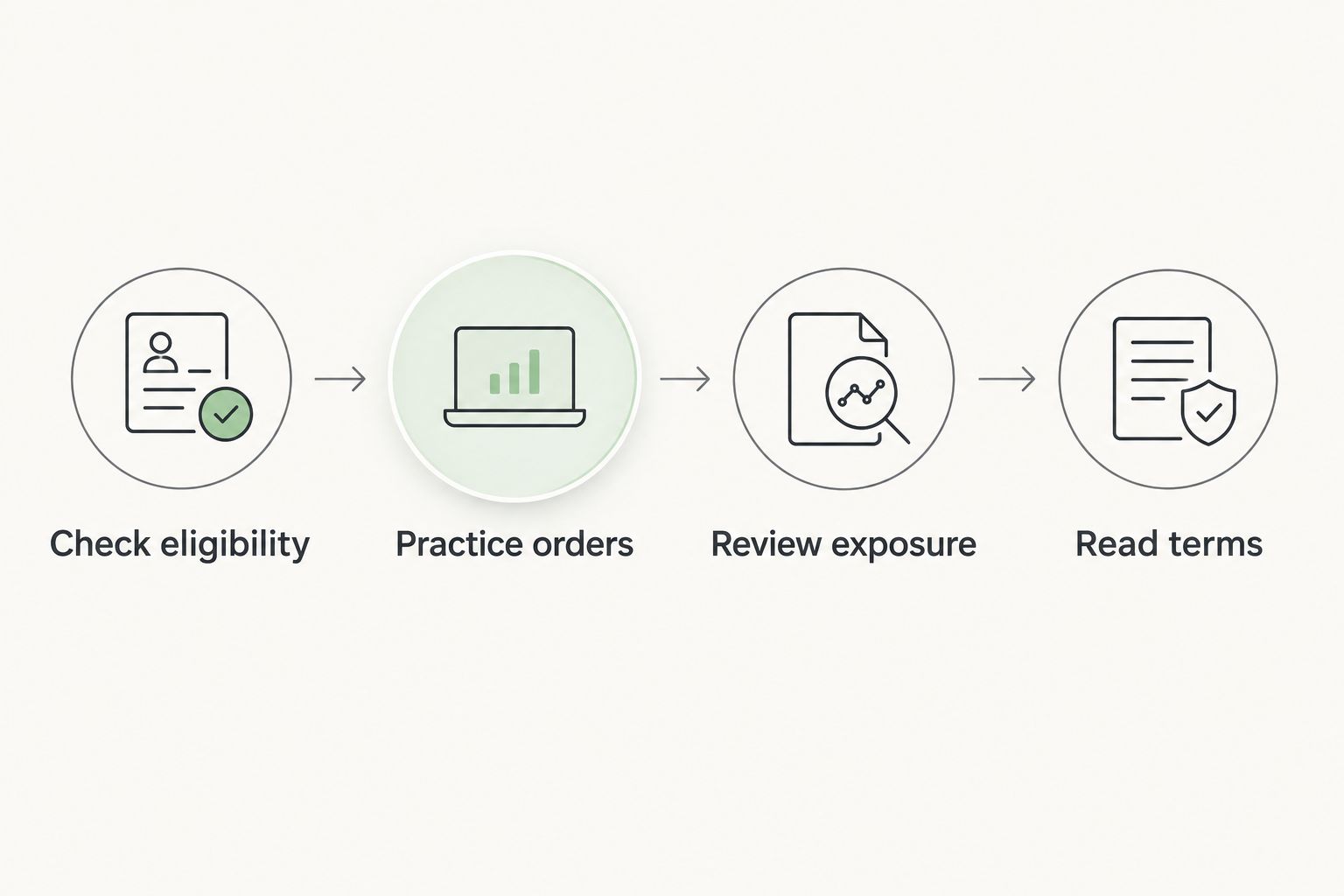
Use this sequence before applying:
- Check eligibility: Confirm residence, contracting entity, and product permissions.
- Practice orders: Rehearse entry, modification, and exit in a demo account.
- Review exposure: Explain position size, margin, and the loss associated with your planned exit.
- Read terms: Review execution, financing, withdrawal, and account conditions.
Do not open several live accounts just to compare interfaces. Demo practice is the place to identify which workflow you understand.
FAQ
What's the best forex broker for beginners in 2026?
OANDA is this guide's default for a forex-focused beginner, subject to residence and account eligibility. FOREX.com suits platform choice, while tastyfx suits U.S. browser-based forex trading.
Which forex brokers should U.S. beginners compare?
U.S. beginners should start by checking OANDA, FOREX.com, and tastyfx. Verify the U.S. contracting entity and its registration through NFA BASIC before applying.
Is FOREX.com better than OANDA for a beginner?
FOREX.com is the better fit when choosing between its broker platform and MetaTrader 4 is important to you. OANDA is this guide's default for a forex-focused start without making that choice the main requirement.
Can U.S. residents use Pepperstone for retail forex?
Pepperstone is not an option for U.S. residents seeking retail forex accounts. U.S. beginners should compare brokers operating through an appropriate U.S. entity.
How much does a beginner forex account cost?
Account costs depend on the broker, entity, product, and trading activity. Read spreads, commissions, overnight financing, and currency-conversion terms together rather than treating account opening as the whole cost.
Does a demo account prove a forex strategy works?
A demo account does not prove future profitability. It helps you learn platform mechanics, but simulated trading does not reproduce the financial pressure of live losses.
Is currency conversion the same as forex trading?
Currency conversion is not the same as opening a speculative forex position. A brokerage account can permit conversion while applying separate eligibility requirements to forex trading.
One last thing
A stop-loss order is an instruction, not a guaranteed execution price. Fast markets and gaps can produce a different fill unless a specific guaranteed-stop arrangement applies under the broker's terms.
Tradeforex is best for individuals seeking forex trading information before choosing a broker. Your next move is not a deposit: it is confirming eligibility and demonstrating that you understand the position you intend to open.