
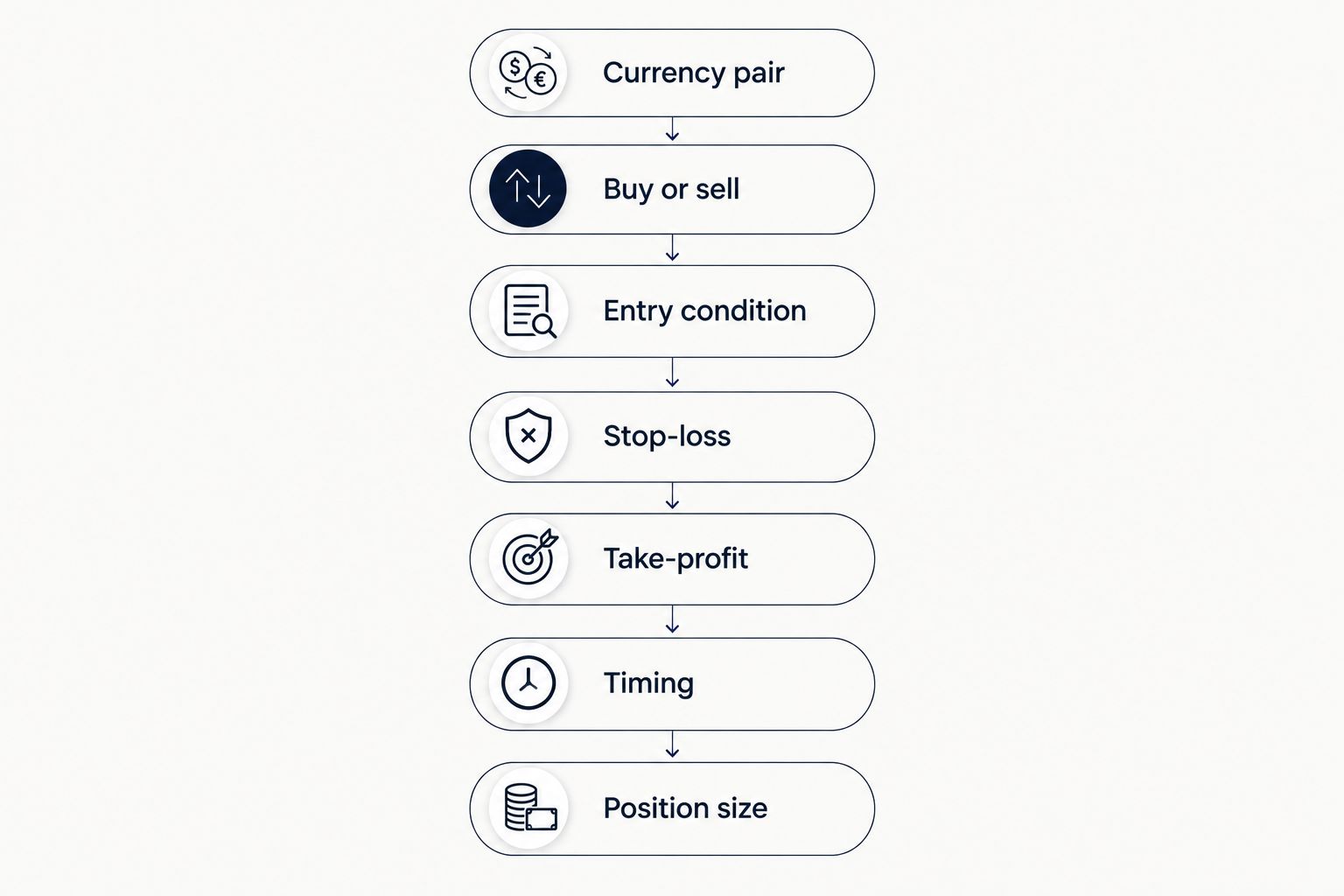
Read forex signals by checking the currency pair, buy or sell direction, entry condition, stop-loss, profit target, and timing before calculating your position size. A signal is a trade idea, not an instruction you must follow: skip it when its meaning is unclear, its entry condition no longer applies, or its potential loss exceeds your planned limit.
- Learning how to read forex signals starts with understanding the pair, direction, entry, stop-loss, and take-profit.
- Tradeforex delivers forex signals inside its web app; a signal is not a guaranteed outcome.
- Check timing and position size before placing an order in your broker’s trading app.
- Skip unclear trade ideas rather than guessing what the signal provider intended.
Why this matters
A forex signal can look precise without giving you enough information to place a sensible trade. An entry level alone does not tell you when the idea expires, where it becomes invalid, or how much money your position puts at risk.
Your job is to translate the message into an order you understand, not simply copy its numbers. That distinction matters just as much in 2026 as the app you choose. Tradeforex provides its own forex signals service, with signals delivered inside its web app; you still need to distinguish receiving an idea from executing a trade through a broker.
How do you read forex signals before placing a trade?
Read a signal in the order below. If a required detail is missing, get clarification before submitting an order rather than filling the gap with an assumption.
1. Identify the currency pair
A currency pair tells you which currency you are buying or selling against another. In EUR/USD, EUR is the base currency and USD is the quote currency. The displayed exchange rate expresses the value of the base currency in the quote currency.
Check the exact symbol in your broker’s app. Do not substitute a different pair because its name looks similar or its chart appears to move the same way. Also check the instrument description: a forex-related symbol does not establish that every broker offers the same contract or trading conditions.
2. Confirm whether the signal says buy or sell
A buy signal expresses a view that the base currency will rise against the quote currency. A sell signal expresses the opposite view. Neither direction tells you whether the trade fits your account or whether the entry remains valid.
| Direction | Meaning for EUR/USD | Best for | Main limitation |
|---|---|---|---|
| Buy | A trade based on EUR rising against USD | Expressing a bullish view on the pair | Losses develop if the pair moves against the position |
| Sell | A trade based on EUR falling against USD | Expressing a bearish view on the pair | A falling-price idea still requires an entry and risk plan |
These are directional choices, not quality ratings. A sell signal is not inherently riskier or safer than a buy signal; position size, market conditions, and execution determine the exposure.
3. Separate the entry level from the order instruction
An entry level describes where the provider wants the trade to begin. It does not automatically mean you should buy or sell immediately at the price currently displayed.
Read whether the instruction calls for immediate execution, a pending order, or a condition that must happen first. A pending order waits for specified conditions rather than opening immediately. If the signal describes a breakout or a retest without defining the trigger, do not invent your own interpretation and assume it matches the provider’s plan.
A price is not a complete entry instruction. You need to understand what makes the trade eligible to open.
4. Find the stop-loss and understand its purpose
A stop-loss is an order intended to close a position when the market reaches an adverse level. It helps define the planned exit if the trade goes wrong, but it is not a promise that the final loss will equal your calculation.
Execution can differ from the requested level during fast markets or price gaps. Check the broker’s order terms and understand whether any special protection applies rather than assuming it does.
If the signal lacks a stop-loss or another clearly defined loss-exit method, you cannot calculate its planned downside from the entry alone. Do not treat that omission as permission to hold indefinitely.
5. Read the take-profit instructions
A take-profit level identifies a planned exit when the market moves favorably. It is a target, not a forecast that the price must reach.
Some signals list several targets. Before entering, understand whether those targets are alternatives, partial exits, or successive instructions. Taking part of a position off at an earlier target changes the result compared with closing the entire position at a later target.
Do not assume every target applies to the full position. Also check whether the provider specifies how to handle any remaining position after an exit; an unexplained target list leaves that decision unresolved.
6. Check the timestamp and validity condition
Read when the signal was issued and which time zone the timestamp uses. Then check whether the entry condition still exists. A message you see now is not necessarily a new trade idea.
An entry becomes unsuitable when its stated conditions no longer apply, even if the message remains visible. Check whether the price has already passed the entry, stop-loss, or target, and whether a later update canceled the idea.
For your 2026 trading records, keep the original timestamp and the time you reviewed the signal. That separation helps you distinguish a delayed response from a problem with the original instruction.
7. Calculate exposure before submitting the order
Position size means how much currency exposure you take. It connects the distance to your stop-loss with the money you stand to lose if the planned exit occurs.
Start with your own maximum acceptable loss for the trade. Then account for stop distance, the instrument’s value per price movement, account currency, and trading costs. Use your broker’s contract specifications rather than assuming the same order volume produces the same exposure across every instrument.
Margin is the amount required to support a leveraged position; it is not the maximum possible loss. Being able to open an order does not mean the position size is appropriate.
Which forex signal terms do you need to understand?
You do not need to memorize every trading abbreviation before reading a signal. You do need to recognize the terms that change the order or its potential loss.
| Term | Plain-English meaning | What to check |
|---|---|---|
| Entry | The proposed opening level or condition | Whether it requires immediate or conditional execution |
| SL | Stop-loss | The planned adverse exit and how it will be submitted |
| TP | Take-profit | Whether the target closes all or part of the position |
| Pip | A conventional unit of exchange-rate movement | The convention for the specific pair |
| Spread | The difference between bid and ask prices | How it affects entry and exit conditions |
| Lot | A unit of position size | The broker’s contract specification |
| Expiry | When an instruction stops being valid | Whether cancellation is automatic or requires action |
For most currency pairs, a pip is 0.0001 price units. For many Japanese yen pairs, a pip is 0.01 price units. Some platforms display fractional pips, so the last displayed digit is not always a whole pip.
A standard forex lot conventionally represents 100,000 units of the base currency. That is an exposure measure, not the amount you necessarily deposit. Verify the instrument specification before translating a signal’s lot instruction into an order.
Why does interpreting a forex signal vary?
The same-looking message can require different actions depending on its instructions and your trading setup. These factors explain why copying the visible entry price is not enough:
- Entry method: An immediate order and a conditional order do not open under the same circumstances.
- Signal age: A valid idea at publication can be unsuitable by the time you read it.
- Quoted prices: Bid, ask, and spread affect how your broker triggers and fills orders.
- Contract specification: Order volume must be translated into the actual exposure offered by the broker.
- Account currency: Converting potential gains and losses into your account currency affects your risk calculation.
- Exit instructions: Partial exits, cancellation rules, and later updates change how you manage the original idea.
When comparing services in 2026, ask how these details are communicated. A clear-looking message is useful only if you can explain the action it requires.
How do you know whether a forex signal is still valid?
A forex signal remains eligible only while its stated entry and validity conditions still apply. Check the latest update, current price, and any cancellation or expiry instruction before placing an order.
Do not chase a move simply because the original direction proved correct. Entering later changes the distance to the stop-loss and target, so you are no longer evaluating the same trade. If the provider has not explained late-entry handling, waiting for a new idea avoids guessing.
Should you follow a forex signal without a stop-loss?
Do not follow a signal when you cannot explain how you will exit a losing position. A missing stop-loss does not prove a trade idea is fraudulent, but it leaves a key risk question unanswered.
Ask for the loss-exit method and how it translates into an order. A promise to send an update later is not the same as having an executable exit plan now, particularly if you cannot monitor messages continuously.
How should your signals service and trading app work together?
Your signals service supplies trade ideas; your broker’s trading app handles the orders you submit. Receiving a signal does not mean a position has opened, and viewing an exit update does not mean your existing order has changed.
Tradeforex is for beginners seeking forex trade ideas delivered through a web app, not broker trade execution. Its delivery method is a practical fit if you want to review ideas there; the limitation is that you must separately confirm the trading and order-management process with your broker. Do not infer automatic copying or execution from signal access.
Before subscribing in 2026, use this guide to choosing a forex trading app before subscribing to signals to separate app requirements from signal-service requirements. Check whether you can recognize order types, review open positions, and amend orders without confusion.
Practice the full workflow in a demo environment when your broker offers one. Demo practice helps you learn the controls, but it does not establish that live trading will produce the same fills or results.
Review Tradeforex before subscribing
Signals arrive inside the web app. Review the service separately from your broker’s execution tools.
What should you check immediately before placing the trade?
Pause at the order preview instead of treating it as a formality. Match the intended trade against the actual ticket:
- Confirm the currency pair and direction.
- Match the order type to the entry condition.
- Check the order volume and planned monetary loss.
- Confirm the stop-loss and take-profit fields.
- Recheck current price, timing, and the latest signal update.
- Look for existing exposure that the new trade would duplicate.
Existing exposure matters because separate trades can depend on the same currency movement. Different pair names do not guarantee independent risks. Review the account as a whole rather than deciding that every signal deserves its own position.
Keep a trading journal in 2026 that distinguishes the published idea from your execution. Record whether you followed the entry condition, changed the position size, or exited differently. Otherwise, you cannot tell whether a result came from the signal or your interpretation.
FAQ
How do I read forex signals as a complete beginner?
Read the currency pair, buy or sell direction, entry condition, stop-loss, take-profit, and timing, then calculate position size. Do not place the trade if you cannot explain any of those instructions.
Does a buy signal mean I should buy immediately?
No, a buy signal does not necessarily require immediate execution. Read whether the idea requires a pending order or another condition before entry.
What do SL and TP mean in forex signals?
SL means stop-loss, and TP means take-profit. They describe planned exit levels, not guaranteed execution prices or guaranteed outcomes.
Can I use a forex signal after the entry price has passed?
Do not assume a forex signal remains suitable after its entry price has passed. A later entry changes the trade’s risk and reward, so check the provider’s explicit instructions.
Does a forex signal tell me how much money to trade?
A signal does not establish the right position size for your account. Calculate exposure using your acceptable loss, stop distance, account currency, and broker contract specifications.
Are forex signals guaranteed to make money?
No, forex signals do not guarantee profits. A well-explained idea can still lose money, and leverage increases exposure to adverse price movements.
Do I need to check my broker’s app after receiving an exit signal?
Yes, check your broker’s app to confirm the position or pending order has actually changed. Reading an exit message is not evidence that an order was executed.
One last thing
A signal can identify the right direction and still lead to a losing trade if your entry, size, or exit differs from the plan. Direction alone is not a complete trading decision.
For your next practice trade, explain the entire instruction in plain English before touching the order ticket. If you cannot say what opens the position, what closes it, and what loss you are accepting, skip the trade until those points are clear.