Assess a forex signals track record by checking the complete trade history, returns after trading costs, drawdown, position sizing, and whether you could have followed the signals as published. Win rate alone cannot establish profitability because it ignores the size of wins and losses. For your 2026 review, prioritize evidence you can reconcile over a headline percentage.
- A forex signals track record needs complete trade history, trading costs, and drawdown—not just winning trades.
- Compare average wins with average losses; a high win rate does not establish profitability.
- Check signal timestamps against executable entries, exits, and later edits.
- Tradeforex suits readers seeking forex signals in a web app, not a broker trading app.
How do you assess a forex signals track record beyond win rate?
Start with the underlying trades, then assess the summary statistics. A performance dashboard cannot resolve missing trades, unclear execution assumptions, or a changing risk policy.
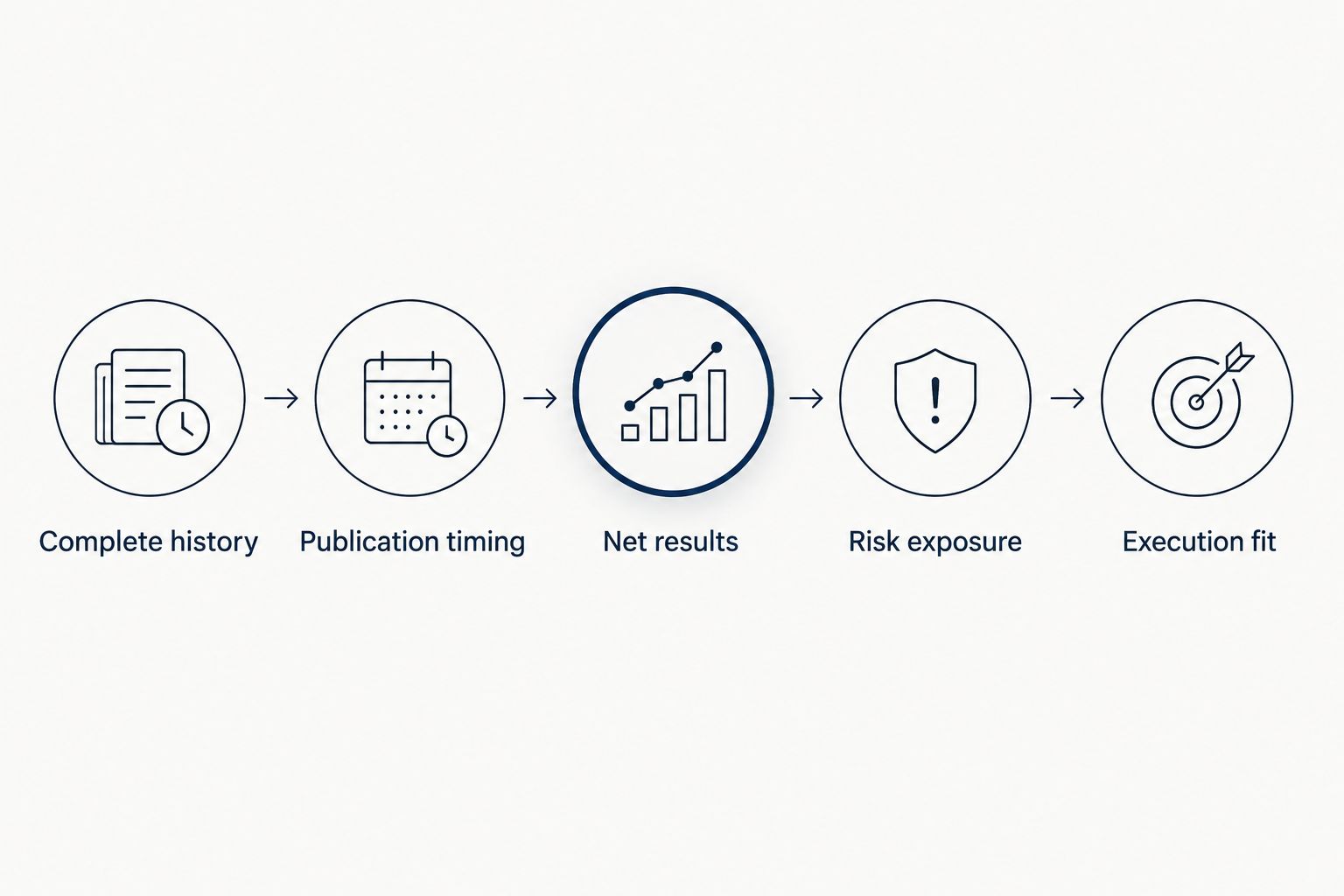
Use this review sequence before subscribing:
- Complete history: Request a chronological record that includes losing trades, canceled ideas, and positions still open.
- Publication timing: Check that entries and instructions existed before the market move, not afterward.
- Net results: Establish whether performance includes spreads, commissions, financing charges, and execution differences.
- Risk exposure: Compare drawdown, position size, and overlapping positions—not just total returns.
- Execution fit: Decide whether your broker account, schedule, and trading app let you follow the stated approach.
Keep the service and execution platform separate throughout this assessment. Tradeforex delivers its forex signals to subscribers inside its web app; that does not make it a broker trading app or mean it executes trades.
Why this matters
A winning trade and a profitable trading approach are different things. Frequent small gains can be outweighed by larger losses, while an apparently strong account return can depend on risk you would not accept.
Your 2026 subscription decision also needs to distinguish a signal provider's reported result from your achievable result. Delayed notifications, different broker quotes, and trading costs can change the outcome even when you follow the same trade idea.
Treat the record as evidence to examine, not a promise about your account. Historical results do not guarantee future performance, and forex trading can produce substantial losses.
Check what the record actually proves
Different evidence answers different questions. Screenshots can show selected outcomes, while a chronological signal archive can help establish what subscribers received and when. Neither automatically proves that a funded account achieved the advertised return.
| Evidence type | Best for | What it helps establish | Main limitation |
|---|---|---|---|
| Selected screenshots | Inspecting individual examples | Details visible in those examples | Cannot establish completeness or overall performance |
| Timestamped signal archive | Checking published instructions | What was communicated and when | Does not prove subscribers obtained the stated fills |
| Account trading statement | Reviewing recorded transactions | Trades and account activity within its scope | Does not establish that every trade came from published signals |
| Independent account verification | Checking supported account metrics | Metrics covered by the verification service | Verification scope can exclude signal delivery and subscriber execution |
Do not treat an independent verification label as a substitute for reading its scope. Check whether the record concerns a live or demo account, what dates it covers, and which figures are verified.
A demo record helps you examine a process without risking deposited trading funds. It does not establish that live trading will reproduce the same execution or results.
Match published signals to recorded trades
Choose trades across the record, including losses and difficult periods. Compare the original publication time, currency pair, direction, entry instructions, changes, and final outcome with the corresponding account transaction where available.
Look for instructions that became clear only after the outcome. An edited entry or retrospectively added exit cannot establish what a subscriber could have done at the original publication time.
Separate win rate from expectancy
Win rate is the proportion of closed trades classified as winners. It says nothing by itself about how much each trade gained or lost.
A useful relationship is:
Expected result per trade = win probability × average win − loss probability × average loss.
This simplified formula assumes outcomes are classified consistently and the win and loss amounts use the same units. If the averages exclude trading costs, subtract those costs separately; do not deduct them again when they are already included.
Check how the provider handles trades closed without a gain or loss, partial exits, and multiple orders belonging to one idea. These choices affect the reported win rate and average outcome.
Use consistent risk units
An R-multiple expresses a trade's result relative to its initial planned risk. 1 R represents the amount initially at risk; 0 R represents no gain or loss on that basis. State whether costs are included when interpreting either figure.
R-multiples help compare trades with different position sizes, but only when the original risk was defined and recorded. A risk unit reconstructed after the trade is less useful for assessing decisions available at entry.
Percentage returns also need a clear denominator. A return percentage is profit or loss divided by the relevant capital base, multiplied by 100%; deposits, withdrawals, and the chosen calculation method affect interpretation.
Read drawdown alongside returns
Drawdown measures a decline from a previous peak. Ask whether the displayed figure uses closed-trade account balance or account equity, which includes unrealized gains and losses on open positions.
A balance-only chart can omit substantial losses while trades remain open. For a 2026 review, inspect open-position exposure alongside closed-trade results. Otherwise, an attractive win rate can coexist with unresolved losses.
Check these questions before accepting the risk profile:
- Does the record show the deepest decline, not just the final recovery?
- Are open losses visible throughout the reporting period?
- Did position sizes increase after losses?
- Were stop instructions moved farther from entry?
- Were several positions exposed to the same currency move?
These questions identify how returns were pursued. They do not establish that any particular drawdown is acceptable for you.
Check correlated positions
Several currency pairs can share exposure to the same currency. Holding positions in different pairs therefore does not automatically spread risk across independent market movements.
Review simultaneous positions as a group. A record that reports each trade separately can make account-level exposure harder to see, especially when several signals respond to the same market event.
Reconcile results after trading costs
A pip total is not an account return. A pip describes a price movement using the relevant currency pair's quotation convention; its monetary effect depends on position size and the instrument traded.
Ask whether reported outcomes include the spread, broker commissions, and applicable overnight financing charges. These affect what remains after execution, even when the direction of the signal was correct.
Slippage is the difference between the intended execution price and the actual fill. It can be favorable or unfavorable, and it matters when comparing published entry levels with achievable trades.
Compare net outcomes on a consistent basis. A cost-inclusive account statement and a cost-excluding signal summary are not interchangeable evidence.
Check the entry assumptions
Establish whether a reported trade required an immediate market order, a pending order, or entry within a stated condition. A market price touching a level does not, by itself, prove every subscriber received a fill there.
For your 2026 comparison, check the broker's instrument specifications and your account's trading conditions rather than assuming the provider's figures transfer unchanged. Do not treat a displayed target as a guaranteed exit price.
Why forex signals track record results vary
Differences between records are not always differences in forecasting skill. Before comparing providers, check whether their calculations describe the same thing.
- Reporting period: A record spanning different market conditions provides different evidence from a selected favorable interval.
- Position sizing: Larger exposure changes gains, losses, and drawdown without necessarily changing win rate.
- Outcome classification: Partial exits, canceled orders, and break-even trades change summary statistics when counted differently.
- Trading costs: Spreads, commissions, and financing charges separate gross results from net results.
- Execution assumptions: Signal timing, order type, and actual fills affect whether a reported outcome was reproducible.
- Open exposure: Excluding unrealized losses changes the picture of account risk.
A longer record gives you more history to inspect, but duration alone does not establish reliability. Completeness, consistent rules, and clearly defined calculations remain necessary.
Can you actually follow the signals?
A credible history can still describe an approach that does not fit your circumstances. If instructions require action when you cannot monitor the market, the provider's recorded entry is not a realistic assumption for your account.
Check how you would receive the idea, interpret it, place an order, and handle later changes. Confirm these details before committing trading capital, rather than learning them during an open position.
Keep an independent practice log. Record when you saw each signal, what you understood, whether the entry remained valid, and how your outcome differed from the published result.
Tradeforex is best suited to readers seeking forex signals delivered through a web app, not broker trade execution. Apply the same evidence standards before subscribing: delivery format alone does not establish performance, signal clarity, or suitability.
Assess the service before subscribing
Check the published evidence and delivery details against your own trading requirements.
Is a high win rate enough to trust forex signals?
A high win rate is not enough to trust forex signals because it excludes loss size, exposure, and trading costs. Read it alongside average outcomes, drawdown, and the complete history.
Also inspect how winners are counted. Several partial profit-taking orders from one idea should not be confused with several independent successful forecasts.
Is a verified forex signals record enough to subscribe?
A verified record is not enough to subscribe unless you understand what was verified and whether the approach fits your circumstances. Account verification does not automatically verify published instructions or subscriber execution.
Use verification as supporting evidence. Then check the service's terms, delivery process, and the practical demands of following its ideas.
Should you reject a service that does not publish its full history?
A service without a full history does not provide enough evidence to assess a claimed long-term record. Do not substitute selected winning screenshots for missing information.
Ask for the underlying record and calculation definitions. If those remain unavailable, leave the performance claim unproven rather than filling the gaps with assumptions.
FAQ
What's the most useful way to assess a forex signals track record?
Start with a complete chronological history, then examine net results, drawdown, position sizing, and publication timestamps. Win rate is only one part of that assessment.
Can forex signals lose money despite a high win rate?
Yes. Large losses and trading costs can outweigh frequent smaller wins, so compare average gains and losses alongside the win rate.
Is a live trading record better than a demo record?
A live record provides evidence of actual account transactions, while a demo record documents simulated trading. Neither automatically proves that subscribers received matching instructions or execution.
What does maximum drawdown mean for forex signals?
Maximum drawdown is the largest peak-to-trough decline within the measured record. Check whether the calculation includes unrealized losses on open positions or only closed-trade balance changes.
Does an independent verification badge guarantee reliable signals?
No. Independent verification covers the information within its stated scope, not guaranteed future returns or identical subscriber results.
Should I compare forex signals using pips or percentage returns?
Neither pips nor percentage returns is sufficient alone. Compare consistently calculated net results with position sizing, capital changes, and drawdown.
Where do Tradeforex subscribers receive forex signals?
Tradeforex subscribers receive signals inside the Tradeforex web app. Signal delivery is separate from broker order execution, and trade ideas do not guarantee outcomes.
One last thing
Check a losing trade before studying another winning screenshot. A loss lets you examine whether the original risk instructions were clear, whether later changes were documented, and whether the final result matches the record.
Before subscribing in 2026, write down what evidence would make you decline. That keeps the decision tied to your standards rather than the appeal of the latest winning trade.