You should deposit only an amount you can afford to lose, and only when the broker’s smallest trade fits your loss limit; a forex trading app minimum deposit is an account-opening requirement, not a safe starting balance. For your 2026 decision, separate the broker’s funding requirement from trading costs, margin requirements, and any signals subscription before transferring money.
- A forex trading app minimum deposit does not establish a safe trading budget.
- Choose a starting balance around affordable losses and the broker’s smallest trade, not maximum buying power.
- Use demo trading to practice; simulated results do not establish live profitability.
- Tradeforex delivers forex signals through its web app; subscribers still need a separate broker to execute trades.
Why this matters: An app can accept your deposit while offering trades that are too large for your intended loss limit. That mismatch matters more than how easy the funding screen looks. Before comparing subscriptions, keep the roles separate: Tradeforex provides signals through its web app, while your broker handles your trading account and execution.
How much should you deposit in a forex trading app?
Deposit only when your affordable-loss budget and the broker’s trading requirements fit together. There is no universal deposit amount that makes forex trading safe, and opening an account does not establish that you can manage its smallest available position.
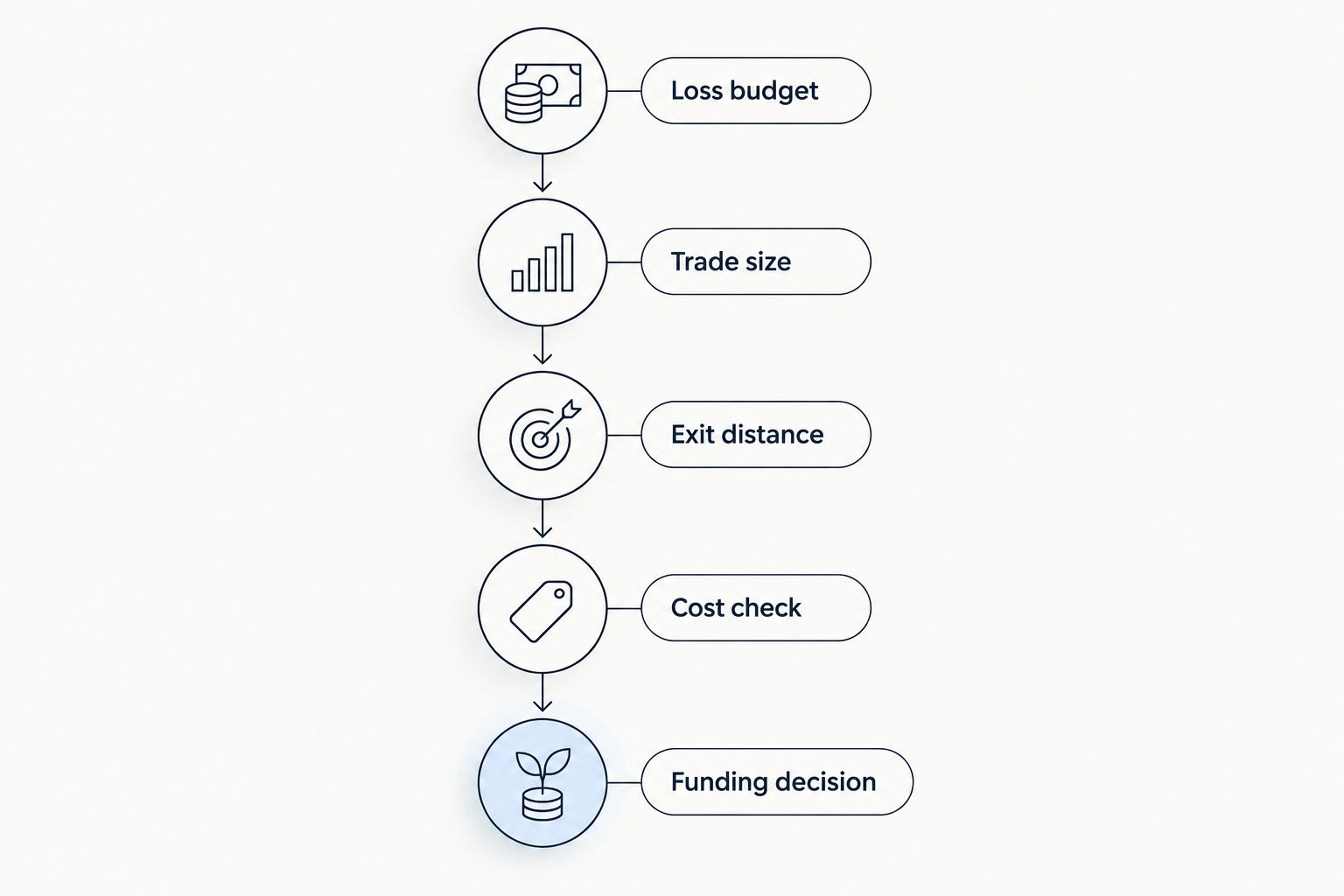
Use this sequence to decide whether to fund an account:
- Set your loss budget. Identify money you can lose without affecting bills, emergency savings, debt payments, or other commitments. If losing the deposit would create financial pressure, do not fund the account.
- Check account requirements. Read the broker’s current minimum deposit, permitted funding methods, account terms, and withdrawal conditions. Confirm that the terms apply to your location and account type.
- Check trade size. Find the smallest position available for the currency pair you intend to trade. The account minimum and the minimum trade size answer different questions.
- Test the planned loss. Calculate what the smallest position would lose if your planned exit were reached. Include trading costs and recognize that execution can differ from the requested price.
- Make the funding decision. If the trade does not fit your loss budget, change the account or instrument, stay with practice trading, or stop. Do not increase your deposit simply to force the setup to work.
The useful outcome is not necessarily a funded account. Discovering that an account does not fit your budget is a valid reason to reject it.
Compare your starting options before funding
For a 2026 comparison, separate learning how an app works from accepting live market risk. These approaches serve different purposes; none establishes a profitable trading strategy.
| Approach | Best for | Main benefit | Main limitation | Funding decision |
|---|---|---|---|---|
| Demo trading | Learning order controls and practicing a process | Lets you rehearse without risking deposited trading capital | Simulated execution and behavior do not establish live results | Practice before committing capital |
| Live account funded at the broker’s minimum | Traders whose smallest permitted position fits their loss budget | Allows real execution experience | A low entry requirement can still leave little room for losses and costs | Check trade risk before depositing |
| Live account funded above the minimum | Traders with an independently affordable capital plan | Can provide more room between planned losses and account depletion | More capital means more money exposed to loss | Do not deposit extra solely to increase position size |
A larger balance does not fix poor judgment, unsuitable account terms, or a strategy you do not understand. Likewise, choosing the smallest deposit does not automatically limit each trade to a sensible loss.
Choose the account around the trade you can manage, not the deposit headline. If you cannot explain what closes the trade and how the loss is calculated, practice those steps before using live funds.
Why the right deposit varies
The broker’s minimum is only a funding threshold. Your decision also depends on these factors:
- Loss budget: Your deposit must fit money you can lose without disrupting essential spending or savings commitments.
- Minimum position: The smallest permitted trade determines how finely you can adjust exposure. Check this for the instrument and account you intend to use.
- Exit distance: A wider distance between entry and a planned stop means a larger planned loss for the same position size.
- Margin requirement: The broker requires funds to support an open position. That requirement is not a cap on what the position can lose.
- Trading costs: Spreads, commissions, and financing charges affect the account balance. Read which charges apply rather than assuming an advertised deposit covers them.
- Account restrictions: Funding, withdrawal, and trading conditions affect whether the account works for your intended use. Check the current agreement, not just the signup screen.
These factors interact. A trade can meet the broker’s margin requirement while still exceeding your personal loss limit. Passing the broker’s account checks is not the same as passing your own risk check.
How do you check whether the smallest trade fits?
Start with a trade plan, not an app’s maximum position setting. You need to understand the currency pair, intended entry, planned exit if the trade goes wrong, and permitted position size.
Loss budget
Decide how much loss you will accept on the trade before considering its potential return. This limit belongs to you; neither an app nor a signal provider can determine what your household can afford.
Keep the overall deposit decision separate from the individual trade decision. A trade that fits inside your account balance can still risk more than you intended.
Trade size
Use the broker’s contract details or calculation tools to understand how price movement changes the position’s value. Currency pairs and account currencies affect that calculation, so do not copy a position size from another trader.
A lot is a unit used to describe trade size. What matters for your budget is the position’s actual exposure and the loss associated with the planned exit, not whether the app describes the trade as small.
Exit distance
Work out the price distance between your entry and the point where the trade idea is invalid. Then calculate the loss for the position size you are considering.
A stop-loss order requests an exit when its conditions are met; it does not guarantee the exact execution price. Fast markets and gaps can produce a worse outcome than the planned loss.
Cost check
Account for applicable charges when deciding whether the trade fits. A spread is the gap between buying and selling prices; a commission is a separate trading charge where the broker applies one.
Positions held beyond the broker’s relevant cutoff can also incur financing adjustments. Read the instrument’s terms rather than treating the deposit as the only money decision.
Funding decision
If the smallest position exceeds your loss budget, reject the setup. Adding money changes the account balance, but it does not reduce that position’s cash loss at the same exit price.
Use the same check in 2026 whether you find the trade yourself or receive it from a signals service. The source of the idea does not change your responsibility for sizing it.
Is the minimum deposit the same as margin?
The minimum deposit opens or funds the account; margin supports an open position. Neither figure tells you the maximum loss you should accept.
Margin trading lets you control exposure larger than the funds committed as margin. This magnifies the effect of market moves on your trading capital in both directions, including losses.
An app’s available buying power is therefore not a spending recommendation. Use your planned loss to assess a trade, not the largest position the app permits.
Check the broker’s margin-closeout terms as well. Forced closure protects the broker’s margin requirements; it is not a substitute for your own exit plan, and you should not assume it will preserve your intended account balance.
Should you deposit more to follow forex signals?
Do not increase your deposit simply because a signal suggests a trade you cannot size safely. A trade idea is not an obligation to place an order, and a subscription does not make an unsuitable account suitable.
Before using any signal, check whether you understand its direction, entry conditions, exit conditions, and risk implications. If those details are absent or unclear, do not supply them by guessing. A signal can also become unsuitable if the market has moved before you act.
Tradeforex is best suited to readers seeking forex signals in a web app, not a broker trading app. Subscribers receive its signals inside the Tradeforex web app; trade execution remains separate. That distinction lets you evaluate the information service and the broker account on their own terms.
The benefit of a signals service is access to trade ideas; the limitation is that receiving an idea does not establish that it fits your account or will succeed. Before subscribing in 2026, assess the current service terms separately from the money you intend to place at risk with a broker.
What should you verify before transferring money?
Check the broker’s legal entity, regulatory status, and account agreement before depositing. An app name is not enough to identify the business holding your funds.
For a US reader, use the relevant regulator’s official records, including CFTC and NFA resources where applicable, to check the firm and its permitted activities. Match the legal entity and contact details rather than relying on a logo or a claim on a promotional page.
Then read the deposit and withdrawal terms. Confirm how you can fund the account, what documentation is required, and what restrictions or charges apply. A successful deposit does not prove that you understand the withdrawal process.
Keep your 2026 account review focused on the entity actually serving you. Terms associated with another country, account type, or similarly named company do not establish the conditions of your account.
FAQ
What is a forex trading app minimum deposit?
A forex trading app minimum deposit is the broker’s minimum funding requirement for the relevant account. It is not a recommended starting balance or proof that the smallest trade fits your loss budget.
How much should a beginner deposit in a forex app?
A beginner should deposit only money they can afford to lose after checking that the broker’s smallest trade fits a defined loss limit. If the trade does not fit, use practice trading or consider a different account rather than automatically depositing more.
Is a lower minimum deposit better for beginners?
A lower minimum deposit reduces the account-opening funding requirement, but it does not necessarily make trading safer. Minimum position size, trading costs, and account conditions still determine whether the account fits your plan.
Can I lose more than the amount I planned for a trade?
Yes, the realized loss can exceed the planned trade loss because execution can differ from the requested exit price. Read the broker’s agreement for margin, closeout, and balance-protection terms rather than assuming protection applies.
Should I practice before making a live deposit?
Practice trading is useful for learning order controls and rehearsing position sizing before risking live funds. Demo results do not establish live profitability or identical execution.
Do I deposit my trading money with Tradeforex?
Tradeforex provides forex signals through its web app, not a broker account that executes trades. Keep the signals subscription decision separate from funding an account with your chosen broker.
Should I add money after losing trades?
Do not add money merely to recover losses or keep following signals. Pause and reassess the account, trade sizing, and loss budget before making a separate funding decision.
One last thing
Depositing more does not make an unchanged trade’s cash loss smaller. If the entry, exit, and position size stay the same, increasing the account balance changes the loss as a share of the account—not the amount lost on that position.
Before funding, ask a more useful question than “What is the minimum?” Ask whether the smallest permitted trade fits a loss you have deliberately chosen to accept. If the answer is no, leave the account unfunded.