Forex trading app fees extend beyond the download: your total depends on the broker’s trading charges, any account-related charges, and any separate signals subscription you choose. An app advertised as free does not establish that placing or holding trades is free. In 2026, compare the full fee schedule against how you expect to trade—not just the download screen.
- Forex trading app fees include more than downloads: check spreads, commissions, financing, and account charges.
- Separate broker trading costs from signals subscriptions; paying for trade ideas does not cover execution.
- Tradeforex delivers forex signals through its web app, not through a broker trading app.
- Compare current fee schedules against your trading frequency, position size, and holding time.
How much does a forex trading app cost beyond the download?
There is no universal total: the relevant cost is the combination of charges your account and trading activity trigger. A download charge, if there is one, tells you nothing about the spread on a currency pair or the financing charge for holding a position overnight.
Start with this breakdown, then use the guide to choosing a forex trading app before subscribing to signals to separate app selection from subscription selection.
| Cost to check | What it means | When it matters | Main limitation to watch |
|---|---|---|---|
| Spread | The difference between the quoted buying and selling prices | When you enter or exit a position | It can change with market conditions |
| Trading commission | A separate transaction charge under the account’s terms | When you place trades on a commission-based account | The quoted charge might apply to only one side of the trade |
| Overnight financing | A charge or credit associated with holding a position past the broker’s rollover time | When you keep positions open overnight | The rate and calculation depend on the instrument and account |
| Currency conversion | A charge or conversion adjustment when currencies are exchanged | When account funding or settlement requires conversion | It can sit outside the advertised trading charge |
| Account and payment charges | Charges defined by the provider’s account and payment terms | When a specified account or payment event occurs | Conditions and payment methods matter |
| Signals subscription | Payment for access to trade ideas | When you subscribe to a separate signals service | It does not eliminate broker charges or trading losses |
Use the table as a checklist, not a claim that every provider applies every charge. Mark each item as applicable, not applicable, or unresolved before comparing accounts.
Why this matters
A cheap download and a suitable trading account are different things. You need an app that lets you understand the order you are placing, alongside an account whose charges fit your behavior.
This distinction matters especially when you follow signals. A trade idea is not an executed order: your broker’s available quote, your order settings, and the time you act affect the transaction you actually receive.
For a 2026 comparison, keep three decisions separate: which broker holds your trading account, which interface you use to place orders, and whether you want a signals subscription. Combining them into one purchase decision hides both costs and responsibilities.
Spread costs: compare the trade, not the headline
The spread is the gap between the price at which you can buy and the price at which you can sell a currency pair. If you buy and immediately sell at unchanged quotes, that gap works against you before any separate commission.
A spread-only charging structure puts the transaction charge into the quoted buying and selling prices rather than listing a separate trading commission. That makes the charge less visible, not nonexistent.
Compare spreads for the currency pairs and trading sessions you actually expect to use. An advertised minimum is not a promise that every order receives that spread. Read whether the quote is a minimum, an average, or a live observation, and check what conditions it describes.
The benefit of spread-only pricing is a simpler transaction breakdown. The drawback is that you must inspect the quote itself to assess the trading charge; looking only for a commission line misses it.
Commission costs: check both sides of the transaction
Commission is a separately stated charge for trading. Depending on the account, the broker can describe it by transaction, by trading volume, or by another defined unit.
Check whether the published charge covers opening a position, closing it, or both. A full comparison needs the cost of the completed trade, not just entry.
Position-size terminology also matters. In standard retail forex terminology, a standard lot represents 100,000 units of the base currency, a mini lot represents 10,000 units, and a micro lot represents 1,000 units. The base currency is the first currency named in the pair; confirm the broker’s contract specification before using these conventions in a calculation.
A separately stated commission can make the transaction charge easier to identify. Its limitation is that it still needs to be considered alongside the spread, rather than treated as the complete trading cost.
Overnight financing: match costs to your holding period
An overnight position is a trade that remains open past the broker’s specified rollover time. Depending on the instrument, direction, and account terms, the associated adjustment can be a charge or a credit.
Read the financing schedule before following a trade idea that you expect to hold overnight. Check the calculation method, the applicable time, and how the provider handles non-trading days.
Closing before rollover avoids that particular overnight holding event, but it does not remove spreads, commissions, or market risk. Nor should avoiding a financing charge become a reason to close a position without considering the trading plan.
A cost comparison that ignores holding time is incomplete. An account that suits your short-duration practice trades needs a fresh assessment before you use it for positions held across several sessions.
Account charges: inspect the conditions outside the trade
Trading charges are only part of the review. Read the terms covering deposits, withdrawals, inactivity, account maintenance, and currency conversion rather than assuming these items are included.
Not every account has every charge. Your task is to establish which conditions apply to the account you would actually open, including your account currency and payment method.
Distinguish a fee from a minimum deposit or a margin requirement. A deposit funds the account, while margin is collateral required to support a position; neither is automatically a charge paid for using the app. Trading losses, however, can reduce the money in that account.
For your 2026 shortlist, record the date of the terms you review. If a comparison page and the provider’s current account documents disagree, resolve the difference before depositing money.
Why forex trading app fees vary
Different totals do not automatically mean one app is better. These factors explain why the same headline offer can produce different costs for different traders:
- Currency pair: Spreads and financing terms depend on the instrument you trade. Compare the same pair across accounts.
- Position size: Volume-based charges and the monetary effect of a spread depend on how much currency you trade.
- Trading frequency: Repeating transactions repeats the applicable transaction charges. A low charge still matters when incurred repeatedly.
- Holding period: Keeping a position past rollover introduces financing considerations that a shorter trade does not have.
- Account terms: The account’s pricing structure, account currency, and payment conditions determine which charges apply.
- Market conditions: Available liquidity and rapid price changes affect spreads and execution. A quiet-market quote does not describe every trading environment.
Use these factors to build a comparison around your intended behavior. Do not choose an account by copying the setup of someone who trades different pairs, uses larger positions, or holds trades for longer.
How do you compare the full cost before opening an account?
Use a repeatable process rather than a list of promotional claims. For a 2026 app comparison, keep the same assumptions across every account you review.
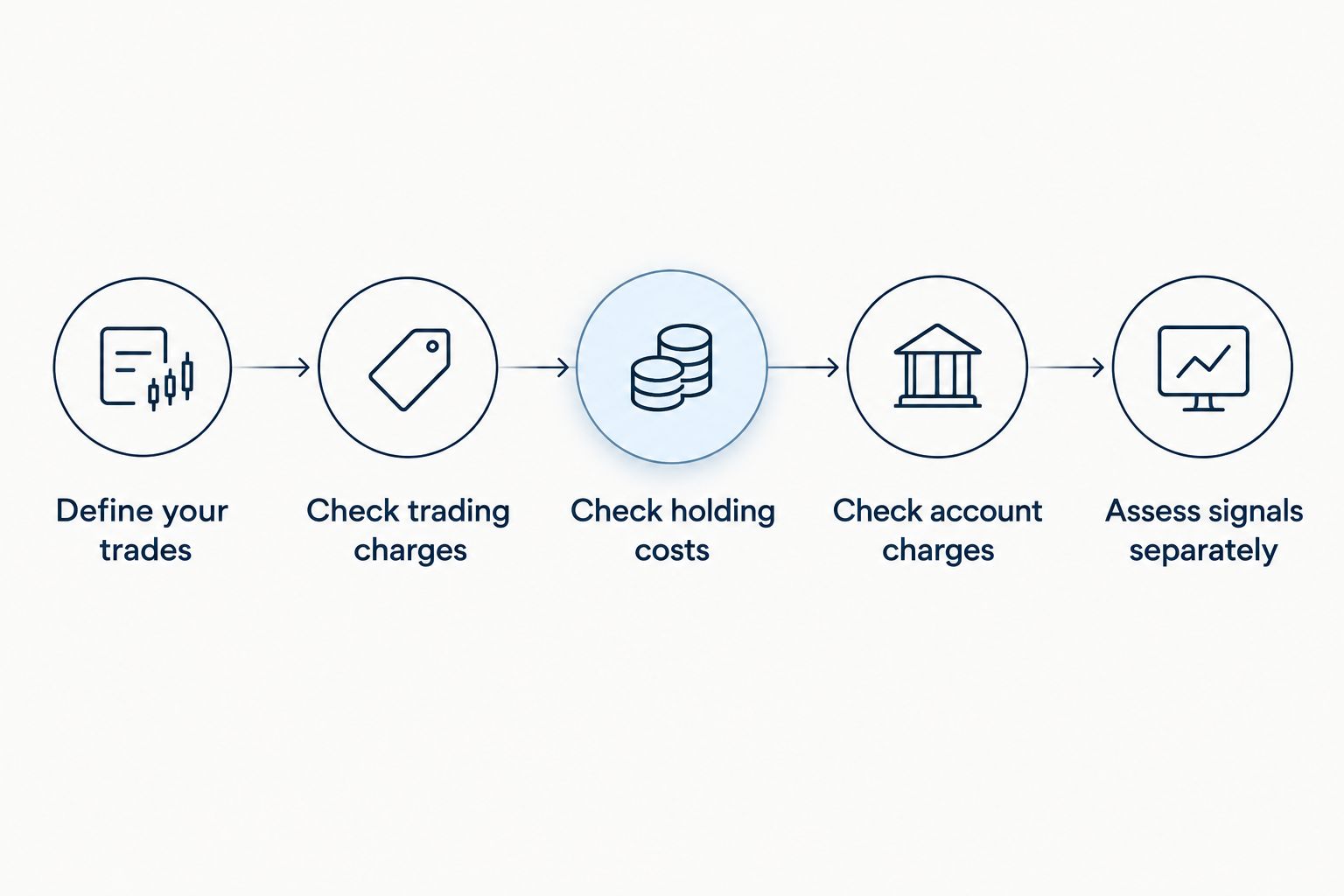
- Define your trades. Write down the currency pairs, intended position sizes, approximate trading frequency, and whether you expect to hold overnight. These are your assumptions, not a forecast of results.
- Check trading charges. Record the spread description and commission basis. Establish whether a commission covers one side or the complete transaction.
- Check holding costs. Read the rollover rules and financing calculation for the relevant currency pair and trade direction.
- Check account charges. Review payment, conversion, inactivity, and other applicable account terms. Keep these separate from trading charges.
- Assess signals separately. Evaluate the subscription as an additional service, not as a substitute for understanding the broker account.
Keep unresolved terms visible. If you cannot explain how a charge is calculated, ask the provider to clarify it before treating that account as cheaper.
A practice account can help you learn order entry and position sizing without placing live trades. It does not establish that live spreads, financing, or execution will match the practice environment, so confirm the live account terms separately.
Where a signals subscription fits
Tradeforex is best for beginners seeking forex signals in a web app, not a broker trading app. Subscribers receive Tradeforex signals inside the Tradeforex web app; the service is separate from the broker account used to place trades.
The useful distinction is access to trade ideas versus execution. A signals subscription supplies ideas for you to evaluate, but subscribing does not establish that a particular idea suits your finances, risk tolerance, or account conditions.
Before subscribing to Tradeforex, review the current service terms and decide what you need explained before acting on any signal. Look for enough information to understand the proposed trade, when the idea no longer applies, and the risk you would take; do not assume those details are included without checking.
The limitation is fundamental: signals do not guarantee outcomes or remove broker charges. You remain responsible for deciding whether to trade, selecting the position size, and understanding the order you submit.
Review the signals service
Check the current service information before deciding whether to subscribe.
Does a free forex trading app mean free trading?
A free download does not mean free trading. The broker account can still apply spreads, commissions, financing, or other charges under its terms.
Check what the word free describes. App installation, account access, and trade execution are separate items; a statement about one does not settle the others.
Are spreads and commissions the only costs to compare?
Spreads and commissions are not the complete cost checklist. Financing, conversion, payment, and account conditions also deserve review when they apply to your activity.
Keep execution risk separate from fees. Slippage—the difference between an expected execution price and the price received—is not the same as a published commission, but it still affects the transaction’s outcome.
Do forex signals replace broker fees?
Forex signals do not replace broker fees. A subscription pays for access to a service, while the broker’s charges apply to trading under the account terms.
Before subscribing in 2026, decide whether the service helps you evaluate trade ideas clearly enough to justify adding another commitment. Do not use an expected profit to excuse an expense you have not assessed.
FAQ
What forex trading app fees should I check first?
Check spreads, commissions, and overnight financing first, then review account, payment, and conversion charges. Assess any signals subscription separately from the broker account.
Is a commission-free forex account cheaper?
A commission-free account is not automatically cheaper because its spread still affects trading costs. Compare the complete transaction under the same currency pair, position size, and holding assumptions.
Do I pay a forex commission when I close a trade?
The account terms determine whether commission applies when you close a trade. Check whether the published charge describes one side of the transaction or the complete opening and closing cycle.
Can holding a forex trade overnight add costs?
Holding a forex trade past the broker’s rollover time can trigger a financing charge or credit. Check the relevant instrument, direction, calculation method, and rollover schedule.
Is a minimum deposit an app fee?
A minimum deposit is funding required for the account, not automatically an app fee. Separate account funding from charges, margin requirements, and the risk of trading losses.
Does Tradeforex place trades for subscribers?
Tradeforex provides forex signals inside its web app, not a broker trading app for execution. Treat the signals service and the broker account used to place orders as separate decisions.
Will a stop-loss guarantee my maximum loss?
A standard stop-loss does not guarantee execution at the specified price. Fast markets and price gaps can produce a different execution price; check your broker’s order terms.
One last thing
A losing trade and an expensive trade are different problems. Fees affect the cost of trading; they do not tell you whether a trade idea is sound, and a low-cost account does not make a risky position safe.
Before your first live order, explain the full transaction in plain English: what you are buying or selling, what charges apply, how you plan to exit, and what happens if the market moves against you. If you cannot explain it, pause the order—not the research.