
Forex trading app spreads increase a signal’s entry cost because you buy at the ask and sell at the bid, rather than trading at a single displayed market price. When evaluating a signal in 2026, check the executable quote in your broker’s app; commissions, slippage, and overnight financing are separate costs that the spread does not fully describe.
- Forex trading app spreads affect executable entries; compare the bid and ask before acting on a signal.
- A signal’s reference entry is not a guaranteed fill at your broker.
- Tradeforex delivers signals through its web app; your broker handles execution.
- Check spreads, commissions, and exit conditions together rather than judging an app by its advertised spread alone.
How do forex trading app spreads change a signal’s entry cost?
The spread separates the price you can buy at from the price you can sell at. A signal can identify an entry level, but your broker’s available bid and ask determine the quotes available when you place an order. Your eventual fill also depends on the order type and market conditions.
Start with how to choose a forex trading app before subscribing to signals if you have not yet separated the signal service from the broker. That distinction matters: receiving an idea and executing it are different activities.
| Trade direction | Entry side | Closing side | What to check |
|---|---|---|---|
| Buy, also called going long | Ask | Bid | Whether the ask matches your acceptable entry |
| Sell, also called going short | Bid | Ask | Whether the bid matches your acceptable entry |
If quotes remain unchanged, opening and immediately closing a position produces a spread-related loss before other charges. This is why a newly opened trade can show a negative result without a directional market move.
Do not automatically add the spread again to every profit-and-loss calculation. If your calculation already uses the actual entry and exit fills, the bid–ask difference is already reflected in those prices.
Why this matters
A signal’s directional idea and the result in your account are not the same thing. You can follow the intended direction yet receive a different entry, exit, or result because your execution conditions differ.
For your 2026 app comparison, prioritize the information needed to evaluate an order: visible bid and ask quotes, clear charges, understandable order controls, and accessible execution records. A simple interface helps you place an order; it does not establish whether the trade is suitable.
A signal is a trade idea, not a guaranteed outcome. A narrow spread does not make an unsuitable position safe, and a winning market prediction does not remove execution costs.
Read the spread in the correct units
The spread is the ask minus the bid. Apps can display that difference in pips, points, or quote-currency units, so check the platform’s terminology before comparing figures.
For most currency pairs, 1 pip represents 0.0001 of the quote currency. For pairs quoted in Japanese yen, 1 pip conventionally represents 0.01 yen. These are quotation conventions, not recommended trading distances or forecasts.
A platform that shows an additional decimal place can display fractional pips. Do not assume its smallest visible price increment is a full pip; confusing points with pips distorts your cost comparison.
Position size determines the cash impact of a given spread. A standard forex lot conventionally represents 100,000 units of the base currency, while a mini lot represents 10,000 units; verify the broker’s contract specification rather than assuming every instrument uses those sizes.
The base currency is the first currency named in a pair. The quote currency is the second. For a straightforward currency position, multiplying the spread in quote-currency units by the base-currency position size gives the spread’s cash equivalent in the quote currency, before any account-currency conversion.
Compare spread-only and commission-based accounts
For a 2026 account comparison, read the charging structure rather than treating an advertised minimum spread as the complete cost. These account models describe how trading charges are presented; neither guarantees better execution.
| Account model | Best for | Advantage | Limitation |
|---|---|---|---|
| Spread-only | Beginners who want fewer separate trading-charge components | The spread is the main visible transaction charge | A wider spread can outweigh the simplicity; financing and other fees can still apply |
| Spread plus commission | Traders prepared to calculate the combined transaction cost | Separates the quoted spread from the commission | A narrow spread does not establish a lower total cost |
For a commission-based account, establish whether the quoted commission applies when opening, closing, or across the complete trade. Also check whether it varies with position size and whether currency conversion applies.
For a spread-only account, do not interpret the absence of a separate commission as cost-free trading. The bid–ask difference remains an execution cost.
Compare the same currency pair, position size, and trading period. Otherwise, a difference attributed to the app can actually reflect a different instrument, account arrangement, or market condition.
Why forex trading app spreads vary
Spreads reflect the broker’s pricing and the conditions in the underlying market. These factors explain why a spread shown when reviewing an app is not a promise about a later signal’s execution:
- Currency pair: Different pairs have different liquidity conditions. Do not transfer a spread observation from one pair to another.
- Trading session: Market participation changes across sessions and session overlaps, affecting available quotes.
- Economic announcements: Important releases can change prices quickly and reduce the depth available at a quote.
- Broker and account model: Spread markups and separate commissions change how trading costs appear.
- Market rollover: Spreads can widen around the broker’s daily rollover period. Check the broker’s schedule.
- Available liquidity: A displayed quote does not guarantee that your entire intended position can execute at that level.
Check conditions at the time you intend to trade. An observation made during an active session does not describe execution during a quiet period or a major announcement.
Avoid choosing a broker solely because a promotional page highlights a minimum spread. A minimum describes a boundary, not your expected experience on every order.
Check a signal before placing an order
Use this sequence for each signal you evaluate in 2026. The purpose is to identify a mismatch before you accept it, not to turn a trade idea into a promise.
- Read the signal. Identify the currency pair, direction, reference entry, and any stated timing conditions. If essential instructions are unclear, do not fill the gaps with assumptions.
- Check the quote. Look at the broker’s current bid and ask. Use the ask for a proposed buy and the bid for a proposed sell.
- Review the costs. Identify the spread, applicable commission, and any financing relevant to your intended holding period.
- Set the risk. Determine your acceptable loss and position size using the entry you can actually execute, not just the signal’s reference level.
- Decide or skip. If the current quote no longer fits your plan, leave the trade alone. Receiving a signal does not require placing an order.
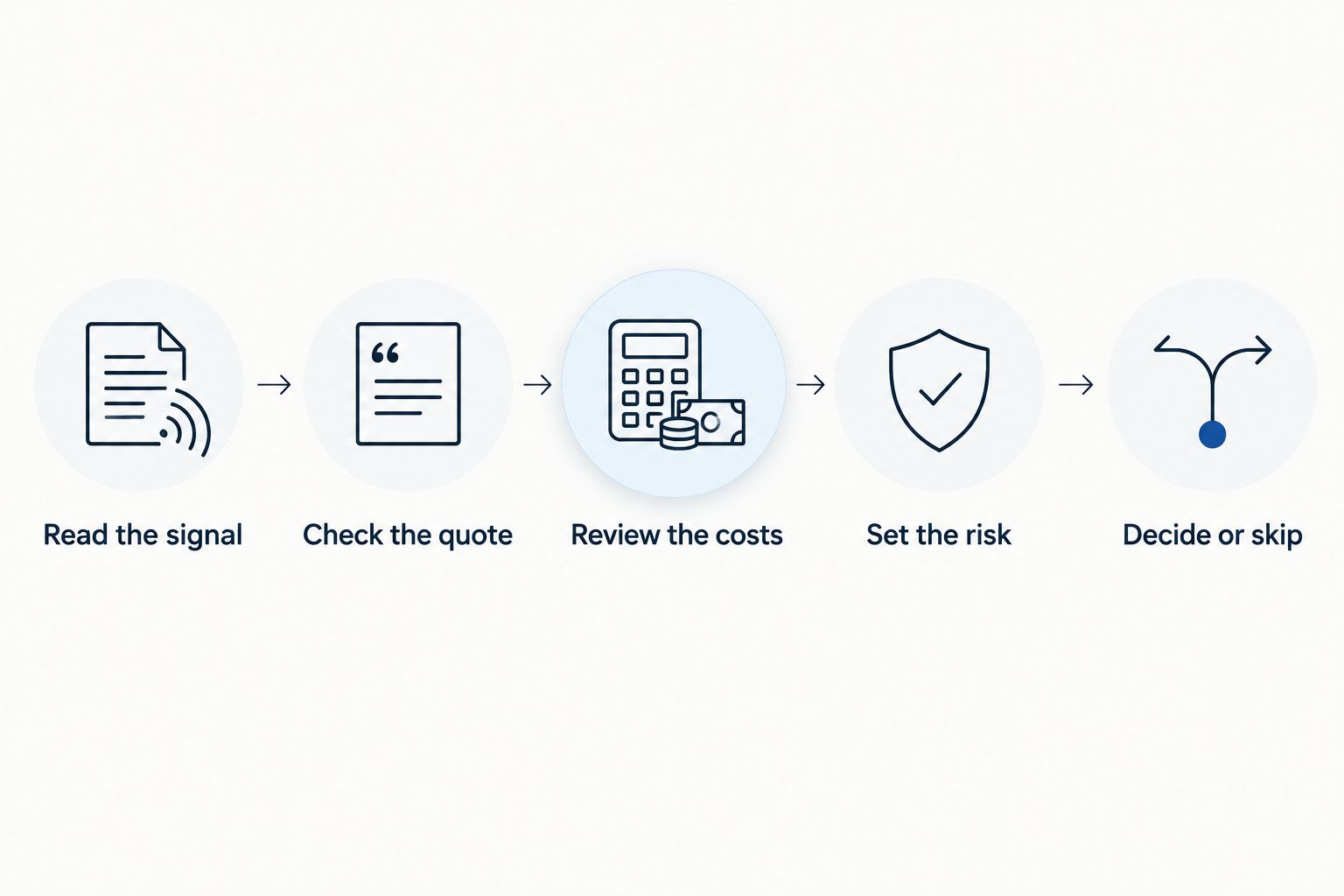
Your planned entry and exit need to make sense together. A less favorable entry changes the distance to a fixed stop or target, so copying a signal’s position size without reviewing your own entry can change the risk you accept.
Tradeforex is best for beginners seeking its forex signals in a web app, not a broker execution app. Subscribers receive signals inside the Tradeforex web app; the service does not replace your broker’s execution interface. Access to a signal does not guarantee a matching fill or a profitable trade.
Before subscribing to any signal service, review whether the information supplied is clear enough for you to assess the proposed trade independently. Do not assume that entry explanations, exit instructions, or risk guidance exist unless the service actually provides them.
Review Tradeforex before subscribing
Review the service with a clear distinction between receiving signals and executing trades.
Does a wider spread always make a signal unsuitable?
A wider spread increases the execution hurdle, but suitability depends on the entire trade plan. The relevant comparison is the spread’s impact relative to the intended entry, exit, holding period, and acceptable loss.
A small intended price move leaves less room for transaction costs than a larger intended move. That does not make a longer-horizon trade safer: it can involve different market risks and overnight financing.
Reject the idea that a spread is acceptable simply because another trader accepted it. Your position size, account currency, broker, and execution time can differ.
Is slippage the same as the spread?
Slippage is the difference between an expected execution price and the actual fill; the spread is the difference between bid and ask. A narrow spread does not eliminate slippage.
Market orders prioritize execution rather than a guaranteed price. Limit orders set a price boundary but can remain unfilled, so choosing an order type involves a trade-off rather than a universal solution.
A standard stop-loss order also does not guarantee an exit at the exact stop level. Understand the broker’s order rules before treating a stop as a fixed maximum cash loss.
Can the chart make an entry look cheaper than it is?
A chart can show a different price basis from the quote needed to execute your trade. Depending on the platform, the chart can display bid, ask, midpoint, or another specified price source.
Check which price the chart uses and which price triggers each order type. A chart touching a level does not, by itself, prove that your intended order was executable there.
This distinction also matters when reviewing a signal afterward. Compare the timestamp and relevant bid or ask with your execution record, rather than using a chart screenshot alone to judge the fill.
FAQ
What are forex trading app spreads?
Forex trading app spreads are the differences between the bid and ask quotes available through your broker. You normally buy at the ask and sell at the bid, so the difference affects entry and exit economics.
Why does my forex trade show a loss immediately?
A newly opened forex trade can show a loss because closing it immediately uses the opposite side of the bid–ask quote. Commissions and market movement can also affect the displayed result.
Can I get the exact entry shown in a forex signal?
A signal’s stated entry is not a guaranteed execution price. Your broker’s quotes, the order type, available liquidity, and the time you submit the order determine the fill.
Is a commission-free forex account cheaper?
A commission-free forex account is not automatically cheaper because its spread still creates a trading cost. Compare the combined spread and commission for equivalent trades, then review financing and other applicable charges.
Does Tradeforex execute the signals for me?
Tradeforex provides forex signals inside its web app, not a broker trading app that executes trades. Receiving a signal and submitting an order through your broker are separate activities.
Should I follow a forex signal when the spread widens?
Do not follow a signal automatically when the spread widens; reassess whether the executable entry still fits your risk and exit plan. Skip the trade if you cannot evaluate the changed conditions.
One last thing
Record the bid and ask when you assess a signal, not just the chart level. For your 2026 trading journal, keep the signal timestamp, order type, actual fill, position size, and applicable charges together.
That record separates a different entry from a different market outcome. It also prevents you from blaming the signal for every execution difference—or treating a good fill as evidence that future signals will succeed.