Full-time employees’ forex app selection is the process of choosing trading software that fits work commitments, with the aim of managing currency trades without constant screen time. The right forex trading app for full-time employees supports a routine you can follow during meetings, commutes, and periods when you cannot check your phone.
- Choose a forex trading app for full-time employees around order controls and your actual checking schedule.
- Tradeforex delivers forex signals inside its web app; it is not a broker trading app.
- Forex signals are trade ideas, not guaranteed outcomes or instructions you must follow.
- Test missed alerts and interrupted sessions before relying on a trading workflow during work.
Why forex trading apps matter for full-time employees
The best app is the one you can use responsibly when work interrupts you. A polished chart does not solve an entry that expires during a meeting, and an alert does not guarantee you can act at its quoted price.
Start with how to choose a forex trading app before subscribing to signals. Choose the order-entry environment first; then assess whether a signals service fits that environment and your schedule.
For your 2026 shortlist, distinguish convenience from control. Phone access helps you review an account, but it does not make frequent trading compatible with a demanding job. A workflow that requires immediate responses is a poor fit when you cannot reliably provide them.
Forex involves substantial risk, including losses amplified by borrowed exposure. Keep trading money separate from essential expenses, and do not treat trading as dependable salary replacement.
Build a forex app routine around your working day
Map your actual checking windows
Write down when you can review trades without interrupting work. Use your real calendar, including unpredictable meetings and travel, rather than the schedule you wish you had.
The manual starting point is a calendar and a short written plan. Mark periods when you cannot respond at all. Those gaps matter more than the number of times you can open an app.
A strategy requiring close supervision does not become suitable because its alerts reach your phone. Match the strategy to your attention before matching the app to the strategy.
- Identify your before-work, break, and after-work review windows.
- Mark meetings, driving, and other no-response periods.
- Set a rule against trading during work that requires concentration.
- Decide what happens to open positions before an extended absence.
Check the broker and order controls
Before comparing chart layouts, establish who holds your account and executes your orders. A broker app and a signals service perform different jobs; access to one does not establish the legitimacy of the other.
For a US-based account, check the legal entity and its registration through official regulatory records, including NFA BASIC where applicable. Match the entity name to the account agreement rather than relying on a logo or app-store listing.
In 2026, make order handling a shortlist requirement. A stop-loss is an instruction intended to limit a loss, not insurance against every market move. Execution can differ from the requested level during gaps or fast markets.
- Confirm which legal entity opens and holds your account.
- Read how market, limit, and stop orders operate.
- Check whether orders remain active after you close the app.
- Find the controls for modifying and canceling orders.
- Review account access protections and recovery procedures.
Separate signal delivery from trade execution
Start manually: write down a trade idea, review its assumptions, and decide whether you understand it before opening an order ticket. This makes the decision visible instead of turning an alert into an automatic instruction.
Tradeforex provides forex signals to subscribers inside its web app. That supplies trade ideas without requiring you to originate every idea yourself, but it does not remove your responsibility to assess the trade or manage an order with your broker.
Tradeforex is best suited to beginners seeking forex signals in a web app, not a broker that executes trades. Its delivery format is a fit criterion, not evidence of profitable results or compatibility with your working hours.
- Identify where a signal appears and where an order is placed.
- Check whether each idea explains its direction and entry conditions.
- Look for understandable exit and risk information before acting.
- Establish how updates, cancellations, or expired ideas are communicated.
- Skip ideas you cannot explain in plain English.
Rehearse the routine in a demo account
Use a broker’s demo account, where offered, to practice without placing live-money trades. Run it during your normal working day rather than only on a quiet weekend.
Rehearse the complete sequence: receive information, inspect the market, check the order, and decide whether to submit it. Include interruptions. A workflow that succeeds only when nothing distracts you has not passed the workday test.
Record these four stages in your notes: Receive, Review, Size, Decide. The final decision includes skipping the trade; it is not a requirement to press a buy or sell button.
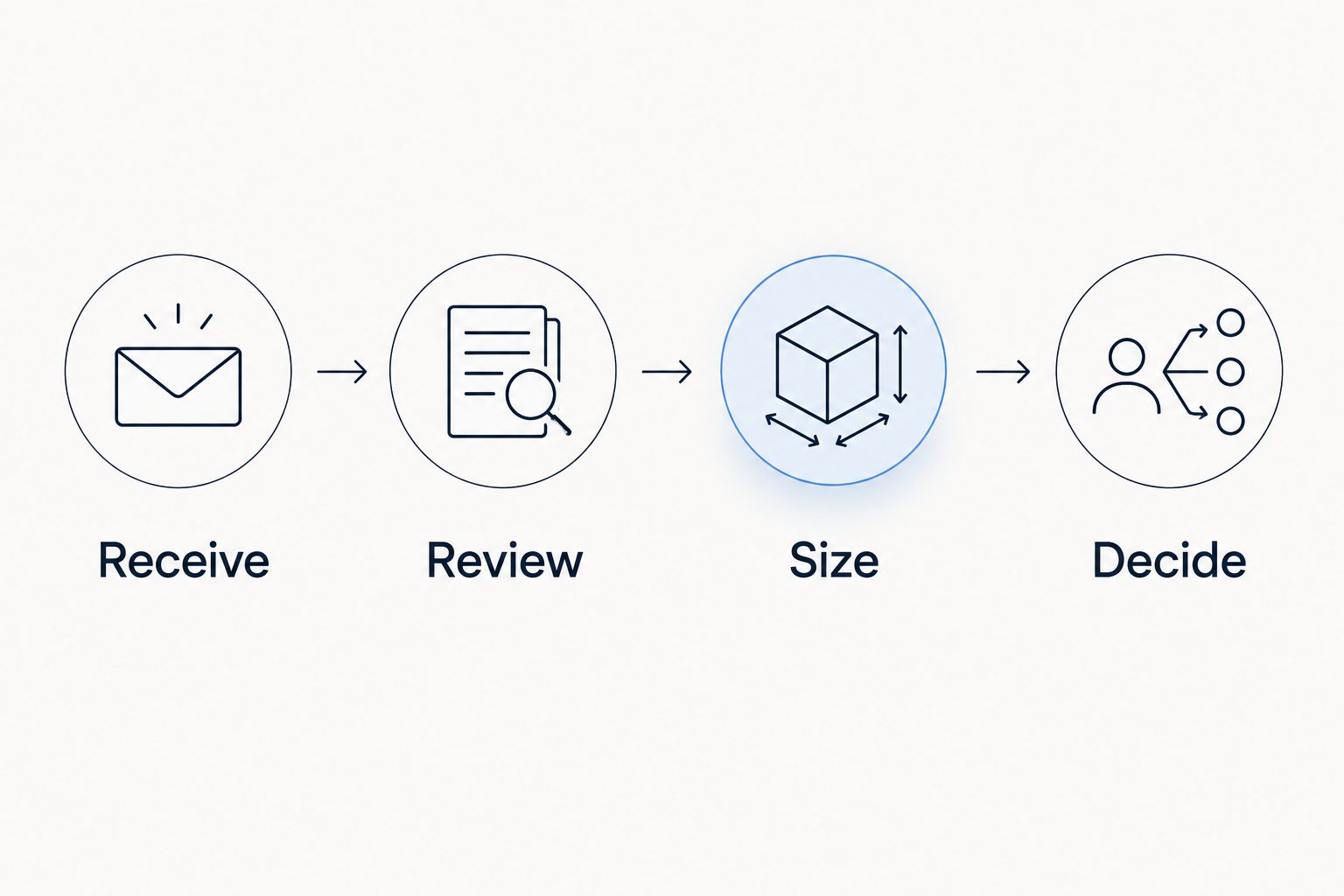
Demo practice tests usability, not future returns. Simulated fills and the emotional pressure of practice differ from live trading, so keep those limits in your evaluation.
- Receive: check where the information appears and its timestamp.
- Review: read the idea before opening the order ticket.
- Size: inspect the position amount and potential loss.
- Decide: place a demo order or document why you skipped it.
Size the position before confirming it
Begin with the amount you are prepared to lose on the trade, not the largest position the account permits. Position size is the amount of currency exposure you take; it is not the same as the cash needed to open the position.
Common forex conventions define a standard lot as 100,000 base-currency units, a mini lot as 10,000 units, and a micro lot as 1,000 units. Broker order tickets can use different labels or increments, so verify what the displayed quantity means.
Use this guide to size a position before following forex signals. The key workday safeguard is deciding the exposure before an interruption, not estimating it while rushing back to a meeting.
- Verify the currency pair and whether you are buying or selling.
- Check the order quantity and its unit of measurement.
- Calculate the planned loss using the entry and stop distance.
- Review other open positions for overlapping currency exposure.
- Reduce or reject a trade whose risk you cannot calculate.
Test alerts without treating them as protection
Start with the phone’s notification settings and the app’s documented behavior. Check permissions, battery restrictions, focus modes, and whether your workplace allows you to receive personal alerts.
Test any alert capability you intend to rely on; do not assume a service provides push notifications merely because it has a web app. Signals delivered inside a web app and operating-system notifications are separate capabilities.
During your 2026 evaluation, test what happens when you miss a message. If the process requires an immediate response and offers no understandable way to assess a late entry, it conflicts with an interruption-heavy job.
- Check timestamps and the time zone used for messages.
- Test the workflow while the phone is locked or silenced.
- Distinguish a new idea from an update or cancellation.
- Recheck the current market instead of chasing an old entry.
- Use broker-side order controls rather than alerts as your only safeguard.
Review your decisions before subscribing or expanding
Keep a simple journal in a document or spreadsheet. Record what you understood, what you missed, and whether the trade required attention you could not give during work.
Evaluate a signals service separately from the broker app. Tradeforex signals arrive inside the Tradeforex web app; assess whether that delivery method fits your checking windows before deciding to subscribe. Do not assume that an attractive trade idea compensates for an unsuitable schedule.
For your 2026 review, consider losses, trading costs, and missed opportunities alongside successful ideas. A high win rate alone does not show whether losses outweigh gains or whether you could have followed the published entries.
- Record the signal timestamp and your actual review time.
- Note whether the entry remained relevant when you checked.
- Document the reason for taking or skipping each idea.
- Separate app usability problems from trading-strategy problems.
- Review subscription terms before committing to a service.
Review Tradeforex before subscribing
Assess whether receiving forex signals inside a web app fits your workday routine.
Compare workflows for employees, not just app features
These options describe ways to organize trading, not a ranking of named brokers. Choose the workflow you can supervise, then evaluate the software that supports it. None removes market risk or the need to understand your orders.
| Option | Best for | Main advantage | Key limitation |
|---|---|---|---|
| Broker app with self-directed research | Employees who want direct control over research and orders | Keeps trade decisions and order management under your control | Requires time to develop and assess your own ideas |
| Broker app plus a separate signals service | Employees who want trade ideas to evaluate independently | Separates idea generation from execution | Requires checking the idea against current broker conditions |
| Demo-first workflow | Beginners testing whether trading fits their job | Reveals confusing controls and scheduling conflicts without live-money trades | Does not reproduce live financial pressure or guarantee comparable fills |
| Desktop review with mobile account checks | Employees who can reserve uninterrupted review time | Supports detailed preparation away from a small screen | Mobile checks cannot replace supervision required by the strategy |
A longer intended holding period does not automatically mean a low-maintenance trade. Overnight exposure, economic announcements, and changing market conditions still require a plan. Conversely, receiving fewer signals does not prove those signals are better suited to your job.
Common mistakes full-time employees make
Choosing speed over a manageable routine
An app that lets you submit orders quickly does not establish that you should trade between meetings. Rushed decisions make it harder to verify direction, quantity, and exit instructions. Finish the review or skip the trade.
Chasing a signal after a meeting
The market can move while you are unavailable. A later entry changes the relationship between the entry, intended exit, and planned loss. Do not copy an old price into a new decision without reassessing the setup.
Confusing notifications with risk management
An alert tells you something happened; it does not close a position. If your only response plan depends on seeing a message immediately, a silenced phone becomes a trading dependency. Check which protections sit with the broker and how they work.
Using salary as a reason to accept more risk
Employment income does not make a trade safer. Keep rent, bills, emergency savings, and other obligations outside your trading allocation. Do not increase exposure simply because payday is approaching or because you missed an earlier trade.
Subscribing before testing the handoff
Moving from a signal to a broker ticket requires judgment, even when the information looks straightforward. Test the handoff before subscribing, and reject any workflow you cannot operate without guessing. A subscription does not transfer responsibility for your account.
FAQ
What's the best forex trading app for full-time employees?
The best fit is an app whose order controls and review requirements match your working schedule. Verify the broker, rehearse the workflow, and reject strategies that require attention you cannot provide.
Can I use forex signals while working a full-time job?
You can evaluate forex signals alongside a full-time job, but the timing must fit periods when you can review them properly. Skip ideas that require immediate action while you are unavailable.
Does Tradeforex place trades for subscribers?
Tradeforex provides forex signals inside its web app; it is not a broker trading app and does not execute trades. You must assess an idea separately from any order you place with a broker.
Are stop-loss orders enough when I cannot check my phone?
Stop-loss orders do not eliminate trading risk or guarantee the requested execution price. Understand the broker's order rules and plan for gaps, fast markets, and periods when you cannot intervene.
Should I follow a forex signal after the entry has moved?
Do not follow a signal solely because you received it earlier. Reassess the current entry, exit conditions, and potential loss; skip the idea if those conditions are unclear.
Is a demo account enough to prove my trading routine works?
A demo account helps test controls and scheduling, but it does not prove future profitability. Live execution and the pressure of risking money differ from practice.
Should I choose a broker app before subscribing to signals?
Choose and test your broker workflow before adding signals. You need to understand order types, position sizing, and account controls before deciding whether a separate source of trade ideas helps.
One last thing
Make skipping a trade an explicit part of your 2026 trading plan. Write down the conditions that mean you will not act: an expired idea, an interrupted review, unclear risk, or insufficient time. A missed trade is not an instruction to take the next one.