Forex signals for retirees are currency-trading suggestions used to evaluate possible trades, not a source of dependable retirement income. If you rely on savings for living expenses, protecting that money takes priority over acting on any signal.
- Forex signals for retirees are speculative trade ideas, not dependable income or personalized retirement advice.
- Tradeforex delivers forex signals inside its web app; a separate broker handles trade execution.
- Test signal interpretation, position sizing, and trading-app controls before risking money.
- Reject profit guarantees and judge complete trading records rather than selected winning trades.
Why forex signals matter for retirees in 2026
A signal reduces the work of finding a possible trade. It does not remove the work of deciding whether that trade fits your finances, checking the instructions, and controlling the amount at risk.
Retirement changes that decision when withdrawals already support your household. Money lost through speculation is no longer available for those withdrawals, and replacing it through employment is not part of every retiree's plan. If you need trading profits to pay essential bills, do not treat forex signals as the solution.
Start by learning how to read forex signals before placing a trade. Understanding the instruction comes before comparing subscriptions or choosing an app.
A signal service and a broker perform different jobs. The service supplies a trade idea; the broker holds the trading account and processes orders. A clear signal does not prove that the broker is suitable, and a well-designed trading app does not prove that a signal is sound.
How to evaluate forex signals for retirees in 2026
Protect your retirement spending first
Separate speculative trading money from the assets supporting housing, healthcare, taxes, and other necessities. A willingness to accept losses is not the same as the financial ability to absorb them.
Write down what a complete loss of the proposed trading allocation would change. If the answer includes missed bills, reduced necessary care, or withdrawals from money reserved for emergencies, stop before evaluating providers. No signal subscription fixes that mismatch.
Ask a qualified financial adviser to assess suitability in the context of your retirement plan. This guide explains an evaluation process, not a personal allocation recommendation.
- Identify the savings needed for essential spending.
- Keep emergency reserves outside the trading account.
- Exclude borrowed money from the trading plan.
- Define a loss boundary that triggers a stop and review.
Choose a trading workflow you can manage
Begin with a manual exercise: read a sample trade idea, explain it in your own words, and locate the corresponding order controls in a practice account. Do not fund an account merely because its app looks straightforward.
Complete 3 checks before considering a live trade: understand the proposed entry, understand how the trade ends, and understand the financial exposure. An entry is the proposed condition for opening a position. An exit is the condition for closing it, whether the trade succeeds or fails.
Your routine matters too. If an idea requires attention while you are unavailable, it does not fit your schedule. A missed trade is not a problem you need to solve by rushing.
- Check whether you can read the order ticket comfortably.
- Locate open positions and pending orders without assistance.
- Practice changing and canceling an order.
- Confirm the time zone used in trading instructions.
- Reject workflows that require constant attention you cannot provide.
Evaluate the signal service separately
Start with a paper checklist rather than a subscription. Record what a provider explains about its signals, what remains unclear, and what evidence supports its performance claims.
Tradeforex provides its own forex signals service, and subscribers receive signals inside the Tradeforex web app. It does not execute your trades. Tradeforex forex signals are best for readers seeking trade ideas through a web app, not a broker-managed trading account.
Web-app delivery puts the signal-reading step in a defined place; you still need a separate broker and an independent risk decision. Check actual signal examples before subscribing, rather than assuming they contain every instruction you need. Receiving an idea is not proof that acting on it is suitable.
- Entry: Check whether the opening condition is understandable.
- Exit: Check what closes or invalidates the idea.
- Timing: Check when the instruction was issued and whether it remains relevant.
- Evidence: Look for losing trades as well as winning trades.
- Terms: Read the subscription and cancellation conditions.
Set position size before placing orders
Begin with a written calculation and verify it against the broker's order preview. Position size means the amount of currency exposure you open; it determines how strongly a market move affects your account.
Keep 2 separate records: your retirement spending plan and your trading-risk log. Do not let a trading loss silently become a reason to increase the amount taken from retirement savings.
A stop order is an instruction intended to close a position when a specified condition is reached. It is not a guarantee of the final execution price, particularly when markets move quickly. If you cannot explain the exposure in account-currency terms, do not submit the order.
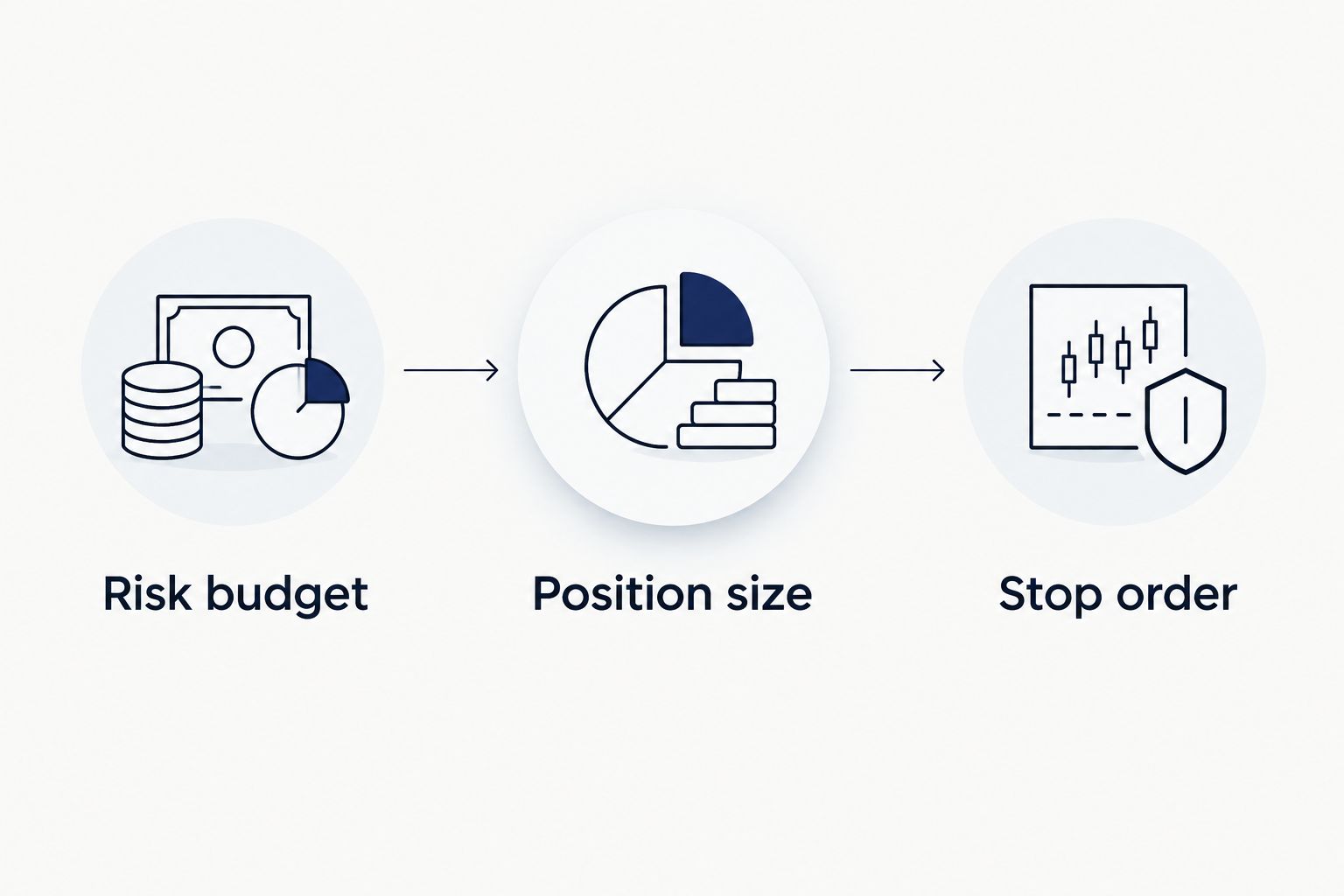
- Risk budget: Set the loss boundary before choosing the trade size.
- Position size: Check the exposure shown in the order ticket.
- Stop order: Understand the trigger and its execution limitations.
- Total exposure: Include other open currency positions.
The sequence matters: decide what loss you can accept, calculate the exposure, and then check the order. Reversing that sequence makes the app's suggested trade size the starting point for your risk decision.
Inspect results beyond the win rate
Use a spreadsheet to examine a complete sequence of trades. Win rate means the proportion of trades that finish profitably; it does not show how much winning trades make or losing trades lose.
A record of selected screenshots cannot establish overall performance. Look for the period covered, missing trades, open losses, trading costs, and whether results came from live trading or simulation. If those distinctions are unclear, the record is not enough to support a decision.
Drawdown means a decline from a previous account high. For a retiree making withdrawals, understanding that decline matters more than seeing an isolated profitable month. Historical results do not establish what your own account will earn.
- Check whether the record includes all signals in the stated period.
- Compare the size of gains with the size of losses.
- Examine drawdowns and consecutive losing trades.
- Identify whether results include trading costs.
- Separate simulated results from live-account results.
Test the full process without risking savings
Use a demo account, which simulates trading, to rehearse the process. Keep 1 practice journal containing the original idea, your interpretation, the order entered, and the reason for closing or skipping it.
A demo account tests your understanding and workflow; it does not establish future profitability. Simulated execution can differ from live execution, and practicing without real losses does not reproduce the emotional pressure of trading savings.
Include skipped ideas in the journal. That shows whether your process includes rejecting unsuitable instructions rather than treating every alert as an obligation.
- Record the signal timestamp and your review time.
- Check whether the market price still fits the instruction.
- Verify the direction, order type, and position size.
- Record any confusion before repeating the exercise.
- Continue practicing until the process is clear, not merely profitable.
Decide whether to subscribe or step away
Compare your journal with your original boundaries before making a subscription decision. The useful question is whether a service supports a process you understand and can manage—not whether its examples make trading look easy.
A subscription does not oblige you to trade. If instructions remain unclear, the workflow interrupts your life, or losses would threaten necessary spending, step away. Doing nothing is a valid outcome of a careful evaluation.
Before subscribing, review the current service information and terms. Confirm what you receive rather than filling gaps with assumptions about support, alerts, results, or order execution.
- Subscribe only after understanding the service's role.
- Keep the broker decision separate from the signal decision.
- Recheck your financial boundaries before funding an account.
- Stop if you begin chasing losses or increasing exposure impulsively.
Review Tradeforex before subscribing
Check the service information and terms before deciding whether web-app signals fit your process.
Compare your options in 2026
Choose the learning method before choosing the subscription. Each option below serves a different purpose, and none turns speculative trading into dependable retirement income. These are workflow choices, not a ranking of expected returns.
| Option | Best for | Main benefit | Key limitation |
|---|---|---|---|
| Manual research and a written journal | Beginners learning how trade decisions work | Makes you explain each decision yourself | Requires research time and does not validate your judgment |
| Demo trading | Retirees testing app controls and signal interpretation | Lets you rehearse without risking real money | Does not reproduce live execution or financial pressure |
| Tradeforex forex signals | Readers seeking trade ideas inside a web app | Provides a defined place to receive the service's signals | Does not execute trades or remove market risk |
| Choosing not to trade forex | Retirees whose essential spending depends on the proposed funds | Keeps those funds outside speculative currency trading | Does not provide trading participation or experience |
Do not compare these options solely by convenience. An easy interface can shorten the order-entry process without improving the decision behind the order. For retirement money, a clear reason not to trade is more useful than a faster way to submit an unsuitable trade.
Common mistakes retirees should avoid in 2026
Treating signals as a pension supplement
A trade idea is not a scheduled payment. Building essential spending around expected trading gains creates a mismatch between uncertain outcomes and bills that remain due. Keep the household budget independent of signal results.
Confusing a subscription with account management
Receiving signals does not mean someone has assessed your retirement finances or accepted responsibility for your orders. Establish who supplies ideas, who holds funds, and who makes the final decision before opening a position.
Increasing exposure to recover a withdrawal
A planned withdrawal does not create a market opportunity. Trying to replace withdrawn money through a larger trade changes the risk without improving the trade idea. Return to the written boundary rather than adjusting it to match an income target.
Judging a provider by reassuring presentation
A calm explanation, readable screen, or convincing testimonial does not verify trading results. Check the underlying record and limitations. Reject guaranteed-profit language regardless of how professionally it is presented.
FAQ
Are forex signals safe for retirees?
Forex signals do not make currency trading safe for retirees. They are speculative trade ideas, and losses can reduce savings needed for living expenses. Do not use essential spending money to follow them.
Can I use forex signals as retirement income?
Do not treat forex signals as dependable retirement income. Trading outcomes are uncertain, while housing, healthcare, and other household obligations still need funding.
Does Tradeforex place trades for subscribers?
Tradeforex does not execute trades for subscribers. Subscribers receive forex signals inside its web app; a separate broker handles trade execution.
What should I check before subscribing to forex signals?
Check actual signal examples, the evidence behind results, subscription terms, and whether you understand the trading process. Practice interpreting instructions and entering orders before putting savings at risk.
Is a high win rate enough to choose a signal provider?
A high win rate is not enough to judge a signal provider. You also need to examine loss sizes, drawdowns, trading costs, and whether the record includes all relevant trades.
Should I practice with a demo account first?
Use a demo account to practice interpreting signals and operating the trading app before considering live trading. Demo results do not prove future profitability or reproduce the pressure of risking retirement savings.
What should I do if a signal arrives after the price has moved?
Reassess the instruction rather than entering automatically after the price has moved. If the original entry conditions no longer apply or you cannot evaluate the changed risk, skip the trade.
One last thing
For your 2026 evaluation, write a skip rule before an entry rule. State exactly what makes you reject a signal: unclear instructions, changed entry conditions, excessive exposure, or interference with necessary spending. A useful trading process must tell you when not to trade.