College students’ forex app selection is the process of choosing a currency-trading platform with the aim of learning order placement and risk control without putting education expenses at risk. The right forex trading app for college students supports practice and fits around classes; signals are separate trade ideas, not guaranteed outcomes.
- Choose a forex trading app for college students around demo practice, order controls, and your class schedule.
- Tradeforex delivers forex signals inside its web app; it does not execute your trades.
- Evaluate trading apps and forex signals separately before subscribing or funding an account.
- Keep tuition, rent, emergency savings, and borrowed education funds outside your trading budget.
Why forex app selection matters for college students
A class schedule creates a practical constraint: you cannot assume you will be available when a trade idea arrives. An app that demands attention during lectures, labs, or exams is a poor fit, regardless of how attractive its charts look.
In 2026, start with how to choose a forex trading app before subscribing to signals. App selection determines how you inspect prices and place orders; signal selection determines which outside trade ideas you consider.
Make 2 separate decisions: where you place trades and whose trade ideas you evaluate. A useful signal cannot fix an unsuitable account, and a convenient app cannot make an unreliable signal profitable.
Your financial boundary matters just as much. Money committed to tuition or living expenses is not trading capital. Forex trading can lose money, and borrowed funds add repayment obligations that remain after a trading loss.
How to choose a forex trading app around college life
Protect your education budget first
Start with a written budget using a spreadsheet or notebook. Separate money you need for education, housing, food, transportation, and emergencies before considering any trading deposit.
A small deposit is not automatically a small risk. What matters is the amount exposed through your orders and whether losing that money would disrupt essential spending. Do not use a trading goal to justify spending money that already has another job.
Treat your initial budget as a boundary, not a target you must deposit. Choosing not to fund an account is a valid result of this exercise.
- Exclude tuition payments, rent, and emergency savings.
- Keep student loans and other borrowed education funds out of trading.
- Write down what a complete loss of your trading budget would affect.
- Keep subscription spending separate from money placed in trades.
- Stop the funding process if essential expenses depend on trading gains.
Practice the order workflow before depositing
Use a demo account, where available, to learn with simulated funds. Practice entering, reviewing, changing, and closing an order before considering a live account.
A market order requests execution at the available market price. A limit order sets a price boundary for execution, while a stop order becomes active when its trigger conditions are met. Read the broker’s definitions because order handling depends on the account and product.
For your 2026 comparison, prioritize whether you understand the order ticket over how many indicators the app displays. Demo practice teaches the interface; simulated results do not establish what you will earn with real money.
- Identify the currency pair and whether the order buys or sells it.
- Find the trade-size field and confirm its unit.
- Locate pending orders separately from open positions.
- Practice setting an exit and checking the confirmation.
- Learn how to cancel an unfilled order.
- Check which demo conditions differ from the live account.
Separate signal delivery from trade execution
Begin manually: write down a trade idea and compare it with the price and order controls in your chosen broker app. This reveals whether you understand the idea before any subscription becomes part of your routine.
Tradeforex is best suited to beginners seeking forex signals in a web app, not a broker that executes trades. Subscribers receive Tradeforex signals inside the Tradeforex web app. You still need to evaluate each idea and decide whether to place an order through a separate broker.
The advantage is access to outside trade ideas; the limitation is that a signal does not remove execution decisions or trading risk. Review Tradeforex as a signals service, rather than treating it as your trading account.
- Identify where you receive the signal and where you place the order.
- Check the currency pair and direction before entering anything.
- Look for the idea’s timing and conditions, rather than assuming immediate action.
- Assess any entry, exit, and risk information actually provided.
- Skip an idea you cannot explain in your own words.
Match your workflow to your timetable
Map your actual class and work commitments before deciding how you will monitor trades. A calendar and a written checklist are enough to start; you do not need an automated system to discover a schedule conflict.
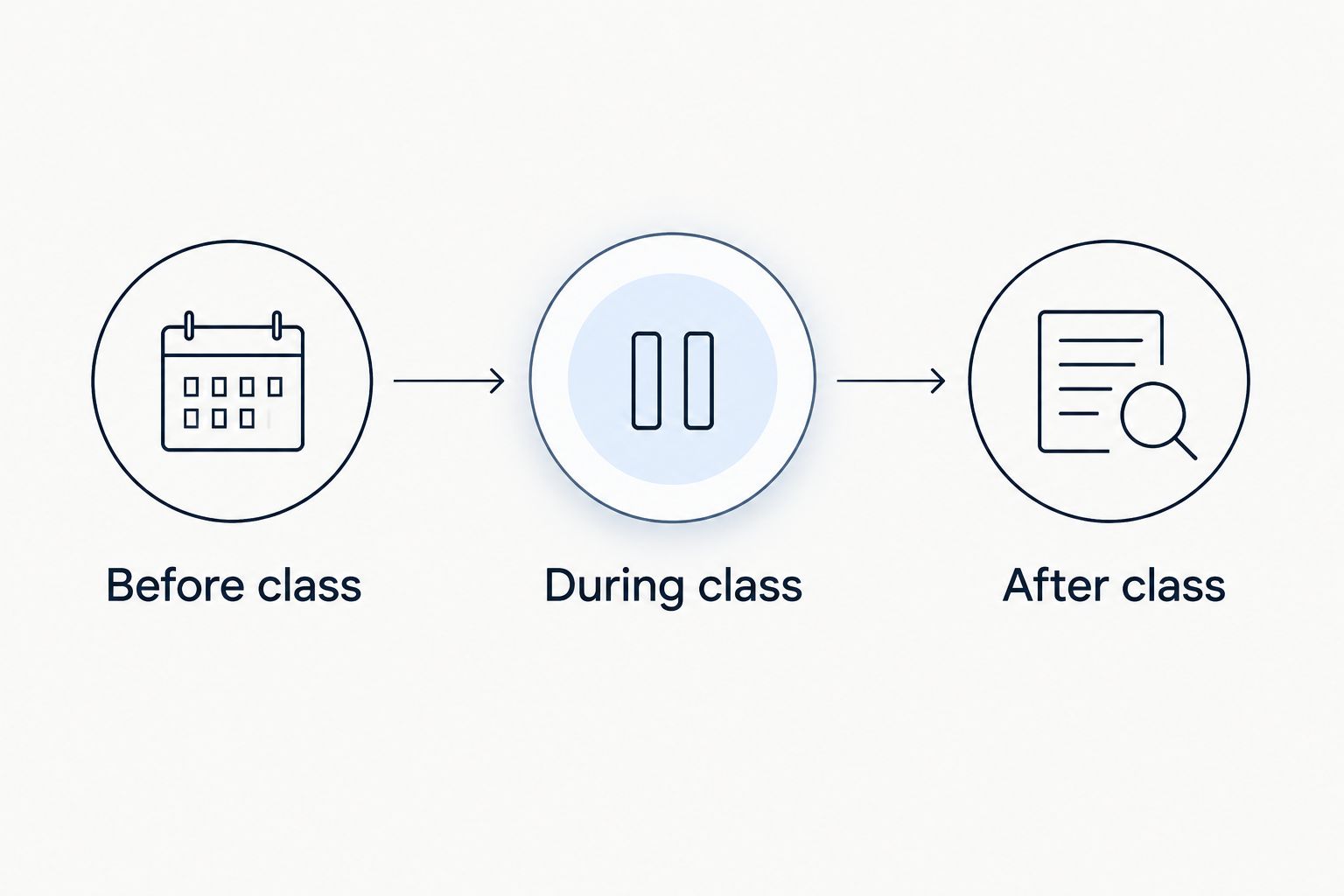
Use 3 checks: Before class, During class, and After class. Establish what you can review beforehand, what remains unattended, and what you will inspect afterward. If the plan requires checking your phone throughout a lecture, change the plan rather than your attendance.
For the 2026 semester, test this routine with simulated orders before relying on it with real money. Notifications are prompts to review information, not instructions to trade immediately.
- Before class: review open positions and pending orders.
- During class: avoid a workflow that depends on constant monitoring.
- After class: check order status before reacting to old alerts.
- Confirm the time zone used in any signal or trading history.
- Reassess the routine when exams or work shifts change your availability.
Check account safeguards and order limits
Start with the broker’s official account documents and the relevant regulator’s register. For a U.S. account, check the legal entity and its registration status through official CFTC and NFA resources; do not treat an app-store listing as regulatory approval.
Distinguish account security from trading protection. Strong login controls help protect access, but they do not prevent market losses. Likewise, a stop-loss order requests an exit under specified conditions; it does not guarantee the exact exit price during a price gap or fast market.
Read withdrawal and account terms before depositing. An account is unsuitable if you cannot explain who holds the funds or how you request them back.
- Match the legal entity in the account agreement to the regulatory record.
- Enable additional login verification when the provider supports it.
- Check the smallest permitted trade size and how position size is displayed.
- Read how stop orders behave during gaps and fast price changes.
- Confirm withdrawal procedures and identity-verification requirements.
- Reject requests to share passwords or remote access to your device.
Record decisions before judging results
Use a spreadsheet to record your reasoning, the order you intended, and what actually happened. Separate signal quality from execution mistakes: entering the wrong size is different from following an idea that loses despite correct execution.
Review losses as well as gains. Win rate describes how often trades win; it does not explain whether gains outweigh losses and trading deductions. A record that omits losing trades cannot support a meaningful evaluation.
Keep the same review method throughout your 2026 practice period. Changing the rules after every result makes it harder to identify whether your decisions are improving.
- Record the signal time and your review time separately.
- Note the intended entry and the actual execution price.
- Record planned risk, trade size, and the exit decision.
- Separate trading results from subscription spending.
- Include skipped ideas and the reason you rejected them.
- Review whether trading interfered with study, sleep, or work.
Compare workflows, not just app names
The useful comparison is between jobs: learning the interface, executing orders, and receiving outside ideas. These options are not interchangeable, and none establishes that you are ready to trade with money.
| Option | Best for | Main advantage | Key limitation |
|---|---|---|---|
| Demo account | Students learning order placement | Lets you rehearse the interface with simulated funds | Does not establish live trading results |
| Broker trading app | Students ready to manage their own orders | Provides the account interface for submitting and managing trades | Requires account checks and exposes deposited funds to trading risk |
| Tradeforex signals web app | Beginners seeking outside forex trade ideas | Delivers the service’s signals inside its web app | Does not execute trades or guarantee outcomes |
| Manual journal and calendar | Students testing a repeatable routine | Makes reasoning and schedule conflicts visible | Requires consistent entries and does not place orders |
Choose the workflow you can explain and maintain, not the one with the most features. If you cannot reliably review an idea before its conditions change, adding more signals does not solve that problem.
Before subscribing to Tradeforex, confirm how its signal delivery fits your routine and review the current service terms. A subscription is a decision about receiving ideas, not evidence that those ideas will produce a profit.
Review the signals service
Check the service details and terms before deciding whether a subscription fits your routine.
Common mistakes college students make
Treating a trading account as an income plan
Do not assign future trading gains to next semester’s expenses. A budget needs money you already have or dependable income, not an uncertain market result. Keep academic and living costs independent of trading outcomes.
Trading between classes without checking the idea
An alert arriving during a break does not establish that the original entry still makes sense. Read the conditions and compare them with the current market. Missing a trade is better than placing an order you have not evaluated.
Confusing a small balance with controlled exposure
A small account does not excuse skipping position-size calculations. The order size and exit conditions determine how a price move affects the account. If the minimum permitted trade is too large for your risk boundary, remain in practice mode.
Judging signals by screenshots or win rate alone
Selected winning trades omit the context needed to assess a service. Look for a record that includes losses, dates, trade assumptions, and the effect of trading deductions. Do not substitute a persuasive screenshot for an understandable record.
Letting exam pressure change trading rules
An exam period is a reason to reduce commitments, not compress your checks. Revisit the routine before your availability changes. Do not leave a position unattended simply because closing or reviewing it feels inconvenient.
FAQ
What's the best forex trading app for college students in 2026?
The best fit is an app you can practice with, understand, and use without disrupting classes or essential spending. Compare demo access, order controls, account safeguards, and schedule fit before funding it.
Can I use student loan money to trade forex?
Keep student loan money out of forex trading. Borrowing creates repayment obligations, while trading can lose the funds you need for education and living expenses.
Do forex signals place trades for me?
A forex signal is a trade idea, not an executed order. Tradeforex subscribers receive signals inside its web app; the service does not execute their trades.
Is demo trading enough to prove I am ready?
Demo trading is useful for learning an interface, but it does not prove readiness for live trading. Real-money decisions and live execution conditions require separate evaluation.
Should I follow a signal that arrived during a lecture?
Do not follow an old signal without reassessing its conditions. Compare the current price and timing with the original idea, and skip it if you cannot establish that it still fits.
Does a stop-loss guarantee how much I can lose?
A stop-loss does not guarantee an exact exit price. Price gaps and fast market movement can cause execution at a different price, so position size still matters.
Can I compare forex signals using win rate alone?
Win rate alone is insufficient because it does not show the size of gains and losses or trading deductions. Evaluate the complete record and its assumptions rather than selected winning trades.
One last thing
A trade that earns money can still reveal a bad process: you might have entered the wrong size, ignored the idea’s conditions, or used money needed for rent. Judge the decision separately from the outcome. For your 2026 semester, keep a record of rules followed as well as money gained or lost.