Best overall for learning: ChatGPT. Best for reviewing your trading journal: Claude. Best chart-checking companion: TradingView. Best for rule-based automation: MetaTrader 5. This 2026 forex trading AI shortlist separates general-purpose AI assistants from charting and automation tools, so you choose by task rather than a promise of profitable trades.
- For forex trading AI education, choose ChatGPT to explain terms—not to supply verified market facts.
- Use Claude to review trading journal entries against rules you provide, not to predict currency prices.
- TradingView supports chart checks; MetaTrader 5 supports automated strategies. Neither makes a strategy profitable by itself.
- Tradeforex delivers forex signals inside its web app; it is not a broker trading app.
Why this matters
An explanation tool, a signals service, and a broker perform different jobs. An AI assistant produces responses; a signals service supplies trade ideas; a broker handles orders. Confusing those roles leaves you relying on a tool for something it does not establish.
Tradeforex provides forex signals to subscribers inside its web app. Tradeforex is best for readers seeking forex signals delivered through a web app, rather than a broker trading app. That describes the delivery model, not a performance endorsement or evidence that its signals use AI.
Before choosing an assistant, choose a forex trading app before subscribing to signals. Your ability to understand and place an order matters more than the label on the research tool.
What makes the best forex trading AI tools?
Use these criteria for your 2026 shortlist:
- Task fit: Identify whether you need explanations, journal review, chart checks, or automation. These are different requirements.
- Checkable output: Prefer work you can inspect against a source, chart, trading rule, or account record.
- Order control: Know whether the tool only supplies information or can trigger transactions through a connected system.
- Data context: Check the currency pair, timestamp, source, and timezone before relying on market information.
- Risk visibility: Require a clear way to assess potential loss before any order, regardless of who suggested it.
- Practice workflow: Test the complete process without committing real money before relying on it with a funded account.
A confident answer is not evidence. The useful tool makes your decision easier to inspect, not harder to question.
Forex trading AI tools at a glance
The first two options are general-purpose AI assistants. The other two are trading-workflow tools included because AI-generated ideas still require chart checks and, where relevant, execution software.
| Tool | Best for | Standout function | Key limitation |
|---|---|---|---|
| ChatGPT | Learning forex terminology | Explains concepts through follow-up questions | Can generate incorrect explanations or unsupported market claims |
| Claude | Reviewing a written trading journal | Organizes supplied notes against stated rules | Cannot establish missing facts about your trades |
| TradingView | Checking chart context | Displays charts and supports technical analysis | Chart patterns do not establish future returns |
| MetaTrader 5 | Implementing rule-based automation | Supports Expert Advisors and strategy testing | Automation can execute a flawed strategy consistently |
No tool on this list receives a ranking for profitability. The recommendations concern workflow roles, not trading results.
1. ChatGPT: best forex trading AI for learning the basics
ChatGPT is a general-purpose AI assistant that can explain forex vocabulary and answer follow-up questions. Use it to understand a concept before you encounter that concept in a trading app or signal.
Ask ChatGPT to explain the difference between a market order and a limit order, then describe when each order executes. A market order seeks execution at an available price; a limit order sets a price constraint and does not guarantee execution.
ChatGPT pros:
- Lets you ask follow-up questions about unfamiliar terms.
- Can rewrite dense explanations in plain English.
- Can turn your own trading rules into a checklist.
ChatGPT cons:
- Can present an incorrect answer confidently.
- Does not make an unsourced market statement reliable.
- Cannot determine whether a trade suits your finances from a brief prompt.
Best for: Beginners building vocabulary before evaluating apps or signals.
For your 2026 learning workflow, ask for definitions, assumptions, and a worked explanation—not a currency pair to buy. Verify order behavior in your broker's documentation before using it.
Verdict: Buy into the learning workflow; skip using ChatGPT as an unverified trade authority.
2. Claude: best forex trading AI for journal review
Claude is a general-purpose AI assistant that can summarize and organize text you provide. Its distinct role here is reviewing your written trade journal against your own stated process, rather than explaining forex from scratch.
Supply anonymized notes and ask Claude to separate planned actions from actual actions. Useful questions include whether you entered after your stated condition, changed your exit plan, or omitted a reason for taking the trade.
Claude pros:
- Can organize unstructured trading notes into consistent headings.
- Can compare written decisions against rules you supply.
- Can identify unanswered questions in a journal entry.
Claude cons:
- Missing or inaccurate records weaken the review.
- A coherent explanation after a trade does not prove what caused its result.
- Sensitive account information requires care before sharing.
Best for: Traders who already record decisions and want a structured review.
Remove account identifiers, credentials, and unnecessary personal information. Ask Claude to mark missing information rather than fill gaps, and check every conclusion against the original journal.
Verdict: Buy into structured journal review; skip asking Claude to turn incomplete notes into a proven strategy.
3. TradingView: best forex chart companion for checking AI ideas
TradingView is a charting and market-analysis platform, not a general-purpose AI assistant. It belongs in this comparison as a checking tool: a written claim about price action needs a chart, an identified instrument, and a timestamp.
Use TradingView to inspect the currency pair and chart timeframe behind an idea. Then check the tradable quote in your broker's app; a chart observation is not an executable offer from your broker.
TradingView pros:
- Gives price-based claims a visible chart context.
- Supports technical indicators and chart analysis.
- Helps you examine an idea across different chart timeframes.
TradingView cons:
- Indicators do not prove that a forecast will succeed.
- Chart data and broker quotes can differ.
- Adding more indicators does not resolve an unclear trading rule.
Best for: Readers checking a chart-based claim before deciding whether it deserves further attention.
In 2026, the useful question remains specific: does the chart support the description at the stated time? Do not replace that check with an assistant's confident summary of a chart it has not been given.
Verdict: Buy into chart verification; skip treating a displayed pattern as a promised outcome.
4. MetaTrader 5: best forex automation platform for explicit rules
MetaTrader 5 is a trading platform that supports automated programs called Expert Advisors. An Expert Advisor follows programmed instructions; that does not automatically make it AI.
Use this route only when you can explain the strategy's entry, exit, and risk rules. If you cannot describe what the program should do, you cannot reliably judge whether it is doing the right thing.
MetaTrader 5 pros:
- Supports rule-based trading through Expert Advisors.
- Includes strategy-testing capabilities.
- Makes automation a defined software process rather than a conversational suggestion.
MetaTrader 5 cons:
- Coding errors can change order behavior.
- Historical test results do not guarantee future results.
- Broker conditions and live execution can differ from a test.
Best for: Traders ready to inspect explicit rules and test automated behavior—not beginners seeking hands-off certainty.
AI-generated code requires review before use. Check order size, duplicate-order prevention, exit handling, and what happens when a connection fails. A program that compiles has passed a software check, not a trading-quality check.
Verdict: Hold until you understand the rules and have tested their behavior without real-money exposure.
Keep research, signals, risk, and orders separate
Build your 2026 workflow around four responsibilities: Learn, Check signals, Set risk, and Place orders. Keep the boundaries visible even when several tasks happen on the same screen.
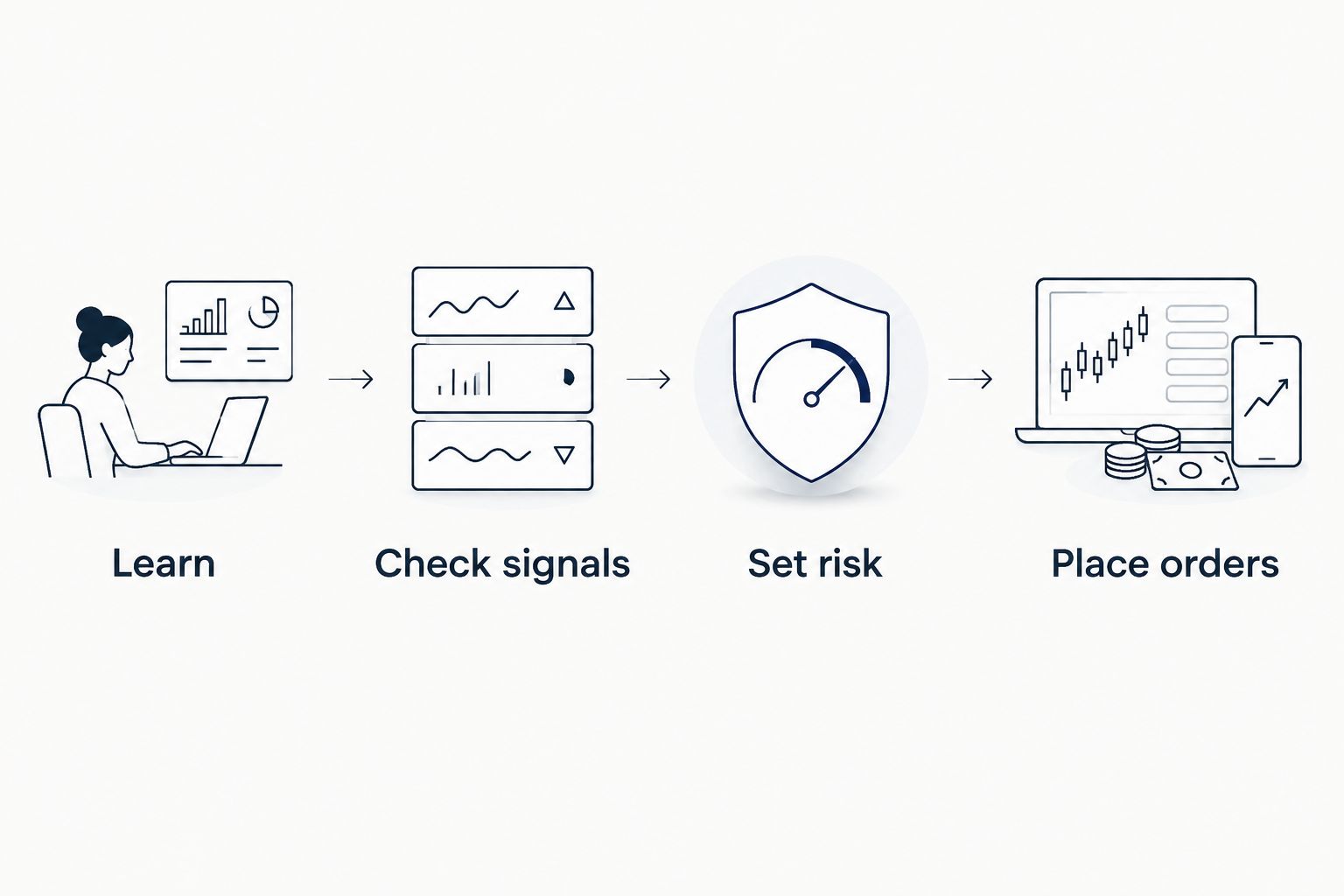
- Learn: Use an assistant to clarify a term or restate a rule. Verify anything that affects order behavior.
- Check signals: Identify the proposed trade, its timing, and the information needed to evaluate it. Do not assume an alert remains relevant after the market moves.
- Set risk: Decide the loss you are prepared to accept before selecting the position size.
- Place orders: Check the actual order ticket, instrument, direction, size, and exit instructions in the trading app.
For an arithmetic example—not a recommendation—a $1,000 account with a $10 planned loss has 1% of its balance at planned risk. Actual loss can differ because execution, gaps, and trading costs affect outcomes. A stop-loss instruction is not an unconditional guarantee of the final loss.
Tradeforex forex signals fit the trade-idea part of this workflow. Receiving a signal inside the Tradeforex web app does not establish that the idea suits your account or that an order has been placed with a broker.
Review the signals service
Tradeforex subscribers receive forex signals inside the web app. Assess the service before subscribing.
How the ranking works
The ranking follows task fit, checkable output, order control, data context, risk visibility, and practice workflow. ChatGPT takes the learning slot; Claude takes written journal review; TradingView supplies chart context; MetaTrader 5 supports programmed execution.
These are workflow recommendations, not results from a trading-performance test. There is no profitability leaderboard here, and the list does not claim that one assistant forecasts exchange rates better than another.
For any tool you assess in 2026, ask it to distinguish observed facts, assumptions, and conclusions. If you cannot check the important claim independently, leave that claim out of your trading decision.
Which forex trading AI tool should you choose?
Choose ChatGPT for learning if you are undecided. Understanding order types and risk comes before automation. Choose Claude instead when your immediate problem is reviewing written decisions you already record.
Use TradingView when an idea depends on chart context. Consider MetaTrader 5 automation only after you can describe, inspect, and test the rules. None of these choices removes the need to assess a signals subscription separately.
For Tradeforex forex signals, assess the service as a source of trade ideas delivered through its web app—not as a broker, a guaranteed outcome, or an established AI forecasting system. Subscribe only after the service information answers the questions that matter to your decision.
FAQ
What's the best forex trading AI tool for a beginner?
ChatGPT is the default recommendation here for learning forex terminology and asking follow-up questions. Verify explanations that affect orders or risk, and do not treat generated trade suggestions as established market evidence.
Is Claude better than ChatGPT for forex trading?
Choose by task rather than assuming one predicts currencies better. This guide assigns ChatGPT to learning and Claude to reviewing supplied journal entries; neither recommendation establishes a forecasting advantage.
Is TradingView an AI forex trading bot?
TradingView is a charting and market-analysis platform, not automatically an AI trading bot. A chart, indicator, or script does not by itself establish autonomous trading or profitable predictions.
Does MetaTrader 5 use AI to trade automatically?
MetaTrader 5 supports automated trading through Expert Advisors, but automation is not necessarily AI. The program's actual instructions determine its behavior, and those instructions require inspection and testing.
Does Tradeforex execute trades for subscribers?
Tradeforex provides forex signals inside its web app; it is not a broker trading app. Treat the signals as trade ideas to evaluate separately from the process of placing orders with a broker.
Can forex trading AI guarantee profitable signals?
No forex trading AI tool can guarantee profitable signals. Currency prices, trading costs, and execution conditions can produce losses even when a trade idea appears persuasive.
What should I check before following an AI-generated forex idea?
Check the currency pair, timestamp, source information, entry logic, exit conditions, and intended risk. Confirm the order details in your trading app rather than copying an assistant's response without review.
One last thing
Test whether the tool can explain why you should skip a trade. An answer that only supplies reasons to enter leaves out half the decision. If the conditions for rejecting an idea are unclear, stop before the order ticket—not after the position is open.