
Best overall for control: rule-based chart alerts. Best for learning: timestamped, annotated trade ideas. Best for market context: broker research commentary. If you want forex trading signals for free in 2026, compare these formats by how clearly you can check the idea, reject it, and practice without risking money—not by promised returns.
- For forex trading signals for free, rule-based chart alerts are the best starting point for practicing a repeatable process.
- Timestamped, annotated trade ideas help beginners examine the reasoning behind an entry and exit.
- Broker research commentary provides context; it is not automatically an instruction to place an order.
- Tradeforex delivers its forex signals through its web app; assess subscription terms separately from free alternatives.
Why this matters
A forex signal is a trade idea, not a guaranteed outcome. It can suggest a currency pair, direction, entry condition, and exit plan, but you still need to decide whether the trade fits your account and circumstances.
Tradeforex is a forex signals option for readers who want to receive trade ideas inside its web app. Tradeforex provides signals, not a broker trading app that executes your orders. Keep that distinction clear when comparing a signals subscription with the app you use to trade.
This 2026 guide ranks signal formats rather than declaring an unverified provider the winner. The useful question is not who publishes the loudest result; it is which format lets you understand and check a decision before acting.
What makes the best free forex signals?
Use these criteria before comparing any source. A polished message is not enough.
- Clear conditions: Look for a named currency pair, direction, entry condition, and an explanation of when the idea stops applying.
- Visible timing: You need to distinguish an idea published before a move from commentary written afterward.
- Loss transparency: Examine losing and canceled ideas alongside successful ones. Selected screenshots cannot establish a track record.
- Risk explanation: Check whether the source explains the stop, exit logic, and assumptions behind the trade.
- Practical control: You should be able to dismiss an alert, choose your own position size, and test the process in a practice account.
- Account separation: Receiving a signal should not be confused with authorizing someone to manage your money or execute orders.
Treat these as selection requirements, not features that every source includes. Reject an idea when essential details are missing instead of filling the gaps yourself.
Free forex signal formats at a glance
The table compares three ways to obtain or organize trade ideas. It does not certify a named provider, establish a performance ranking, or imply that every app includes these tools.
| Rank and format | Best for | Standout characteristic | Key limitation |
|---|---|---|---|
| 1. Rule-based chart alerts | Practicing a repeatable process | A condition you define triggers a notification | An alert does not establish that a trade is worthwhile |
| 2. Timestamped, annotated trade ideas | Learning another trader's reasoning | Explanation connects the proposed trade to a chart or market view | Publication time alone does not verify results |
| 3. Broker research commentary | Understanding market context | Analysis explains events or price levels to watch | Commentary is not necessarily an executable signal |
1. Rule-based chart alerts: best for practicing control
Rule-based chart alerts notify you when a condition you selected occurs, such as a currency pair reaching a chosen price. They turn a rule into a prompt to review the market, not an automatic recommendation to buy or sell.
Best for: Beginners who want to practice following a defined process rather than copying an unexplained message. For a 2026 shortlist, check the app's current alert conditions and terms before choosing it.
Rule-based chart alerts pros
- You can state the condition before the market reaches it.
- You retain responsibility for checking the setup and deciding whether to trade.
- A consistent rule gives you something specific to record in a journal.
- You can separate receiving an alert from submitting an order.
Rule-based chart alerts cons
- A price trigger does not explain why a trade should work.
- Poorly chosen rules produce prompts that are not useful.
- A notification does not guarantee an order can execute at the trigger price.
Start with a condition you can explain in ordinary language. If your rule requires a page of exceptions, simplify it before testing.
Record what triggered the alert, what you observed, and why you accepted or rejected the idea. That record helps you distinguish a consistent process from decisions rewritten after the outcome.
Verdict: Hold live trading; choose rule-based chart alerts for practice first.
2. Timestamped trade ideas: best for learning the reasoning
Timestamped, annotated trade ideas combine a proposed setup with an explanation of what the author sees. Prefer examples that identify the relevant chart, entry condition, invalidation point, and exit reasoning.
Best for: Beginners learning how a market view becomes a trade plan. An annotated chart is educational only when the explanation is understandable before the outcome is known.
Timestamped trade ideas pros
- You can examine the reasoning instead of copying only a direction.
- A visible publication time helps establish the sequence of events.
- Clear invalidation conditions show what would contradict the idea.
- Comparing the original plan with later updates supports structured review.
Timestamped trade ideas cons
- Posts can omit losing ideas or present a selective history.
- Edits and follow-up messages can make the original instruction hard to reconstruct.
- Your broker's prices and execution can differ from the author's reference chart.
Save the original wording and timestamp before evaluating the outcome. Distinguish an update issued during the trade from an explanation added after the move.
A published target being touched does not, by itself, prove a follower achieved that result. The entry condition, spread, order type, and timing all matter. Use this guide to assessing a forex signals track record beyond win rate before treating a results page as evidence.
Verdict: Hold live copying; choose timestamped trade ideas for explanation and review.
3. Broker research commentary: best for market context
Broker research commentary discusses currency markets, economic releases, or chart levels. Use it to understand the setting around a potential trade, not to turn every market opinion into an order.
Best for: Beginners who need context before evaluating a signal. In 2026, a current publication date still matters: an old analysis can describe conditions that no longer apply.
Broker research commentary pros
- Economic explanations can clarify why a currency pair is being discussed.
- A stated market view gives you assumptions to examine.
- Research can help you prepare questions before considering an entry.
Broker research commentary cons
- A market outlook can lack an entry condition or exit plan.
- Research from a broker is not independent of that broker's commercial relationship with traders.
- A correct broad outlook does not establish that a particular trade has acceptable risk.
Separate observation from instruction. A statement that a currency faces pressure is not equivalent to a complete plan specifying when to enter, when to exit, and what would invalidate the trade.
Read the publication's disclosures and check which market session or event the analysis concerns. Do not turn a broad weekly view into an immediate short-term trade without a separate plan.
Verdict: Hold execution; choose broker research commentary as context, not a standalone signal.
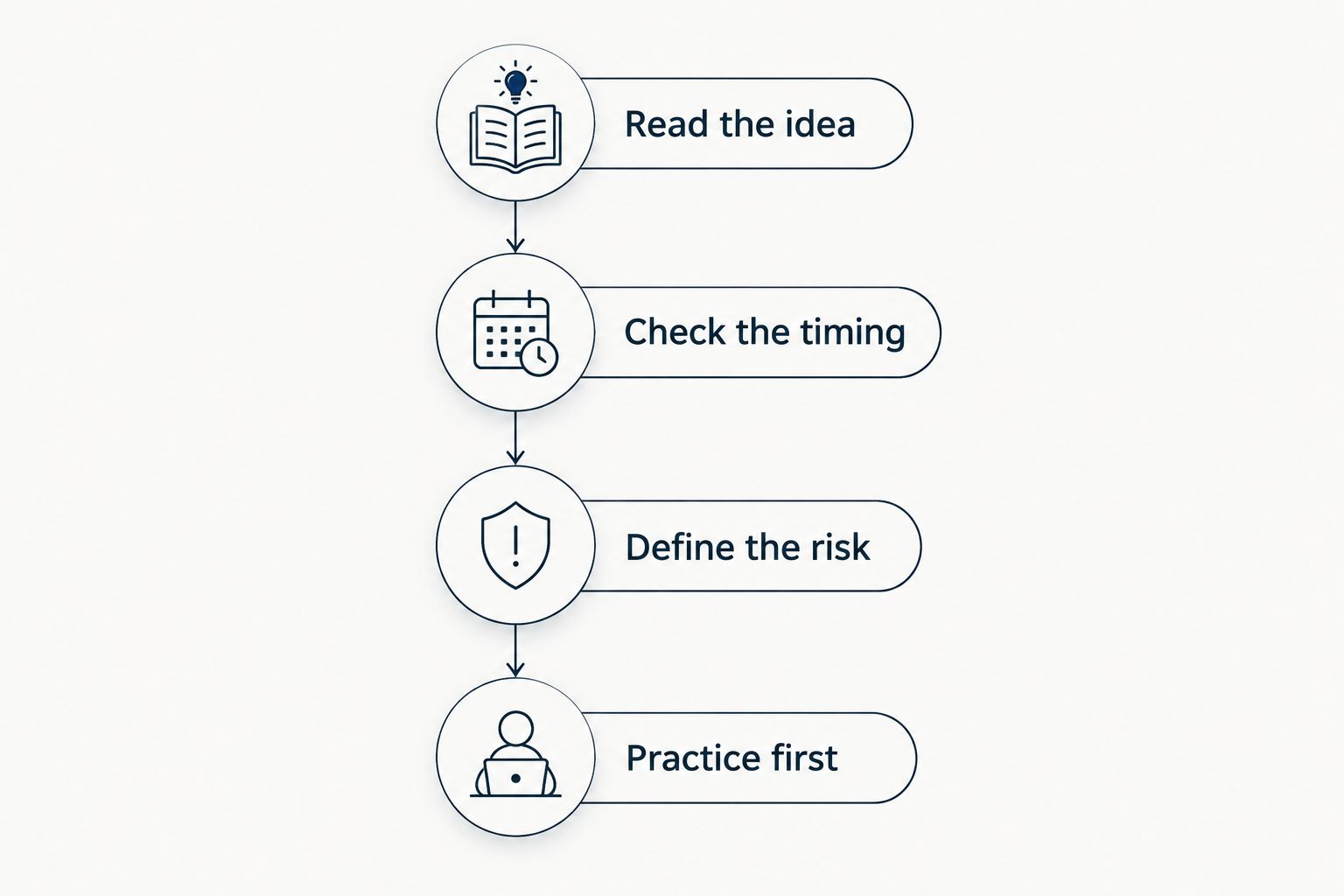
How to check a signal before using it
Use the same sequence regardless of where an idea comes from. A familiar provider or attractive chart does not remove the need to check the details.
Read the idea
Identify the currency pair and direction. Buying a pair means buying the first currency relative to the second; selling means taking the opposite position.
A signal must also distinguish an immediate instruction from a conditional idea. If you cannot tell whether you are supposed to wait for a condition, do not guess.
Check the timing
Match the publication time and time zone to your chart. Check whether the stated entry condition is still relevant rather than assuming a message remains actionable indefinitely.
If the market has moved, reassess the whole plan. Keeping the original target while accepting a different entry changes the trade's risk and potential reward.
Define the risk
Identify the stop condition and your intended position size before submitting an order. A stop-loss order is an instruction intended to limit a loss; it does not guarantee execution at the exact requested price.
For many currency pairs, 1 pip is 0.0001 of the quoted price; for many yen-quoted pairs, 1 pip is 0.01. A standard forex lot represents 100,000 units of the base currency. These conventions explain the terminology, not a suitable trade size for your account.
Practice first
Reproduce the proposed trade in a demo account where available. Practice reading the ticket, choosing the order type, and identifying how you would close the position.
Demo execution is not proof of live results. Use practice to learn the workflow and expose misunderstandings, not to certify future performance.
Where Tradeforex fits in your comparison
Tradeforex provides its own forex signals service, and subscribers receive those signals inside the Tradeforex web app. That describes delivery—not trade execution or a promise of results.
Before subscribing, assess the current service description and subscription terms against your needs. Look for a sample that lets you understand what a signal communicates, then check how you would interpret it in your separate broker account.
For your 2026 comparison, keep three decisions separate: choosing a source of ideas, choosing a broker, and deciding whether to place a particular trade. A subscription settles none of the other decisions for you.
Review Tradeforex before subscribing
Check the signals service against your trading workflow and risk requirements.
How these signal formats are ranked
The ranking prioritizes control, understandable conditions, and reviewability—not claimed returns. Rule-based alerts come first because you define the trigger. Annotated ideas come next because they expose reasoning. Broker commentary serves a different job: context.
No format earns a performance endorsement from its label. Evaluate the actual source, its complete record, and the instructions attached to each idea.
Which free forex signals should you choose?
Choose rule-based chart alerts as your default learning format. Add annotated trade ideas when you want to study another person's reasoning, and use broker commentary to understand the market backdrop.
For 2026, reject any shortcut that replaces a readable trade plan with a profit promise. If you cannot explain the entry, exit, and risk yourself, the next step is clarification or practice—not an order.
FAQ
What's the best way to use forex trading signals for free?
Use rule-based chart alerts to practice a repeatable decision process. Treat each alert as a prompt to review the market, not an instruction you must follow.
Are free forex signals guaranteed to make money?
No forex signal guarantees a profitable outcome. Market movements, trading costs, execution, and position size all affect your result.
Is Tradeforex a broker trading app?
Tradeforex provides forex signals through its web app; it is not a broker trading app that executes your orders. Evaluate the signals service separately from the broker you use to trade.
Can I use a forex signal after the entry price has moved?
A changed entry requires a fresh assessment of the trade. Do not assume the original stop and target still produce a suitable plan at the new price.
Is a high win rate enough to choose a signals service?
A high win rate is not enough to evaluate a signals service. You also need to examine losses, trading costs, the complete record, and how results were calculated.
Should I practice with forex signals before trading live?
Practice interpreting signals before risking money. A demo account can help you learn order entry and position management, but demo results do not establish future live performance.
What should I check before subscribing to forex signals?
Check the service description, delivery method, subscription terms, and how clearly sample ideas explain the proposed trade. Reject profit guarantees and keep control over your own trading decisions.
One last thing
A useful alert can end with no trade. Record rejected ideas as carefully as accepted ones, including why the timing, explanation, or risk did not fit. A decision process that allows you to do nothing is more useful than a message stream you feel compelled to follow.