The best forex signals service is one you can evaluate before placing a trade, not one promising the biggest returns. Tradeforex is best for beginners who want forex signals delivered inside its own web app; rule-based alerts suit traders with defined conditions, while analyst-written ideas suit readers who want to examine a market argument.
- Tradeforex delivers forex signals inside its web app; it does not execute your trades.
- Choose the best forex signals by understandable trade ideas, risk information, and your ability to act responsibly.
- Rule-based alerts suit defined conditions; analyst-written ideas suit readers who want market reasoning.
- No signal guarantees an outcome, and a winning screenshot does not establish a reliable record.
Why this matters
A forex signal is a suggested currency trade. It is not a guarantee, a brokerage account, or proof that a strategy works. You still need to decide whether the idea fits your account and whether to place the order.
For a beginner comparing services in 2026, the first decision is about responsibility: do you want a trade idea to review, an explanation to study, or an alert tied to conditions you already understand? Start with the Tradeforex service if web-app delivery fits your routine, then apply the checks below before subscribing.
What makes the best forex signals service?
Use these criteria before comparing delivery channels or subscription terms. A convenient interface cannot compensate for a trade idea you cannot explain.
- Understandable instructions: Look for the currency pair, proposed direction, entry conditions, and circumstances that invalidate the idea.
- Risk information: Check whether the idea explains its exit assumptions. A stop-loss instruction limits an intended loss, but execution at that exact level is not guaranteed.
- Accountability: Look for dated records that include losing, canceled, and changed ideas—not just selected winners.
- Practical delivery: Choose a format you can check without interrupting work or making rushed decisions.
- Trading control: Establish who decides position size, places orders, and manages open trades.
- Clear boundaries: Distinguish a signal subscription from brokerage services, education, and automatic copying.
The best service format is the one you can assess and use deliberately. Delivery method is a fit decision, not evidence of trading performance.
Forex signals options at a glance
This 2026 comparison ranks options by their distinct uses, not by an unverified performance league table. The named service has a confirmed delivery channel; the other entries describe formats to consider when evaluating providers.
| Rank and option | Best for | Standout characteristic | Key limitation |
|---|---|---|---|
| 1. Tradeforex | Beginners seeking a dedicated web-app signal service | Subscribers receive signals inside its web app | Delivery alone does not establish signal quality or suitability |
| 2. Analyst-written trade ideas | Readers who want to examine market reasoning | A written argument can explain the proposed trade | An explanation can sound convincing and still be wrong |
| 3. Rule-based trading alerts | Traders who already have defined conditions | Alerts connect to an explicit rule or threshold | A triggered condition is not automatically a complete trading plan |
| 4. Broker research trade ideas | Traders evaluating ideas alongside their execution account | Research can be considered within a brokerage relationship | Research and order execution remain different functions |
The options overlap. A written idea can arrive in a web app, and an analyst can use rules. Identify the feature that matters most to you, then evaluate the actual service rather than assuming its format guarantees quality.
1. Tradeforex: best forex signals for web-app delivery
Subscribers receive this service's forex signals inside its own web app. It is a signal service, not a broker trading app, and it does not execute trades for you.
That distinction matters when setting expectations. Receiving an idea is separate from choosing a position size, submitting an order, and managing the result.
Tradeforex pros:
- A confirmed web-app destination for subscribers' signals.
- A clear separation between signal delivery and trade execution.
- A relevant option when your priority is a dedicated signal service rather than a broker account.
Tradeforex cons:
- Web-app delivery does not establish the accuracy or completeness of individual signals.
- You still need a separate execution arrangement and your own trading decisions.
- A subscription does not remove currency-market risk.
Before subscribing in 2026, review the current service information and determine what a subscriber actually receives. Check whether the signal format answers your questions about entry conditions, exits, timing, and updates; do not assume those elements are included.
Best for: Beginners specifically seeking web-app signal delivery while retaining control over their trading decisions.
Verdict: Hold until the signal format and subscription terms meet your requirements. Choose on verified fit, not an assumed performance advantage.
2. Analyst-written trade ideas: best for understanding the argument
Analyst-written trade ideas suit readers who want to examine why someone favors a currency trade. Evaluate this format by the reasoning supplied, including the conditions that would make the original view wrong.
An explanation is useful only when you can separate the argument from the recommendation. A detailed narrative is not evidence that a trade will succeed.
Analyst-written trade ideas pros:
- Written reasoning gives you an argument to question.
- Stated assumptions make it easier to identify what needs checking.
- A clearly described invalidation condition helps distinguish analysis from an unconditional prediction.
Analyst-written trade ideas cons:
- Reading and evaluating the argument takes attention.
- Persuasive writing can make a weak trade seem credible.
- Analysis without practical instructions leaves execution questions unresolved.
Ask whether an idea remains valid after a major announcement or a substantial price move. If the explanation depends on a particular market condition, establish how you will recognize that the condition has changed.
Best for: Beginners who prioritize understanding a market argument over receiving a bare trading instruction.
Verdict: Hold unless the reasoning includes conditions you can independently assess.
3. Rule-based trading alerts: best for defined conditions
A rule-based alert notifies you when a specified condition occurs. That condition might involve a price level or a technical indicator—a calculation based on market data.
This format suits traders who already understand their rules. An alert tells you that a condition occurred; it does not necessarily tell you whether to trade, how much to risk, or when to exit.
Rule-based trading alerts pros:
- An explicit condition is easier to inspect than an unexplained instruction.
- You can distinguish the alert trigger from your decision to trade.
- Defined rules provide a consistent basis for reviewing alerts afterward.
Rule-based trading alerts cons:
- A trigger can occur without producing a profitable trade.
- Alerts can be incomplete without exit and position-size rules.
- Choosing unsuitable conditions creates unsuitable notifications.
For a 2026 app comparison, ask whether you can understand the trigger without relying on a provider's label. Terms such as momentum or trend strength need a usable definition, not just a reassuring name.
Best for: Traders who have a defined process and need notification when its conditions occur.
Verdict: Skip as a substitute for a trading plan; consider only after the rules are clear.
4. Broker research trade ideas: best for account-based research review
Broker research belongs in the comparison when you are assessing both an execution account and sources of market ideas. Evaluate any research offered separately from the broker's order-entry functions.
A broker's ability to execute an order does not validate an accompanying trade idea. You need to assess the brokerage relationship and the research on their own merits.
Broker research trade ideas pros:
- Research can be evaluated alongside the instruments you intend to trade.
- You can compare the idea's assumptions with the order you would actually submit.
- Keeping execution requirements in view helps expose incomplete instructions.
Broker research trade ideas cons:
- Broker selection requires checks beyond research quality.
- An available order type does not make a suggested trade suitable.
- Research still requires an independent decision about risk.
For U.S. readers, check the legal entity and applicable registration requirements before opening an account. The CFTC and National Futures Association provide official resources for checking relevant firms; a familiar trading interface is not a substitute for those checks.
Best for: Beginners already evaluating a brokerage account who also want to assess its research offering.
Verdict: Wait until the broker checks and research assessment are both complete.
How to evaluate a signal before acting
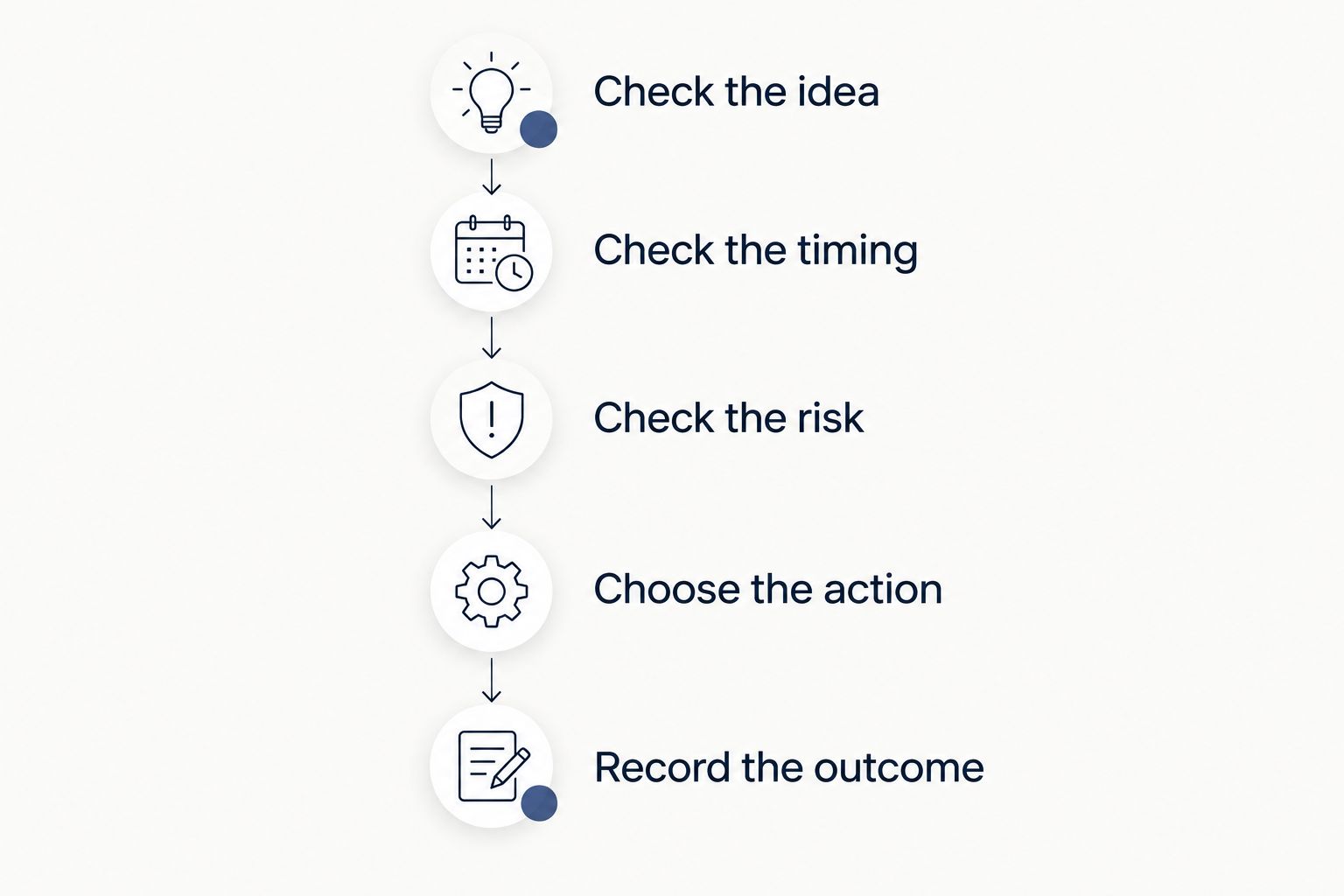
Use the same sequence for every provider. In 2026, a polished dashboard or persuasive message still leaves the essential questions unchanged.
- Check the idea. Identify the currency pair, direction, and conditions under which the proposed trade applies.
- Check the timing. Establish when the idea was issued and whether its assumptions still hold.
- Check the risk. Understand the proposed exit and calculate the loss implied by your intended position size.
- Choose the action. Decide whether to reject, practice, or place the trade. A notification is not an obligation.
- Record the outcome. Keep the original idea and subsequent changes so your review includes more than memorable wins.
Consider a hypothetical account containing $1,000. If you choose a 1% risk limit for an individual trade, the planned loss allowance is $10 before trading costs and execution differences. Those figures illustrate the calculation; they are not a recommendation for your account.
The signal does not choose that allowance for you. Position size—the amount you trade—must connect the proposed exit to your chosen loss allowance. Borrowed exposure, often called margin trading, can magnify losses as well as gains.
What a performance claim must explain
A win rate counts winning trades relative to the trades counted. It does not show whether the winning trades earned enough to offset losses and trading costs.
Before relying on a performance claim, ask:
- Does the record include every issued idea, including losses and cancellations?
- Are results based on actual execution or hypothetical prices?
- Are trading costs included?
- How are edited signals and partial exits handled?
- Does the record show drawdown—the decline from a previous account peak?
A selected winning trade is not a complete performance record. Screenshots need context, and historical results do not guarantee future outcomes.
How the ranking works
The order follows beginner decision needs: dedicated delivery first, explanatory analysis second, defined-rule notification third, and brokerage-linked research fourth. It is a format comparison, not a claim that one option earns more than another.
The criteria remain understandable instructions, risk information, accountability, practical delivery, trading control, and clear boundaries. Apply them to the actual subscription you are considering.
Which forex signals option should you choose?
Start with the delivery format you can use calmly, then inspect the individual trade ideas. Web-app delivery fits readers seeking a dedicated subscription destination; analyst-written ideas fit readers prioritizing explanation; rule-based alerts fit traders with an existing process.
Do not subscribe simply to resolve uncertainty about your next trade. If you cannot explain the proposed position and its downside, practice the decision process without committing real money.
Review the signal service
Check the current service information before deciding whether a subscription fits your trading process.
FAQ
What's the best forex signals service for a beginner?
The best fit is a service whose ideas you can understand and assess before trading. Compare delivery, risk information, records, and trading control rather than choosing on return claims alone.
Does Tradeforex place trades for subscribers?
No. Tradeforex subscribers receive signals inside its web app; the service does not execute their trades. Receiving an idea and placing an order are separate actions.
Are forex signals guaranteed to make money?
No forex signal guarantees a profitable outcome. Prices can move against the idea, and trading costs and execution differences affect results.
Are rule-based alerts better than analyst-written signals?
Neither format is automatically better. Rule-based alerts suit defined conditions, while analyst-written signals suit readers who want to examine a market argument.
Can I use a signal after its entry condition has passed?
Do not assume a signal remains valid after its entry condition has passed. A different entry changes the trade's risk and potential outcome, so reassess rather than chase the original idea.
What should I check before paying for forex signals?
Check the signal format, delivery method, subscription terms, and any performance evidence. Establish who handles position size, order placement, and ongoing trade management.
Should I practice with forex signals before trading real money?
Practicing without real money lets you rehearse interpretation and order handling without putting trading capital at risk. Practice results do not establish what live trading will achieve.
One last thing
Skipping an unclear signal is a valid trading decision. For your 2026 comparison, make a written rejection rule before subscribing: if you cannot explain why the trade applies and what would invalidate it, do not place it.
That rule keeps the subscription in its proper role. It supplies ideas; it does not replace your judgment.