Best overall for beginners: a lower-frequency service you can assess before acting. Best for scheduled market checks: a session-focused service. Best for active monitoring: a higher-frequency service. This 2026 guide ranks signal-frequency profiles by beginner suitability; message volume alone does not establish which provider is best.
- The best forex signal providers by frequency fit your schedule; more alerts do not establish better results.
- Tradeforex delivers forex signals inside its web app; it is not a broker trading app.
- Compare new trade ideas separately from updates, cancellations, and repeated notifications.
- Choose a signal cadence you can evaluate without rushing entry, exit, or position-size decisions.
Why this matters
A forex signal is a trade idea, not an instruction you must follow. Its usefulness depends on whether you understand the idea, can assess the risk, and can still act under the stated conditions when you read it.
Tradeforex provides its own forex signals service, with signals delivered inside its web app. Tradeforex is best for readers seeking forex signals in a web app rather than a broker trading app. It does not execute your trades.
For your 2026 shortlist, separate two decisions: where you receive trade ideas and where you place orders. An appealing signals interface does not establish that a broker account, order type, or trade suits you.
What makes the best forex signal providers by frequency?
Use these criteria before comparing daily message totals:
- Distinct trade ideas: Count new setups separately from reminders, commentary, and changes to existing ideas.
- Timing fit: Check whether signals arrive when you can actually read and evaluate them.
- Decision clarity: Look for understandable entry conditions, exit conditions, and a way to assess the trade's risk.
- Complete history: Review losing, canceled, and expired ideas alongside successful ones.
- Exposure control: Check whether several signals would leave you exposed to the same currency or market move.
- Delivery workflow: Confirm how you access signals and how you identify subsequent changes.
These are evaluation criteria, not claims that every provider supplies each feature. Ask to see how a service handles them before subscribing.
Rank the workflow before the message count. A slower feed is not automatically careful, and a busy feed is not automatically useful.
Signal-frequency profiles at a glance
The ranking below reflects how much monitoring each profile asks of a beginner. It is not a measured ranking of named providers, and the frequency labels describe workflows rather than fixed daily quotas.
| Rank and profile | Best for | Standout characteristic | Key limitation |
|---|---|---|---|
| 1. Lower-frequency service | Beginners learning to assess individual ideas | Fewer new setups to review during the same observation period | Fewer alerts do not prove stronger selection |
| 2. Session-focused service | Readers with a defined market-checking window | Signals concentrated around an identified trading session | A convenient delivery window does not settle trade duration |
| 3. Higher-frequency service | Readers able to monitor and filter a busy feed | More distinct setups to assess during the same observation period | More opportunities to act also mean more decisions to manage |
A provider can combine these profiles. A session-focused service, for example, can publish either a quiet or busy feed. Compare frequency and timing as separate dimensions rather than forcing every service into one permanent category.
1. Lower-frequency service: best for learning signal evaluation
A lower-frequency service publishes fewer distinct trade ideas than the alternatives you compare over the same period. Its main beginner advantage is a smaller review workload, not an established performance advantage.
Choose this profile when you need space to understand currency pairs, order types, and position sizing. A currency pair expresses one currency's value against another; position sizing determines how much exposure you take on a trade.
Lower-frequency service pros:
- Fewer new ideas compete for your attention.
- Each setup gives you a manageable subject for a trading journal.
- A quieter feed makes it easier to distinguish a new idea from an update.
Lower-frequency service cons:
- A quiet feed still requires you to check whether an idea remains valid.
- Less activity does not establish better selection or lower risk.
- Sparse signals give you fewer examples to assess during a short observation period.
Best for: Beginners who want to understand each idea before deciding whether to trade.
For a 2026 comparison, inspect the actual sequence of messages rather than accepting a description such as selective. Look at whether the provider explains canceled ideas and whether changes remain understandable after the original message.
Verdict: Hold until the signal history supports a clear, manageable review process.
2. Session-focused service: best for scheduled market checks
A session-focused service organizes activity around an identified market session or trading window. This profile suits readers who can review markets at a predictable time rather than monitor messages throughout their day.
Confirm the time zone and daylight-saving convention. Also separate the signal's arrival time from the expected holding period: receiving an idea during your lunch break does not mean the trade ends before you return to work.
Session-focused service pros:
- A defined window helps you plan when to assess new ideas.
- Timing is easier to compare with your own routine.
- You can evaluate whether the delivery window consistently matches the service's description.
Session-focused service cons:
- Your schedule must match the relevant window.
- Updates or exits can require attention outside the initial delivery period.
- A concentrated burst of alerts can still create a heavy workload.
Best for: Readers with a repeatable market-checking window and a plan for managing open positions afterward.
Before choosing this profile, ask what happens when an idea arrives near the end of the stated session. Check whether it expires, remains active, or needs further instructions. Do not infer the answer from the provider's session label.
Verdict: Hold unless both signal delivery and ongoing trade management fit your schedule.
3. Higher-frequency service: best for active monitoring
A higher-frequency service publishes more distinct setups than the alternatives observed over the same period. This creates a larger review workload, whether you trade every idea, select a few, or reject them all.
The central question is not whether you can receive the messages. It is whether you can evaluate each idea without rushing, duplicating exposure, or treating activity as a reason to trade.
Higher-frequency service pros:
- A larger set of ideas gives you more material to classify and review.
- You can compare how the service handles different setups.
- A detailed record makes repeated or overlapping ideas easier to identify.
Higher-frequency service cons:
- A busy feed demands more attention and recordkeeping.
- Multiple positions can concentrate exposure to the same currency.
- Frequent decisions create more occasions to ignore your own rules.
Best for: Readers who already have a consistent screening process and time to maintain it.
In 2026, do not treat rapid delivery as proof of execution quality. The signal's displayed entry and the price your broker offers are separate observations. Spreads, market movement, and order instructions affect what happens when you attempt a trade.
Verdict: Skip if keeping up requires rushed decisions or trading every alert.
Where Tradeforex fits in your shortlist
Tradeforex provides a forex signals service through its web app. Evaluate it as a source of trade ideas, separately from the broker and trading app you use to submit orders.
Tradeforex pros for this use case:
- Signals are delivered inside the service's web app.
- The signals service has a distinct role from your broker's order-entry workflow.
- You can judge whether that delivery format fits how you review ideas.
Tradeforex limitations for this use case:
- It is not a broker trading app and does not execute trades.
- Receiving a signal does not remove the need to assess its conditions and risk.
- A subscription does not make any trade outcome certain.
Best for: Beginners seeking web-app delivery who will evaluate signal cadence and trade risk before acting.
Before subscribing, check the current service information and decide whether its actual delivery pattern fits your routine. Apply the same recordkeeping standard to this service as to every other provider on your shortlist.
How to compare frequency without counting noise
Use a 4-week observation window as a practical review exercise, not proof of future results. Keep the same calendar window for each provider so you do not compare a quiet period with a different service's busy period.
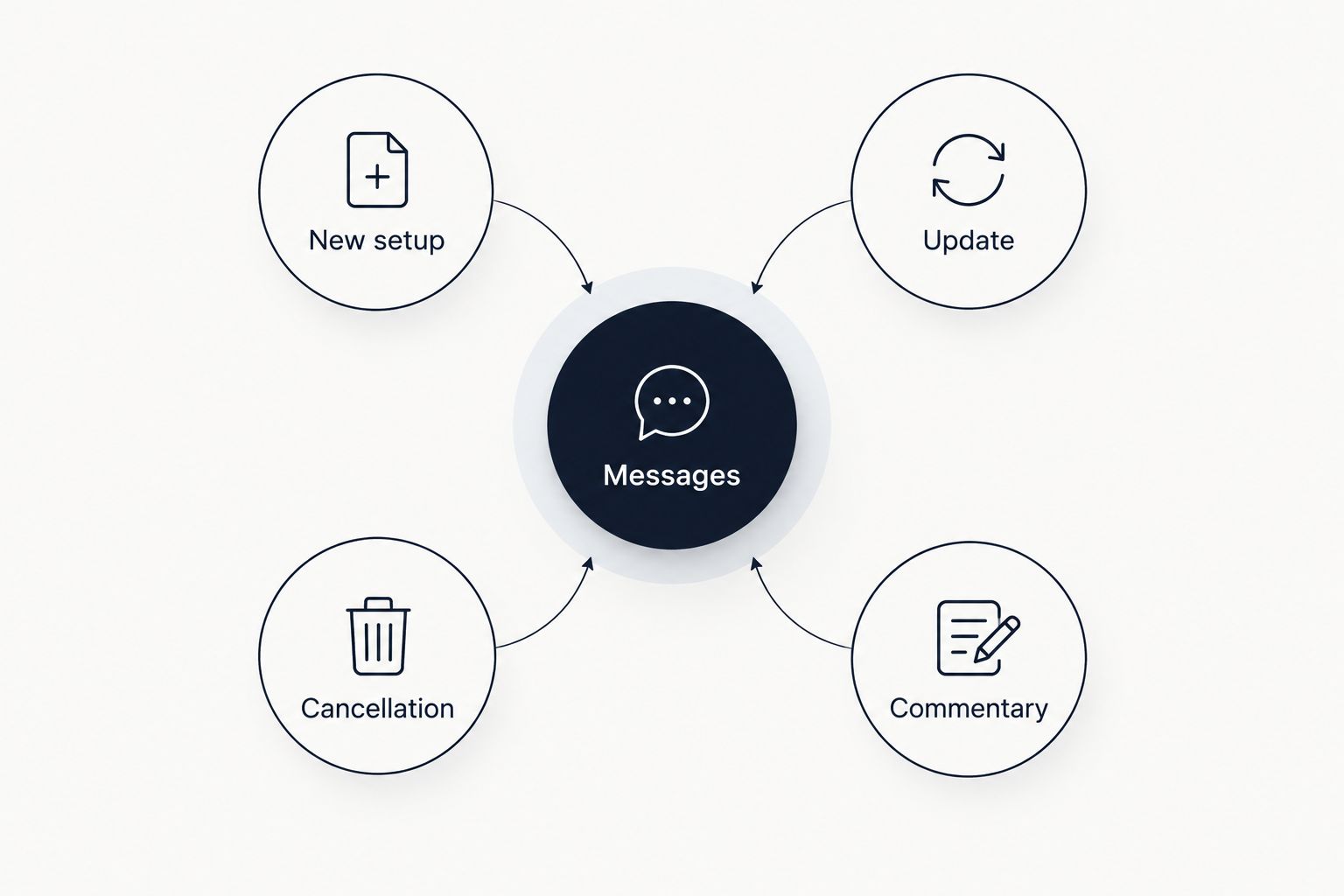
Classify messages before counting them:
- New setup: A distinct proposed trade idea.
- Update: A change or instruction concerning an existing idea.
- Cancellation: Notice that an earlier idea should no longer be treated as active.
- Commentary: Market discussion without a distinct proposed trade.
A service that sends an entry idea followed by several updates has not necessarily produced several new trading opportunities. Keep both counts: unique setups and total messages. The first describes idea frequency; the second helps you estimate attention demands.
Record timestamps in one time zone and preserve the order of updates. Do not delete an idea from your notes because it expired or ended badly; those events belong in the service's history too.
Then assess the record beyond its headline success rate. This guide to assessing a forex signals track record beyond win rate explains why a single percentage is not enough.
Test the workload before making it your routine
Review 10 consecutive signals in a demo workflow without selecting only the convenient examples. This is a process check, not a performance test or a statistically reliable sample.
For each idea, note when you saw it, whether its conditions were still relevant, and what information you needed before placing an order. Record skipped trades too. A missed signal tells you something about schedule fit even when it says nothing about strategy quality.
Use 2 separate logs: one for the provider's published ideas and another for your own decisions. This prevents you from confusing the signal's stated plan with the entry, exit, or size you actually chose.
Before any live order, understand the proposed loss exposure. A stop-loss is an instruction intended to close a position under specified conditions; it does not guarantee the exact exit price during fast movement or a price gap.
How the frequency profiles are ranked
The 2026 ranking prioritizes a beginner's ability to review distinct ideas, understand timing, and control the decision workload. Lower-frequency comes first because it presents fewer setups to assess, not because fewer signals establish better returns.
Session-focused comes next for schedule fit. Higher-frequency comes last because a busy feed requires a developed filtering process. Provider quality still depends on the actual record, clarity, and suitability of the ideas—not the position of a frequency profile in this list.
Which signal frequency should you choose?
Start with a lower-frequency profile if you are still learning to assess signals. Choose a session-focused workflow when its timing and ongoing management demands match your routine. Reject a busy feed if reviewing it properly exceeds your available attention.
For your 2026 shortlist, make the decision in this order: understandable ideas, manageable risk, workable timing, then message volume. Do not subscribe merely to fill quiet hours with trading activity.
FAQ
What's the best forex signal frequency for a beginner?
A lower-frequency feed is the starting choice when you need time to assess each trade idea. Fewer signals reduce the review workload, but they do not establish better results or lower trading risk.
Which forex signal provider sends the most signals?
A comparable, dated message history is needed to identify the highest-frequency provider. Count distinct setups over the same period and separate them from updates, cancellations, and commentary.
Are more forex signals better than fewer signals?
More forex signals are not inherently better. A larger feed creates more decisions, and several ideas can expose you to the same currency movement.
Does Tradeforex place trades for subscribers?
No. Tradeforex delivers its forex signals inside its web app; it is not a broker trading app and does not execute trades. You remain responsible for deciding whether and how to act.
Can I follow signals if I only check markets at set times?
Choose a delivery pattern and trade-management process that fit your checking schedule. A signal arriving at a convenient time does not establish that its later updates or exit will also fit that window.
How should I count a signal that gets several updates?
Count the original distinct setup as one trade idea and record its updates separately. Keep a total message count too, because updates still require attention.
Do forex signals guarantee a profitable trade?
No forex signal guarantees a profitable trade. Market movement, trading costs, execution, and your own decisions affect the outcome, and trading can lose money.
One last thing
A feed can become busier without producing more trade ideas. Updates and cancellations increase message volume, so counting notifications alone answers the wrong question.
Before subscribing, inspect one idea from publication through its final update. If you cannot reconstruct what happened, a larger signal count will not fix that problem.