Forex signals are worth paying for only when credible records show that results survive subscription fees, broker charges, and realistic execution—and the risk fits your situation. A profitable-looking signal history does not establish that subscribers earned the same return. In 2026, judge the service by what you can verify and reproduce, not by screenshots of winning trades.
- Are forex signals worth it? Only when results survive fees, trading costs, realistic execution, and acceptable risk.
- EUR/USD signals still face spreads and slippage; a correct market call does not guarantee a profitable trade.
- Tradeforex delivers forex signals through its web app; broker selection and trade execution remain separate decisions.
- Reject profit guarantees and incomplete performance histories. Evaluate losses and drawdowns alongside winning trades.
Are forex signals worth it after fees and trading costs?
Forex signals must clear two tests: positive results after costs and a level of risk you can tolerate. Passing one does not compensate for failing the other. A strategy that produces a positive balance but exposes you to losses you cannot afford is unsuitable.
Before evaluating a subscription, understand the difference between the signal interface and the broker interface. This guide to choosing a forex trading app before subscribing to signals addresses that separate decision.
Compare these approaches by what you actually need help with:
| Approach | Best for | Main benefit | Main limitation |
|---|---|---|---|
| Paid forex signals | Traders evaluating outside trade ideas | Provides trade ideas to assess rather than requiring you to originate every idea | Subscription costs add another hurdle, and outcomes depend on execution |
| Self-directed trading | Traders willing to develop and document their own decisions | Keeps responsibility for the trading method with you | Requires research, practice, and consistent decision-making |
| Demo testing | Beginners learning order entry and recordkeeping | Lets you practice without exposing real funds | Does not establish that live execution or emotional responses will match |
None of these approaches guarantees a profitable outcome. Signals change where a trade idea originates; they do not remove the uncertainty of currency markets.
Why this matters
A signal provider's published result and your account result measure different things unless their assumptions match. The provider might record a target as reached while your order enters later, incurs different charges, or exits at a different price. Those differences belong in the evaluation, not in a footnote.
For a 2026 subscription decision, ask whether the available evidence represents a result you could actually have achieved. A clean chart is not an account statement, and a collection of successful calls is not a complete trading history.
Your objective is not to find the service with the most exciting examples. It is to decide whether paying for outside ideas improves your decision process enough to justify the cost and risk.
Paid forex signals: judge the result after every charge
A subscription creates a cost that exists independently of whether you take a trade. Broker costs then apply according to your account terms and trading activity. These are separate obligations, so evaluate them separately before combining them.
Start with trading profit or loss after broker charges, then subtract the signal subscription and any other trading-related expenses. Do not subtract a charge twice if the account result already includes it. Check how your broker reports spreads, commissions, and financing before using its figures.
A fixed subscription also consumes a larger share of a smaller account. Increasing trade size to make the subscription feel worthwhile does not solve that problem; it increases exposure to losses. The right response to an unsuitable cost burden is to reconsider the subscription, not to force larger trades.
Self-directed trading: no signal fee, but no shortcut
Trading without a signal subscription removes that particular expense. It does not remove spreads, commissions, financing, or the possibility of losing money. Nor does it establish that your own decisions are better than outside ideas.
Self-directed trading is best for someone willing to define a method, record decisions, and examine mistakes without changing the rules after every loss. The benefit is control over the reasoning. The limitation is that you must supply and evaluate that reasoning yourself.
Compare approaches using the same accounting rules. A self-directed result that excludes broker costs is no more useful than a signal record that excludes them.
Demo testing: useful practice, limited proof
Demo testing is best for learning how to read an instruction, select a currency pair, enter an order, and record an exit. It helps separate an unfamiliar interface from an unfamiliar trading method. That distinction matters when a mistake could otherwise look like a bad signal.
The limitation is straightforward: simulated execution does not establish what a live account will achieve. Actual fills, available liquidity, and your response to real losses can differ.
Use demo records to identify operational problems before risking money. Do not treat a successful practice period as proof that a paid service will produce future profits.
Why the value of forex signals varies
The same trade idea can produce different subscriber outcomes because the surrounding conditions differ. Review these five factors rather than treating a provider's headline return as your expected result:
- Trading costs: The spread is the gap between buying and selling quotes. Commission is a separate broker charge where applicable, and financing can apply to positions held overnight.
- Execution timing: A delayed entry changes the price available to you. Slippage means an order executes at a different price from the one expected.
- Position size: Larger exposure increases the financial effect of a market move. A signal does not determine what loss your finances can absorb.
- Holding period: Keeping a position open can introduce financing charges and exposure to events occurring after the original signal.
- Evidence quality: Complete records let you examine losses, changed instructions, and open positions. Selected winners do not.
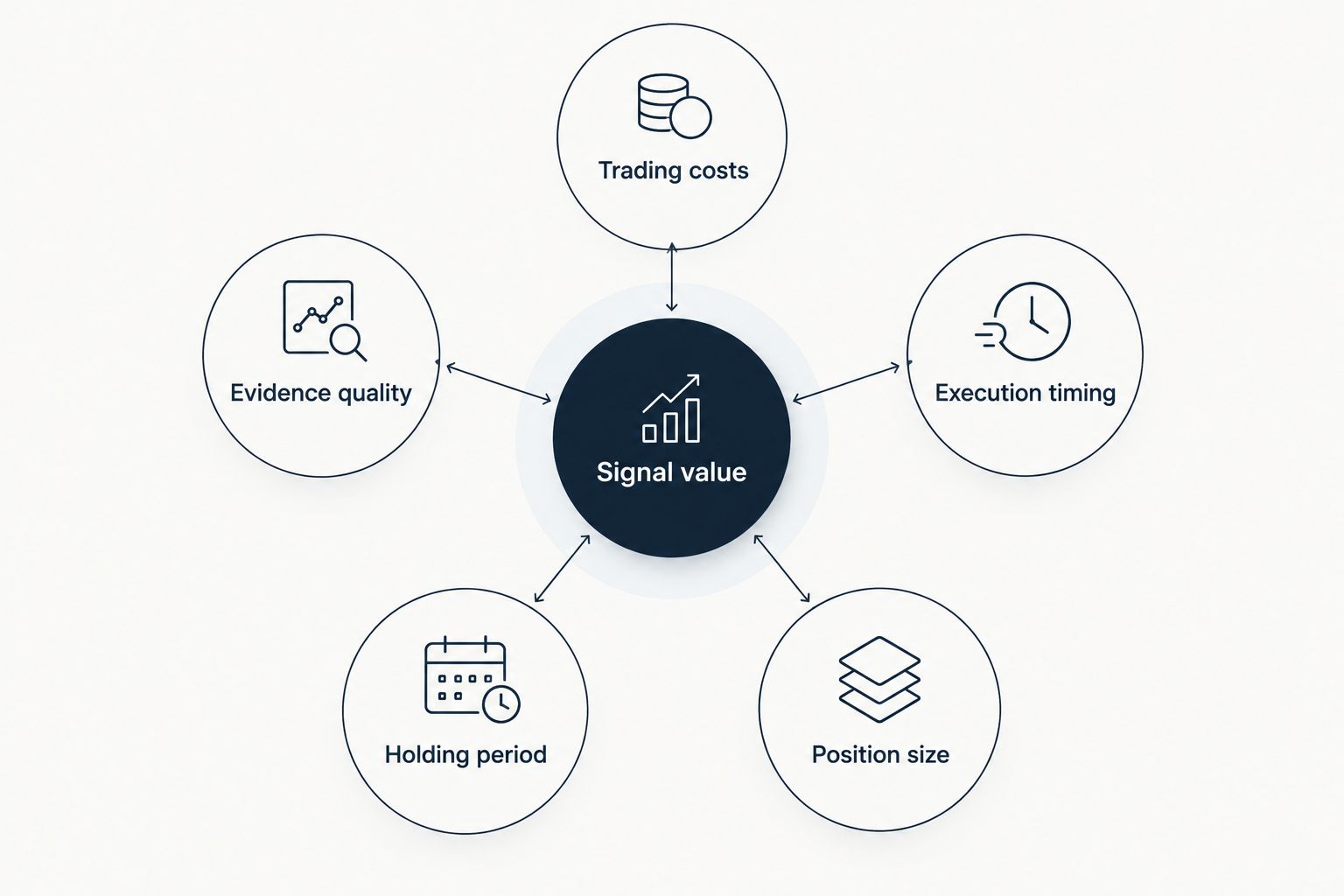
Each factor can change the answer without changing the provider's original market view. Evaluate the whole process, from receiving an idea to closing the position, rather than judging only whether the market eventually moved in the predicted direction.
How do you check whether a signal service is worth paying for?
Use the same review process for every service you consider in 2026. Consistent questions make it harder for attractive presentation to substitute for evidence.
- Request a complete record. Look for dated entries, exits, losses, and positions that remain open. Ask how canceled, revised, or missed trades are recorded. A record that removes unsuccessful ideas cannot support a fair assessment.
- Identify the accounting method. Establish whether results include spreads, commissions, financing, and the subscription. Check whether performance represents closed trades only or includes gains and losses on open positions.
- Examine the downside. Drawdown is a decline from an account's previous peak. Review how losses accumulate, not just whether the final result is positive. Ask whether the method increases exposure after losses.
- Check whether instructions are usable. Determine whether you can understand the currency pair, direction, entry conditions, and exit logic. If those details are unclear, do not fill the gaps with guesses.
- Test your execution process. Record when an instruction arrives, when you act, and what price your account receives. Compare the actual fill with the instruction instead of assuming they match.
- Write a decision rule before subscribing. State what evidence would justify continuing and what would make you stop. Include affordability, instruction quality, record transparency, and your ability to follow the process.
Missing evidence is a reason to withhold a performance judgment, not a reason to assume average results. You do not need to prove a service is bad before deciding that its claims are insufficient for your money.
Keep the review separate from whether you like the provider's commentary. Clear explanations are useful, but they do not replace a complete account of outcomes and risk.
What should a beginner understand about position size?
Position size determines how much currency a trade represents. In standard forex lot terminology, a standard lot represents 100,000 units of the base currency, a mini lot 10,000 units, and a micro lot 1,000 units. The base currency is the first currency named in a pair.
These are trading quantities, not recommended account sizes or suggested amounts to risk. The cash effect of a price movement also depends on the currency pair, the size of that movement, and the currency in which your account is held. Check your broker's contract specifications before placing an order.
Leverage lets you control a larger position than the funds committed as margin. Margin is the money required to support that position; it is not a cap on potential loss. Do not copy someone else's lot size simply because you received the same signal.
A stop-loss is an order intended to close a position when the market moves against you. It does not guarantee the exact exit price during gaps or fast markets. Position sizing must account for that limitation rather than treating an intended exit as certain.
Where Tradeforex fits in the decision
Tradeforex suits beginners looking for forex signals in a web app, not a broker that executes trades. Subscribers receive signals inside the web app. You still need to assess your broker, understand the instructions, and decide whether to place a trade.
The useful distinction is delivery versus execution: a place to receive ideas is not the same thing as an account that handles orders. The limitation is equally important—access to signals does not establish profitability or suitability for your circumstances.
Before subscribing through Tradeforex, apply the same evidence and cost checks described above. Do not infer verified performance, particular risk controls, or detailed instruction features simply from the existence of a subscription service.
Does a high win rate mean forex signals are worth it?
A high win rate does not establish that forex signals are worth paying for. Win rate measures the share of trades that win, not the size of gains relative to losses or the costs of trading.
A method can win frequently and still lose money if its losing trades outweigh its winners. Review the complete pattern of gains, losses, exposure, and charges before drawing a conclusion.
Can a good signal still lose money in my account?
A good market call can still lose money in your account when execution, costs, or position management differ from the published example. A price reached before your entry does not create a return you could capture afterward.
In your 2026 review, compare timestamped instructions with your own order records. Separate the provider's idea from the result of your actual trade.
Should beginners subscribe before choosing a broker app?
Beginners should understand their broker app and basic order controls before acting on paid signals. Otherwise, an unfamiliar interface can turn a clear instruction into an unintended position.
Practice locating the correct currency pair, checking order size, and reviewing open positions first. Paying for ideas does not remove the need to understand the account where you execute them.
FAQ
Are forex signals worth it for beginners?
Forex signals are worth considering only when beginners can understand the instructions, assess the evidence, and afford the risk and costs. They are trade ideas, not a replacement for learning order entry and position sizing.
Can forex signals guarantee profits?
Forex signals cannot guarantee profits. Currency prices, execution conditions, and trading costs can turn an anticipated opportunity into a loss.
How do I calculate whether a signal subscription pays for itself?
Start with your trading result after broker charges, then subtract the subscription and other related expenses not already included. A positive result alone does not establish that the risk taken was acceptable or that future results will match.
Is a high win rate enough to choose a signal provider?
A high win rate is not enough to choose a signal provider. You also need the size of gains and losses, drawdowns, costs, and a complete record rather than selected trades.
Are demo results the same as live signal results?
Demo results are not the same as live signal results. Execution conditions and your response to real financial losses can differ, so practice results do not prove live profitability.
Does Tradeforex execute trades for subscribers?
Tradeforex provides forex signals inside its web app; it is not a broker trading app that executes trades. Receiving an idea and placing an order are separate actions.
What should I check before subscribing to forex signals in 2026?
Before subscribing in 2026, check complete performance records, cost assumptions, downside risk, and whether you can follow the instructions through your broker. Reject guaranteed-return claims and do not commit money you cannot afford to lose.
One last thing
A profitable trade is not proof that subscribing was the right decision. A losing trade is not, by itself, proof that the process was wrong either. Judge the evidence and the decisions, not just the latest outcome.
Before any 2026 subscription, write down what would make you decline it. If missing records, unclear instructions, or unaffordable losses would disqualify the service beforehand, do not excuse those problems after an impressive winning example.