
For forex trading apps ranked by fees, the best comparison starts with the broker account, not the app download: spread-only accounts suit simple cost checks, commission-based accounts suit detailed execution comparisons, and accounts assessed for overnight charges suit multi-day trading. These are comparison categories, not a cheapest-broker leaderboard; the winner depends on your currency pair, trade size, and holding time.
- Forex trading apps ranked by fees should compare broker accounts, trading costs, and holding periods—not download charges alone.
- Spread-only accounts simplify cost comparisons, but commission-free trading still includes the bid–ask spread.
- Commission-based accounts require you to add the spread and both sides of any trading commission.
- Tradeforex delivers forex signals through its web app; your broker handles execution separately.
Why this matters
An app is your interface. The broker account connected to it determines the trading terms, while a separate signals subscription adds another expense to your trading activity. A clean screen tells you nothing about the total cost of following an idea.
Tradeforex provides forex signals inside its web app, not a broker trading app or trade-execution service. Tradeforex is for beginners seeking forex signals through a web app, rather than a broker execution platform. Keep those roles separate when comparing apps in 2026.
What makes the best fee comparison
Use these criteria before judging any account as inexpensive:
- Spread: The gap between the buying and selling quotes. Compare the same currency pair under comparable market conditions.
- Commission: Check whether the quoted charge applies when opening, closing, or completing a trade.
- Holding charges: Identify financing or swap charges that apply when positions remain open past the broker’s rollover point.
- Execution: Compare the requested price with the actual fill. A narrow quoted spread does not describe the whole result.
- Account charges: Read the terms for currency conversion, withdrawals, inactivity, and account services.
- Signal fit: Match the comparison to the trade size, entry method, and holding period you actually intend to use.
The right fee comparison uses the same trade assumptions for every account. Comparing a short daytime position on one account with an overnight position on another produces an unreliable ranking.
Fee structures at a glance
The order below prioritizes beginner decision-making. It does not claim that one account structure is always cheaper than another, and it does not rank named apps without matching account-level evidence.
| Rank and account approach | Best for | Standout comparison feature | Key limitation |
|---|---|---|---|
| 1. Spread-only accounts | Occasional traders learning cost basics | Trading commission is not a separate line item | The spread still represents a trading cost |
| 2. Commission-based accounts | Active traders comparing repeat transactions | Separates commission from the quoted spread | You must combine both components correctly |
| 3. Overnight-cost comparison | Traders holding positions across rollover | Makes holding charges central to the decision | Charges depend on the instrument, direction, and broker terms |
An overnight-cost comparison can include either spread-only or commission-based accounts. It is a different selection priority, not a mutually exclusive account type.
1. Spread-only accounts: best for simple fee comparisons
A spread-only account charges through the difference between the buying and selling quotes rather than a separate trading commission. That makes the visible cost structure easier to learn, but it does not make trading costless.
Best for: Occasional traders who want to understand the spread before comparing more complicated schedules. Start with the currency pair you intend to trade, then check how its spread behaves during your intended trading session.
Spread-only account pros
- You can begin the comparison with the buying and selling quotes.
- No separate trading commission needs to be added to the calculation.
- The structure makes the distinction between an app download and trade execution easier to understand.
Spread-only account cons
- A wider spread can outweigh the absence of commission.
- Spreads can change with market conditions.
- Overnight and account-related charges still need separate checks.
For a 2026 shortlist, compare the actual account terms rather than treating a commission-free label as the final answer. The useful question is whether the complete transaction is economical for your intended trade.
Verdict: Hold until you have compared the spread and any additional charges for the same trading scenario.
2. Commission-based accounts: best for active cost comparisons
A commission-based account lists a trading commission separately from the spread. You need both components to compare its execution cost with a spread-only alternative.
Best for: Active traders who want to calculate repeated transaction costs on a consistent basis. Frequent trading makes small differences worth examining, but frequency alone does not prove that a commission-based account is cheaper.
Commission-based account pros
- The commission appears as a distinct component in the fee schedule.
- You can compare spread and commission separately before combining them.
- A consistent trade-size calculation supports like-for-like account comparisons.
Commission-based account cons
- A narrow spread can distract you from the additional commission.
- One-sided and round-trip commission descriptions require different calculations.
- Minimum charges or account-specific conditions need careful reading when they apply.
Check the unit used in the schedule. A charge described per lot, per side, or per completed transaction cannot be compared directly without converting it to the same basis.
For example, if a commission is charged on each side, include the opening and closing transaction. Do not compare that single-side figure with another account’s completed-trade charge.
Verdict: Hold until the combined spread and commission beat the alternatives under your intended trading conditions.
3. Overnight-cost comparison: best for multi-day positions
If you hold currency positions across the broker’s rollover point, financing belongs near the top of your comparison. An attractive entry spread does not settle the cost of keeping a position open.
Best for: Traders whose planned positions remain open overnight or across several trading days. Check the relevant currency pair and trade direction because the terms are not interchangeable.
Overnight-cost comparison pros
- It accounts for a cost that an entry-only comparison misses.
- It connects account selection to the strategy’s intended holding period.
- It encourages you to inspect rollover rules before opening a position.
Overnight-cost comparison cons
- Financing terms can change and require current checks.
- Calendar treatment and broker rules complicate comparisons.
- An account label alone does not explain every holding-related charge.
In 2026, read the account’s current holding terms before choosing it for multi-day trades. If an account uses alternative administrative charges, include those in the assessment rather than assuming that the absence of a swap label means no holding cost.
Verdict: Skip any account whose holding charges you cannot explain before placing the trade.
How to compare accounts without misleading yourself
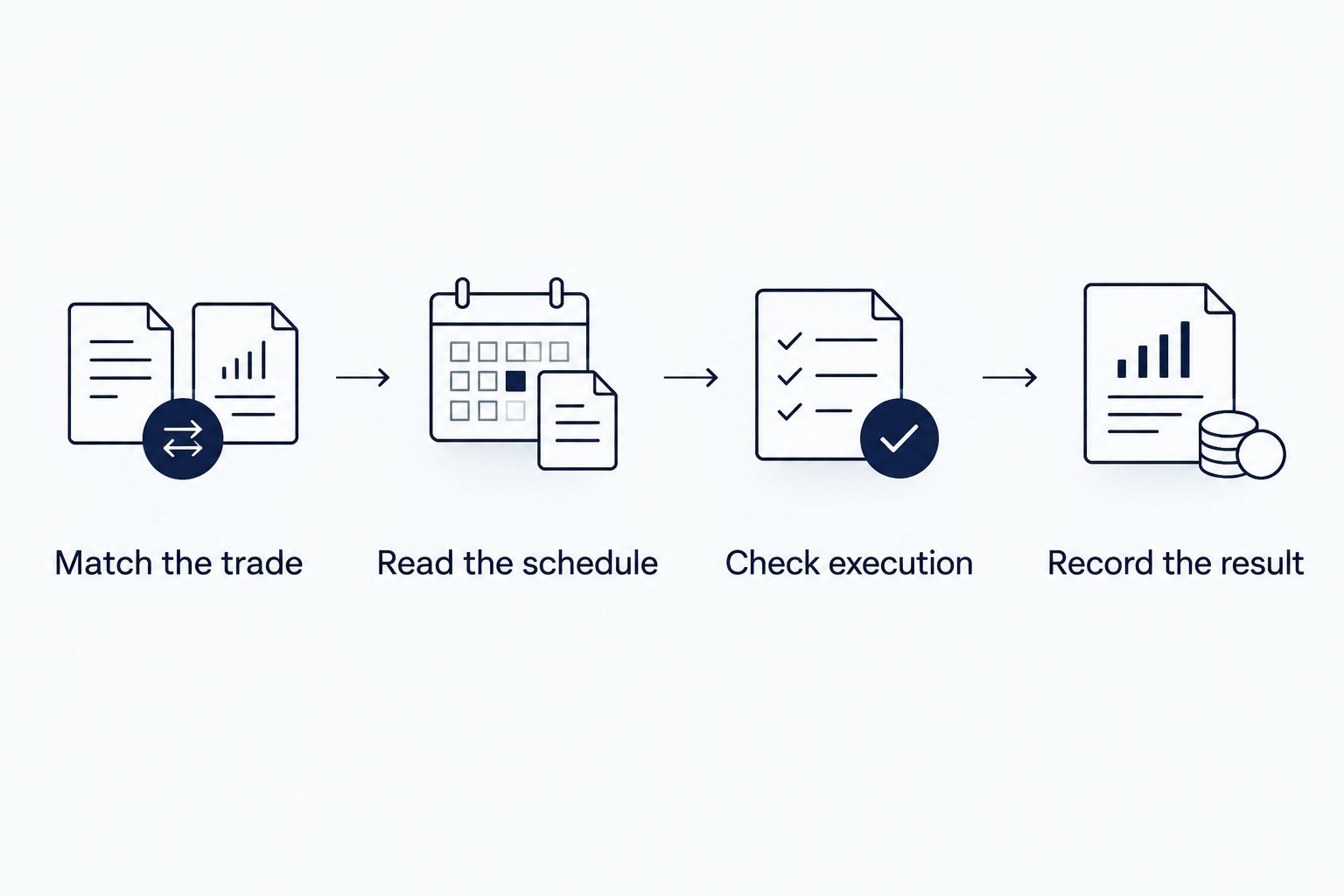
Build a worksheet around the trade you intend to place. Use the same assumptions for every account, then separate quoted trading costs from what actually happened during execution.
Match the trade
Choose the same currency pair, direction, position size, account currency, and intended holding period. Record the comparison time as well; quotes taken under different market conditions are not equivalent observations.
Trade size needs particular care. In conventional forex terminology, a standard lot represents 100,000 currency units, a mini lot represents 10,000 currency units, and a micro lot represents 1,000 currency units. Check the broker’s contract specification rather than assuming every instrument follows that convention.
Those sizes are definitions, not recommendations. Choose exposure according to the loss you can afford, not the largest order the app permits.
Read the schedule
Identify the spread, commission basis, holding rules, and relevant account charges. Keep recurring subscription expenses separate from transaction-level costs so you can see what each service adds.
Check execution
A fill is the price at which your order actually trades. Slippage is the difference between an expected or requested price and the execution price; it can work for or against you.
Record the result
Keep the quote, actual fill, trading charges, and holding charges together. Avoid counting the spread twice when reviewing profit-and-loss figures that already reflect entry and exit prices.
Where forex signals fit into the fee comparison
Tradeforex forex signals arrive inside the Tradeforex web app. A signal is a trade idea, not an executed order or a guaranteed outcome; your separate broker account determines execution and trading charges.
Evaluate the signal service and the broker account as separate decisions. A subscription does not remove spreads, commissions, holding charges, or market risk. It also does not establish whether a proposed trade suits your finances.
Before subscribing, read Are Forex Signals Worth It After Fees and Trading Costs. Assess the service’s explanations and terms alongside the execution costs you expect to incur.
For beginners comparing forex trading apps in 2026, Tradeforex is a signals-service option, not a replacement for broker due diligence. Do not infer entry instructions, exit rules, risk controls, or performance from a service label; assess what the actual signals and terms provide.
Signals-service advantages and limits
- Potential use: A separate source of trade ideas gives you something specific to evaluate against your own trading rules.
- Known delivery method: Subscribers receive Tradeforex signals through its web app.
- Limitation: Signals do not guarantee that your broker will fill an order at a referenced price.
- Risk: A losing trade remains your financial loss, regardless of where the idea originated.
Explore the signals service
Review the service before deciding whether a signals subscription fits your trading approach.
How we ranked the comparison approaches
The ranking uses the criteria above: spread, commission, holding charges, execution, account charges, and signal fit. Spread-only accounts come first for learning the basic transaction cost; commission-based accounts follow for separating components; overnight analysis takes priority when your holding period requires it.
This is a decision sequence, not a measured claim about which broker has the lowest fees. A defensible named-app ranking requires matching account terms, jurisdiction, instruments, trade sizes, and comparison dates.
Which forex trading app should you choose?
Choose the broker account whose complete costs you can explain for your intended trade, then assess the app’s usability. If you are undecided, begin by comparing a spread-only account with a commission-based account under identical assumptions.
For overnight trading, add holding charges before making that decision. For signals-based trading, add the subscription expense separately and check whether the trade idea still fits your risk limits.
Your 2026 shortlist should also pass basic checks for regulatory status, account access, security, and withdrawal terms. A favorable cost comparison is not a substitute for those checks.
FAQ
What's the best way to compare forex trading apps ranked by fees?
Compare the broker accounts behind the apps using the same currency pair, trade size, and holding period. Include the spread, commission, relevant financing, and account charges rather than judging the download alone.
Is a commission-free forex account cheaper?
Not necessarily: a commission-free account still includes the bid–ask spread. Compare its complete trading cost with the spread plus commission on the alternative account.
Are commission-based accounts better for beginners?
Commission-based accounts are not automatically better for beginners. They suit comparisons where you can correctly combine the spread with opening and closing commissions and understand the remaining terms.
Do forex app fees change when I hold a trade overnight?
Holding a position across the broker’s rollover point can introduce financing or other holding-related charges. Check the account terms for your currency pair, direction, and planned holding period.
Does Tradeforex execute trades for subscribers?
Tradeforex provides forex signals through its web app, not broker trade execution. You assess the idea and use a separate broker account if you decide to place an order.
Can a demo account prove which forex app is cheapest?
A demo account does not prove live execution costs. Use it to learn the workflow, then check live account terms and recognize that actual fills can differ from simulated results.
Should I follow a signal if the entry price has changed?
Reassess the trade rather than copying the original instruction automatically. A different entry changes the distance to an intended exit and can change whether the trade fits your risk limits.
One last thing
A trade you decline has no execution cost. If a spread has widened, the entry has moved, or the instructions are unclear, subscribing to signals does not create an obligation to place an order. Decide what makes a trade unacceptable before the next idea arrives.